Saves instantly, no account needed. Already a member? Sign in.
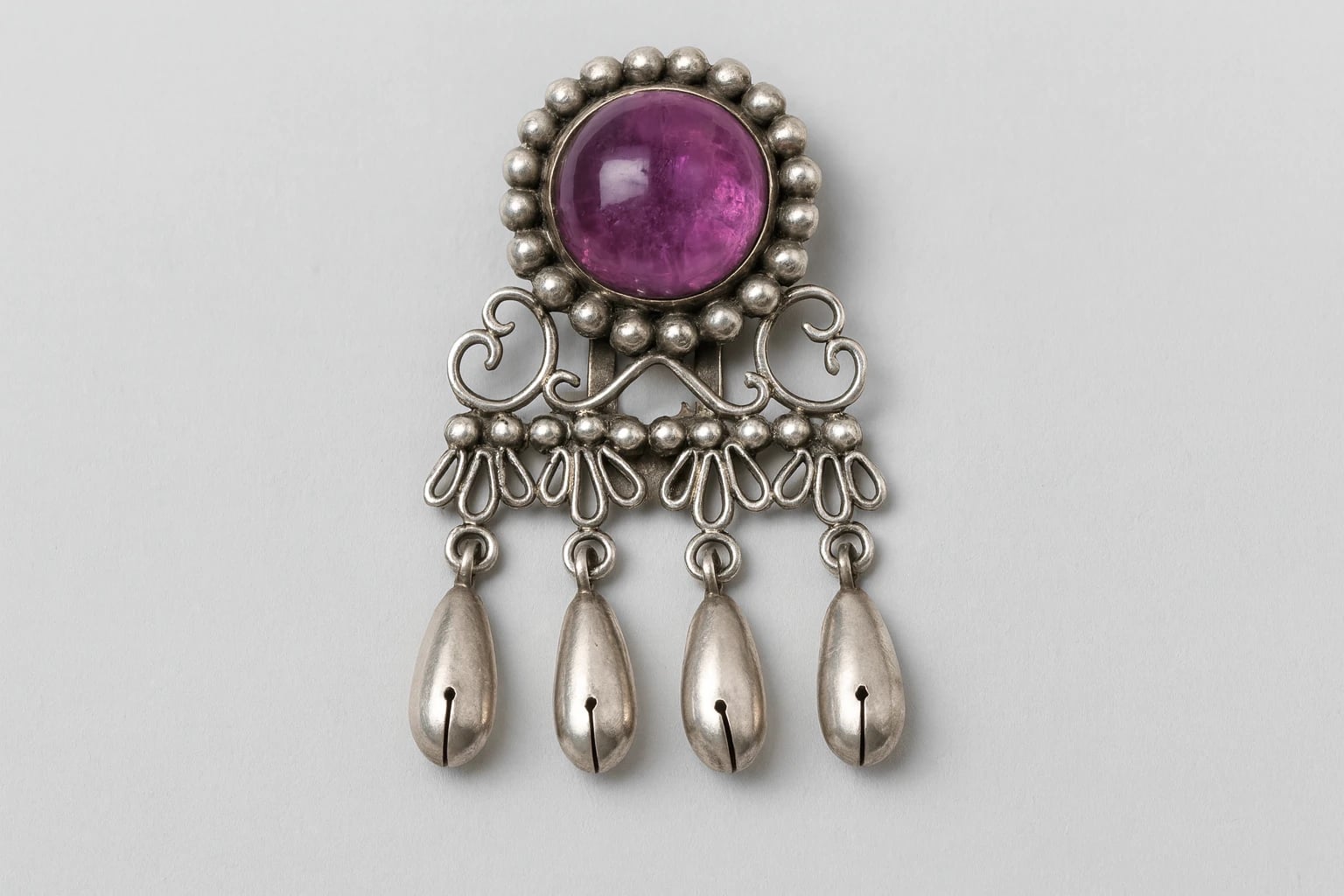
This dress clip gathers Antonio Pineda’s early vocabulary into a compact vertical composition: a domed amethyst cabochon, a tight collar of silver balls, open wire scrolls, and four pendant cascabeles held in measured suspension. At 2 1/2 inches high and 1 3/8 inches wide, it has the scale of an accessory meant to catch light near the face or shoulder, but its structure is closer to a small pendant construction than to a flat pin. The amethyst rises from a plain bezel as the visual center, its violet depth set against the cooler surface of 980 silver. Around it, the applied balls create a granular halo, each bead catching light separately before the eye moves downward into the looser drawing of the wirework.
The lower half is organized by contrast. Above, the cabochon is enclosed and still. Below, the handmade wire opens into curls, loops, and pointed drops, allowing the garment behind it to become part of the design. The cascabeles extend that movement physically. They hang from separate links, so the clip would have shifted subtly with the body rather than remaining a single fixed silhouette. Their polished teardrop forms give weight to the base without making the object visually heavy. Pineda uses repetition carefully here: the four pendants are similar but not absorbed into a mechanical pattern, and the small differences of handmade work keep the surface alert.
The early “AP, Taxco, 980” mark places the clip before the fully developed crowned Antonio mark that later became associated with Pineda’s mature shop identity. Hougart records the AP mark among Pineda’s early marks, and Kim Richter’s catalogue for Silver Seduction documents a closely related amethyst brooch with cascabeles dated 1941 to 1950 and marked AP, 980, Taxco. That context matters because the clip belongs to a moment before the monumental channel settings, architectural cuffs, and severe geometric suites for which Pineda is now widely admired. It shows him working through an earlier Taxco language of wire, beads, pendants, and high silver content, while already imposing the clarity of proportion that would distinguish his later work.
The use of 980 silver also situates the clip within the technical ambitions of early Taxco production. Morrill and Berk describe 980 silver as a higher silver content alloy valued in Taxco for its softer patina and slower oxidation than sterling. In this object, that material choice is not incidental. The pale surface supports fine soldered details, catches light across the beads and pendant forms, and sets off the saturated color of the cabochon without heavy ornament. The clip is a useful early document of Pineda’s development and of the larger Mexican silver renaissance: modern not because it abandons ornament, but because it reorganizes ornament as structure, movement, and disciplined visual rhythm.
Museum of Mexican Silver. “Cascabeles Dress Clip with Amethyst.” Catalog no. MoMS-002302. https://museumofmexicansilver.com/pieces/antonio-pineda-dress-clip
See something wrong with this record? Suggest a correction and the piece details fill in automatically.
Antonio Pineda
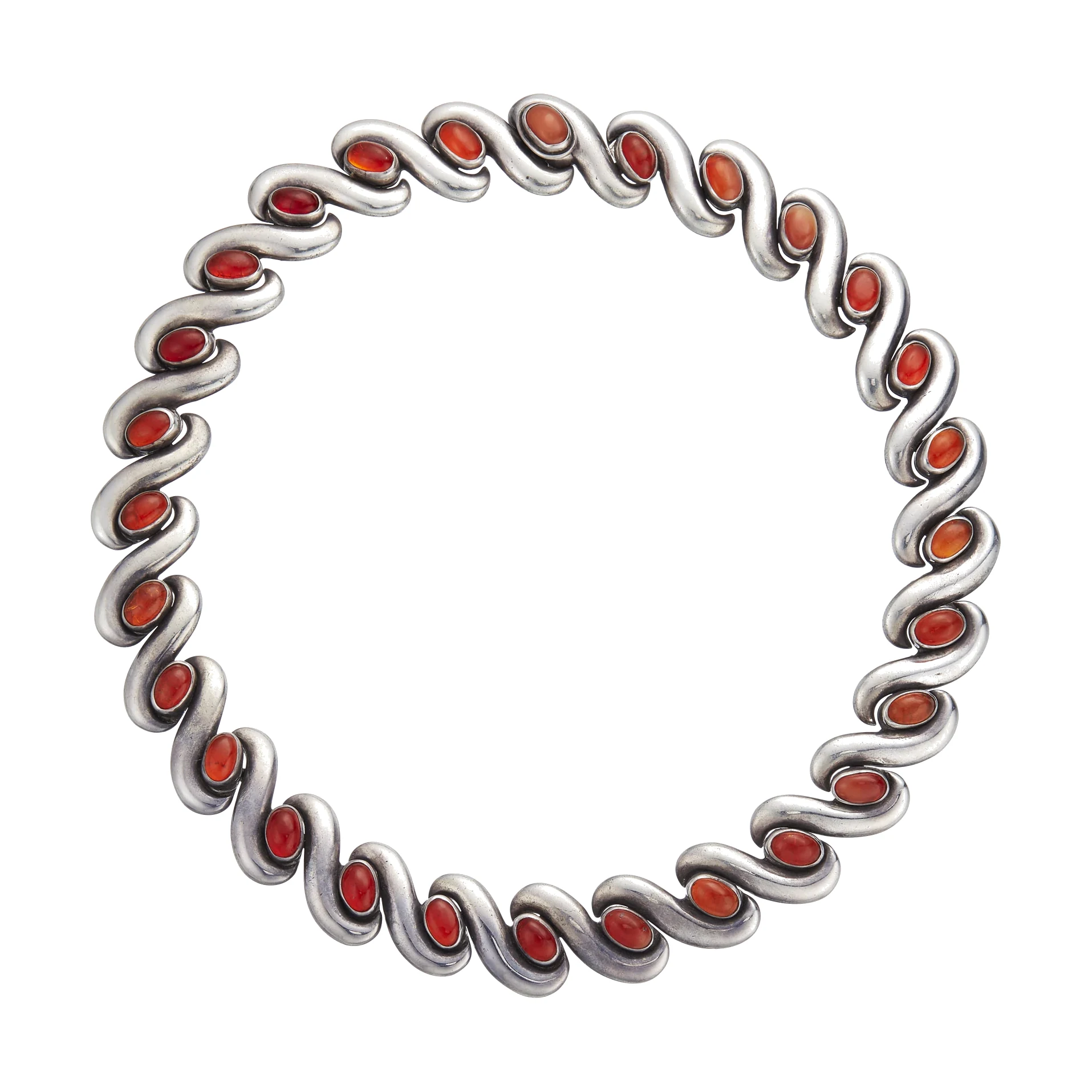
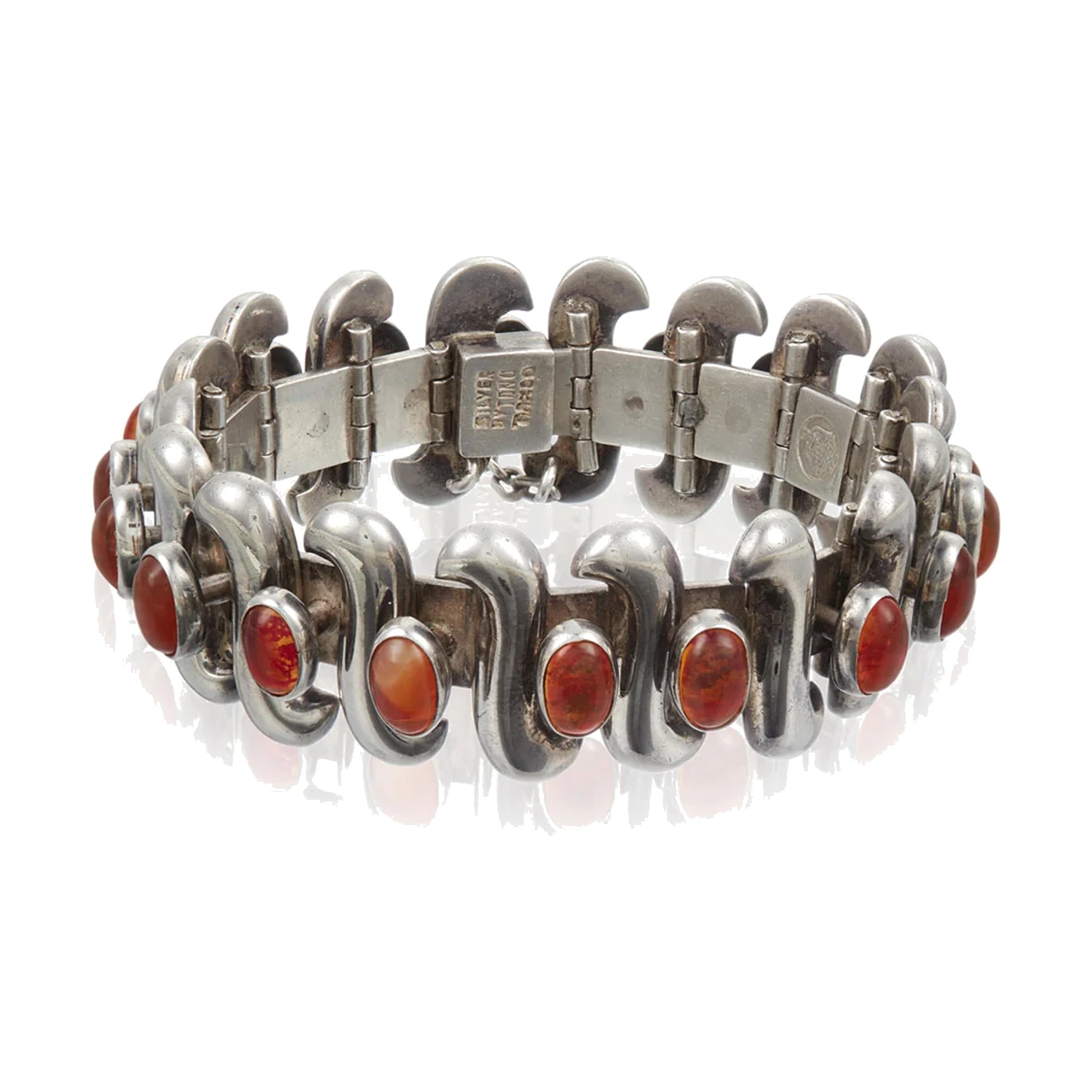
Fire Opal and Silver S-Link Bracelet
Silver