Saves instantly, no account needed. Already a member? Sign in.
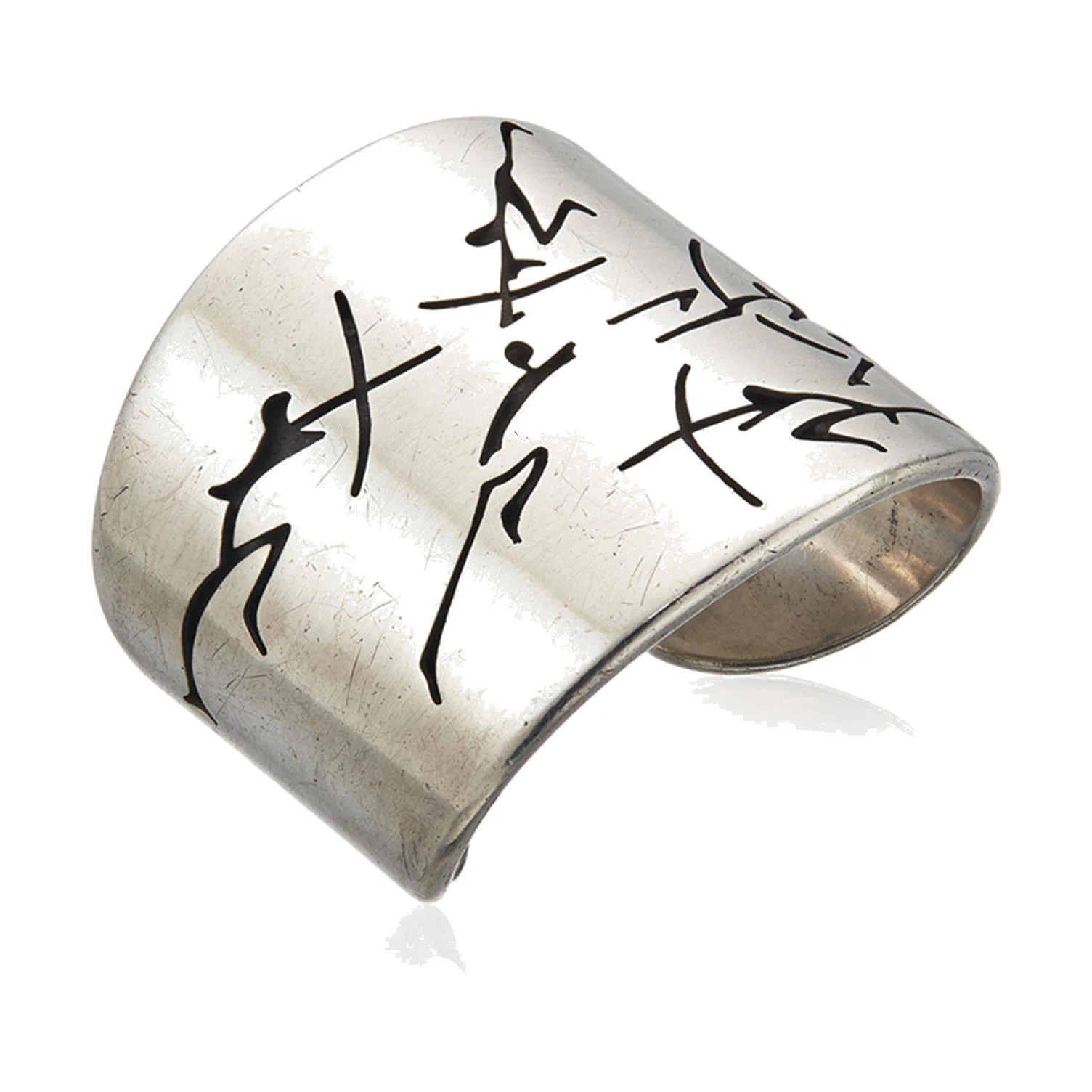
The cuff carries a single figural cartouche across a broad silver band, and the design turns that image into architecture rather than decoration. A standing warrior fills the raised central panel, framed and contained so that the human form reads as a relief set into metal. Antonio Pineda rarely built a bracelet around an explicit figure, and this example shows him working the boundary between narrative image and sculptural object, letting the body become a compositional element within the disciplined mass of the cuff.
The band is conceived as a continuous curve of silver, and the interest lies in how Pineda controls its surface. The figural panel projects, catching light on its highest planes while the recessed ground holds shadow, so the warrior appears to emerge from the metal instead of resting on it. Where the panel meets the smooth walls of the cuff, the transition is deliberate and clean, giving the eye a clear passage from ornament to structure. A cuff of this width carries real presence on the wrist, and Pineda balances that weight by keeping the sides plain, concentrating incident at the center where the image lives.
Pineda's early work under Valentin Vidaurreta, documented by Penny Morrill, gave him a vocabulary for translating older Mexican forms into modern silver, and Morrill notes how motifs drawn from ancient sources were reworked with added texture and dimension for a twentieth century sensibility. That habit informs this bracelet. The warrior is not a literal archaeological copy but a distilled figure, treated with the same restraint Pineda brought to the geometric bands and concave ovals recorded in his mature production. He founded his own workshop and store on the Taxco zócalo in 1941, and across the following decades he refined a language in which a single strong element governs an otherwise austere form. The Antonio crown mark and the 970 silver standard associated with that workshop place this cuff within that developed practice, where design authority and controlled fabrication worked together under his direction.
Within Pineda's output, the figural cuff is the less common register, and it clarifies the range of a designer usually celebrated for abstraction. It shows that his interest in relief and shadow, so evident in the wave and oval bracelets, could serve a representational image without softening into sentiment. For a collection tracing the Taxco School, the piece marks the point where postrevolutionary attention to Mexican identity meets the formal severity of Pineda's silver, held together in a single band worn on the body.
Museum of Mexican Silver. “Native Warrior Silver Cuff Bracelet.” Catalog no. MoMS-002133. https://museumofmexicansilver.com/pieces/antonio-pineda-native-warrior-silver-cuff-bracelet
See something wrong with this record? Suggest a correction and the piece details fill in automatically.
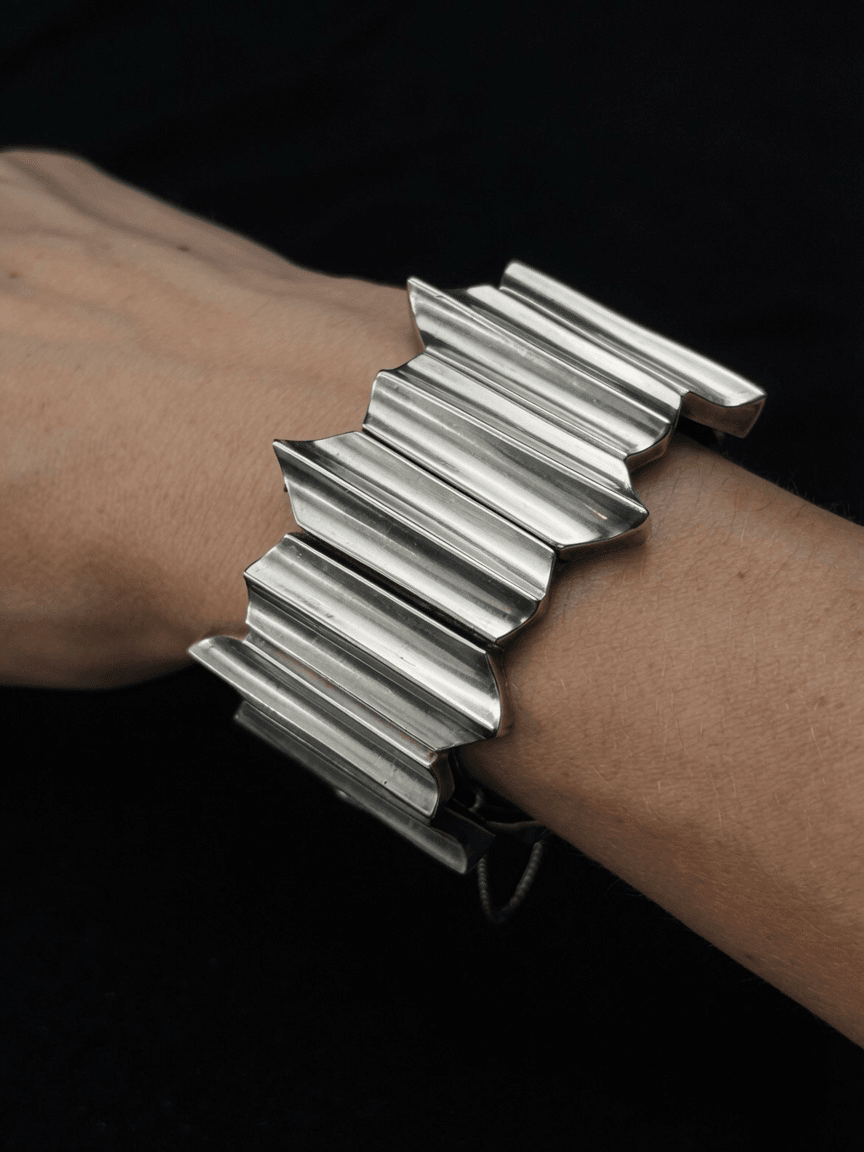
Antonio Pineda
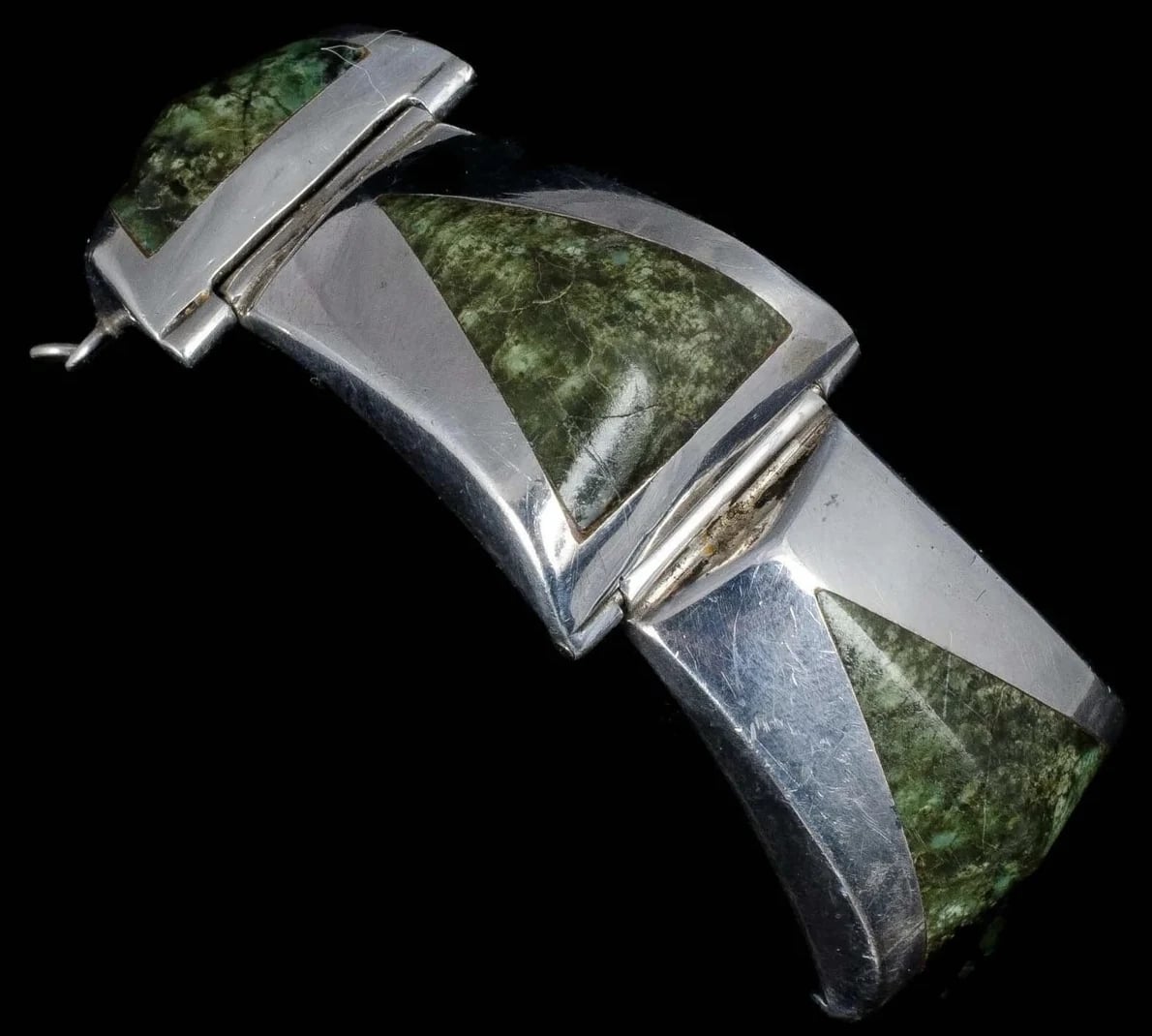
Chevron-Panel Bracelet, Design No. ZZ645
1953 or later
Sterling silver