Saves instantly, no account needed. Already a member? Sign in.
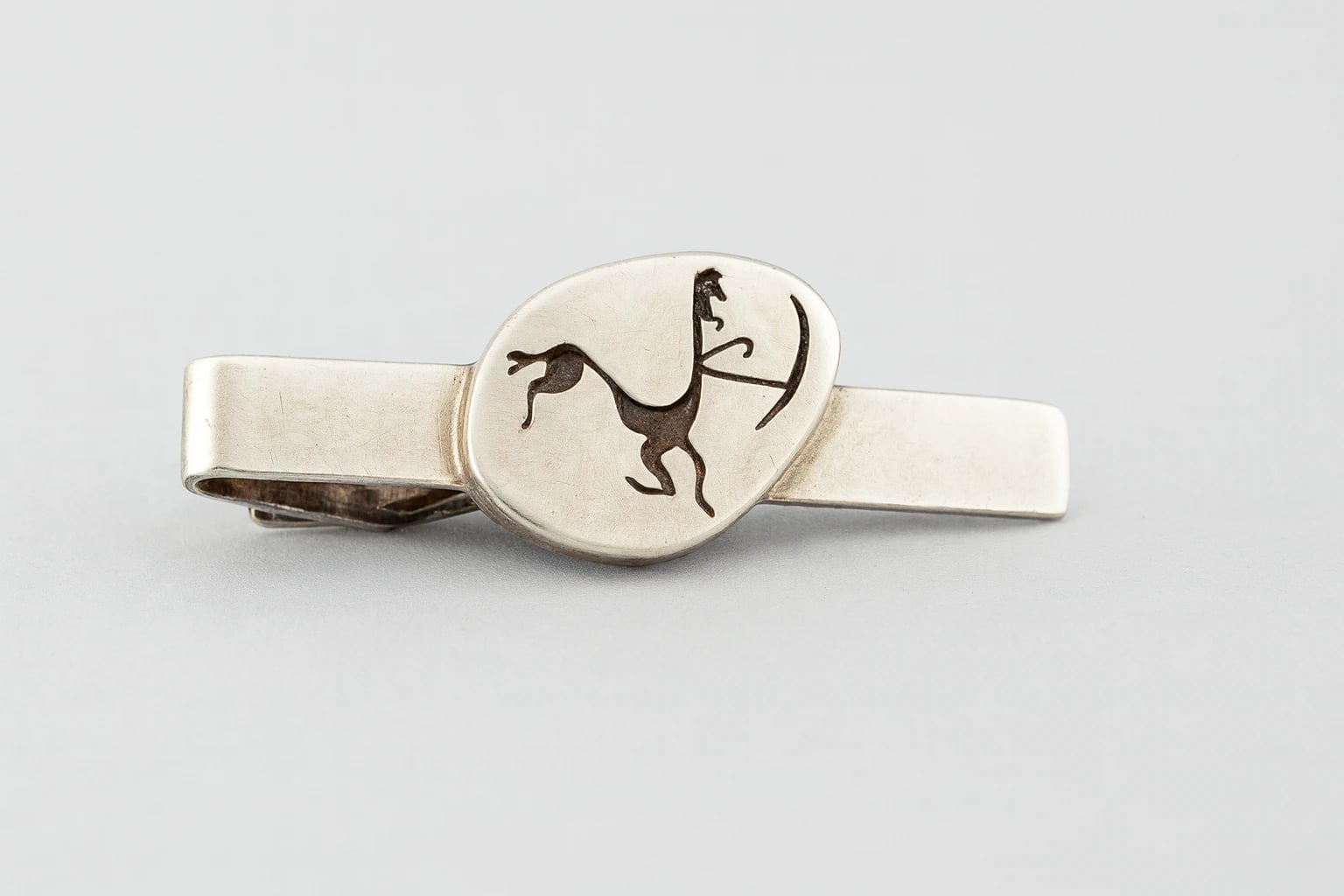
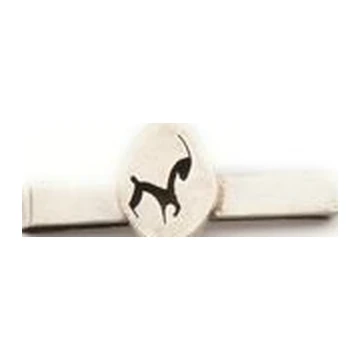
A goat drawn in five or six confident strokes, rearing on a blank silver field the shape of a worn river stone: this money clip shows the Los Castillo workshop applying its full graphic intelligence to one of the smallest and most utilitarian objects it made. The animal is not modeled or engraved in detail. It is a silhouette, oxidized dark against the pale plaque, with a curling tail, arched back, and legs reduced to tapering lines. The drawing style deliberately recalls prehistoric rock painting, in which an animal is captured through gesture rather than anatomy, and the irregular plaque reinforces the association by reading as a fragment of stone or potsherd applied to the plain, machine-straight bar of the clip. The contrast is the whole design: an ancient-looking image carried on a frankly modern, functional support.
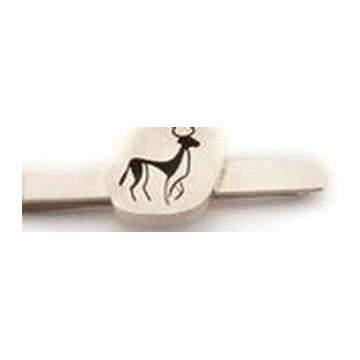
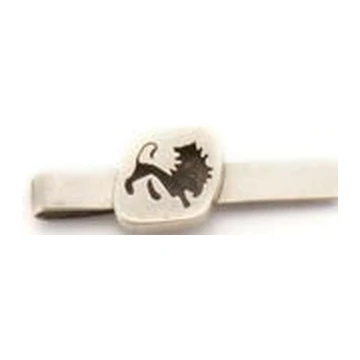
The goat belongs to a series. Companion clips in the Museum's reference group carry a lion, a scorpion, a horse, a deer, a striding human figure, and a pair of vertical bars resembling the Gemini glyph, a combination that strongly suggests the set was conceived as signs of the zodiac, with this goat serving as Capricorn. Each animal is rendered in the same pictographic shorthand, and each plaque takes a slightly different organic outline, so that the series reads as a family of found stones rather than a run of identical stampings. Within the set, the goat is among the most successful compositions. The rearing pose fills the oval field diagonally, the negative space around the figure stays active, and the tail closes the drawing with a single flourish. It is graphic design executed in silver, closer in spirit to mid-century printmaking than to conventional men's jewelry.
The workshop behind it was one of the anchors of the Taxco renaissance. Los Castillo, founded by Antonio Castillo, operated at a scale few Taxco talleres matched, and its documented hallmarks trace an output running from heavy 980-fine jewelry of the early 1940s through the firm's named decorative lines of the 1950s and 1960s, including fired enamel, mosaico azteca, and black onyx inlay (Hougart records twenty-nine distinct marks for the firm). Small men's accessories such as this clip represent the commercial breadth of that operation: the same design office that produced ambitious hollowware also supplied inexpensive, giftable objects, and it gave them real drawing rather than filler ornament. Contreras Osio notes that Los Castillo is one of the very few Taxco houses whose designs continued in production among descendants, while most of the firm's celebrated contemporaries survive chiefly through works held in private collections abroad. Objects at this modest scale seldom enter the published literature, which makes a coherent surviving series like this one useful evidence. The goat clip documents how far down the price ladder the workshop's design standards reached, and how naturally the Taxco vocabulary of archaic imagery and clean modern fabrication adapted to an object meant simply to hold folded bills.
Museum of Mexican Silver. “Goat-Motif Money Clip.” Catalog no. MoMS-002244. https://museumofmexicansilver.com/pieces/los-castillo-goat-motif-money-clip
See something wrong with this record? Suggest a correction and the piece details fill in automatically.
Los Castillo
Centaur-Motif Money Clip