Saves instantly, no account needed. Already a member? Sign in.
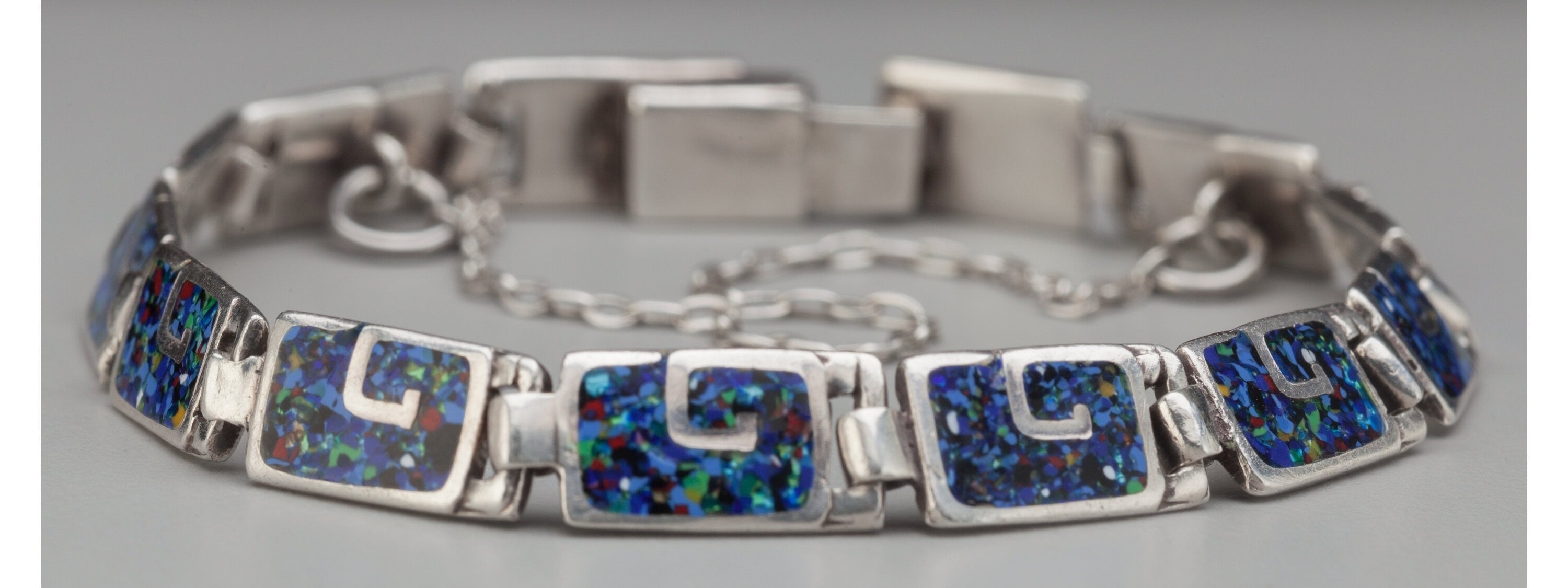
Design 5403 is a champlevé enamel link bracelet of a type that sits at the heart of Margot de Taxco's reputation, and it shows her handling the Greek-fret, or greca, motif in the medium she made her own. Rectangular silver panels, each cut with an open stepped-key spiral, alternate with smaller connecting links and hinge into a supple band; the recessed cells behind and around the fret are flooded with a densely mottled enamel in which cobalt and midnight blue predominate, shot through with flecks of green, red, and turquoise so that the surface reads as a jeweled speckle rather than a single flat color. A safety chain and box clasp complete a construction built for real wear. The greca is one of the oldest and most portable ornamental ideas in Mexican design, and Margot's decision to render it not in worked silver but as an enamel field is precisely what makes the design characteristic of her studio.
The formal interest of the piece lies in the interplay between the silver key and the enamel ground it sits against. The polished fret spirals stand proud of the recessed color, so that the eye reads two registers at once: the crisp linear geometry of the meander, and behind it the restless, granular chromatic field. This is champlevé used with real sophistication — the technique excels at holding enamel within silver-walled cells, and here Margot has made the cell walls themselves carry the design, letting the greca do double duty as both ornament and the structural partition between areas of color. At bracelet scale the effect is compact and disciplined; the repeating panels give the band a steady architectural rhythm around the wrist, and the mottled enamel keeps that rhythm from reading as merely mechanical.
Historically the design draws on two sources that the Taxco school habitually combined. The greca belongs to the Pre-Columbian and Mesoamerican ornamental vocabulary that Stromberg identifies as foundational to the movement — the stepped fret appears across ancient Mexican architecture and textile — while the geometric clarity of its treatment here aligns with the international Art Deco line that Morrill notes ran through Margot's work alongside her Pre-Columbian sources. Morrill describes exactly this compatibility in her jewelry, the way Pre-Columbian motif and Deco energy coexist; a greca bracelet in champlevé is that synthesis made concrete, an ancient Mexican pattern carried by a distinctly modern enameling practice. The mottled, almost mosaic-like enamel further recalls the interest in variegated, stone-like surfaces that ran through mid-century Taxco silver.
Museum of Mexican Silver. “Design 5403 Bracelet.” Catalog no. MoMS-001041. https://museumofmexicansilver.com/pieces/margot-bracelet-5403
See something wrong with this record? Suggest a correction and the piece details fill in automatically.
No production total for design 5403 is documented. Margot's enamels survive less readily than her plain silver, since the vitreous surface chips and abrades with use; an example retaining its enamel intact across every panel, as this one appears to, is the desirable state. Geometric enamel bracelets of this kind are also among the most collectible of her numbered designs, valued for the way they compress her signature technique into a wearable, everyday format without sacrificing the richness of the color work.
The bracelet earns museum consideration as a clear, well-preserved statement of Margot de Taxco's central achievement: the marriage of an ancient Mexican ornamental idea to the champlevé enamel technique she developed into a signature. It documents the greca not as carved silver, the form most Taxco makers gave it, but as a field of color partitioned by a silver key — a small but telling instance of how Margot reimagined familiar motifs through her own medium.
Design 5554 Bracelet
Sterling silver