Saves instantly, no account needed. Already a member? Sign in.
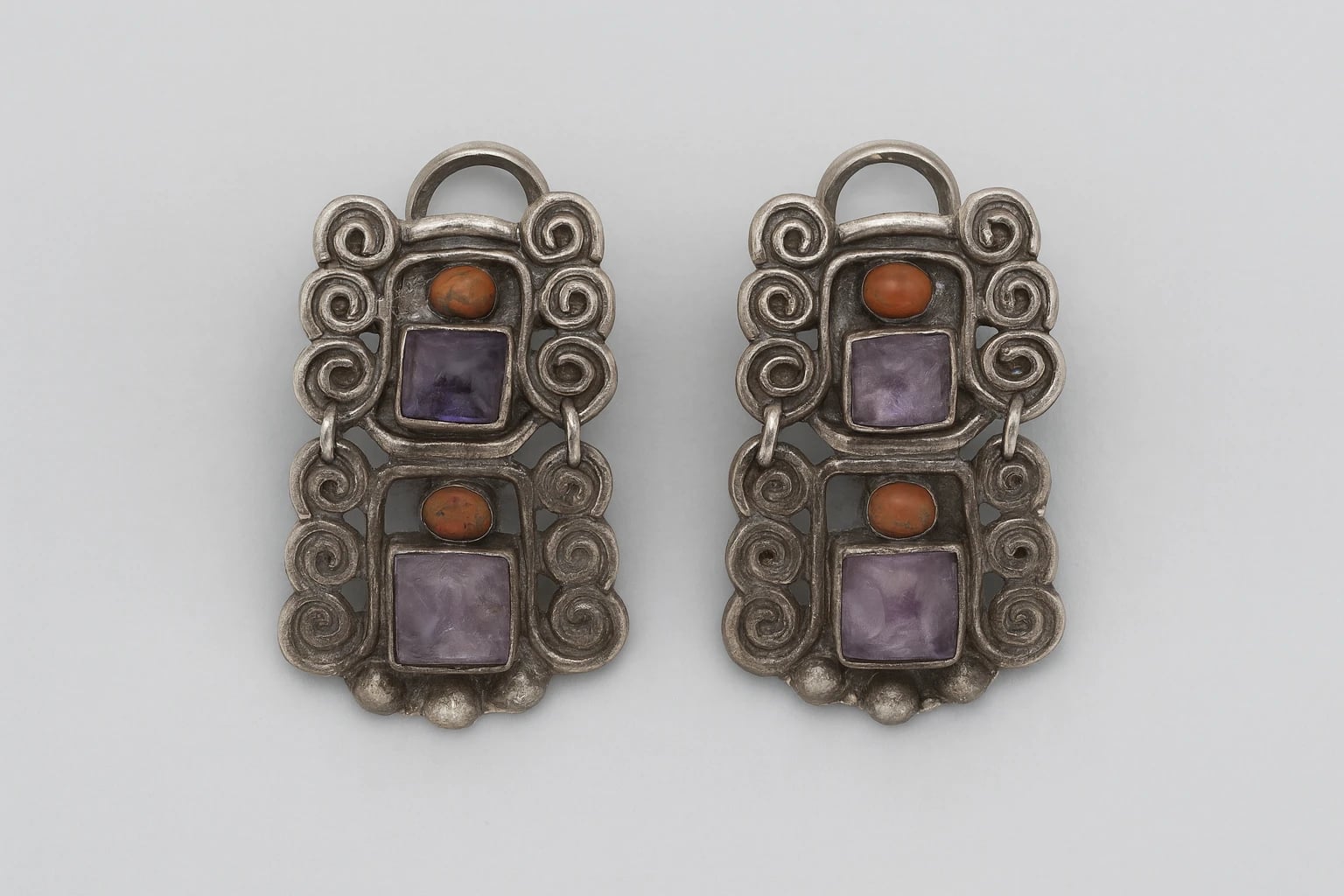
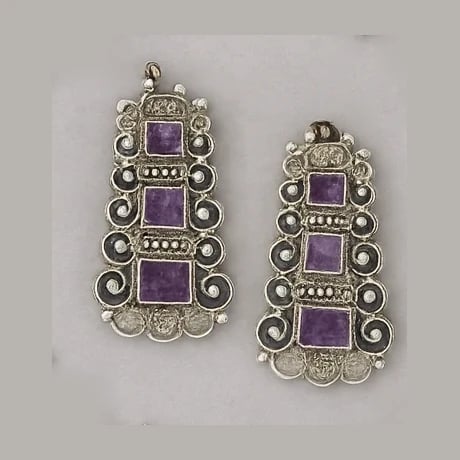
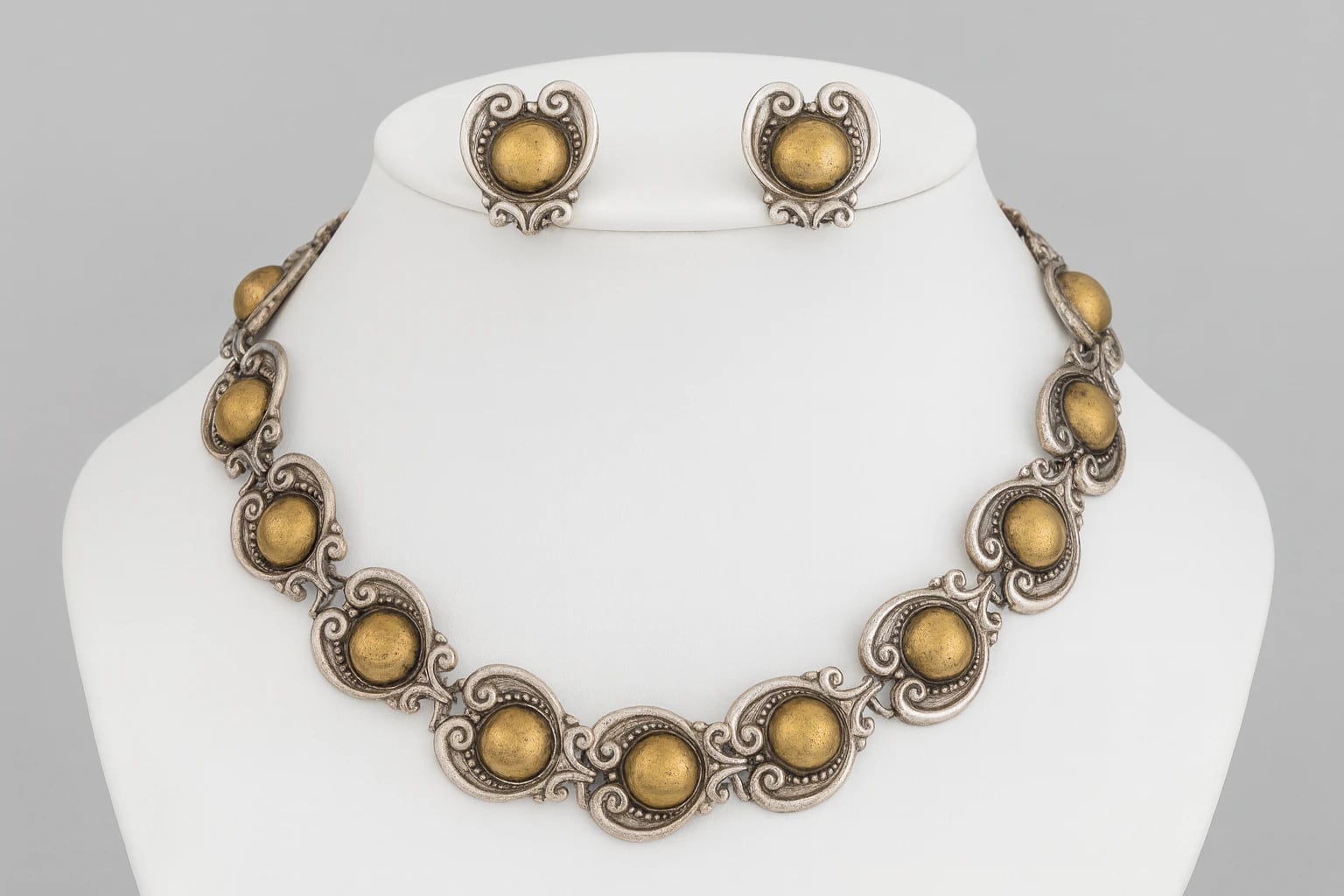
The necklace and earrings organize Margot de Taxco’s early silver vocabulary around a repeated encounter of rounded metal and curling line. Each necklace element holds a brilliant brass half dome inside a sterling frame of scrolls, with small openings that keep the plaques from becoming heavy. The matching earrings compress the same idea into a single unit for the ear. Marked “Margot de Taxco,” “#5210A,” “Sterling,” and “Made in Mexico,” and lacking an eagle assay mark, the suite belongs to the late 1940s, shortly after Margot established her independent shop and before the eagle system became regular on her work.
The necklace measures 15 3/8 inches long by 3/4 inch wide, a scale that keeps the repeated units close to the neck rather than letting them drop as a pendant form. The links build a shallow curve from small episodes of symmetry: dome, silver border, paired scroll, open interval, then the next dome. The brass centers give the surface a warmer register than sterling alone could provide. Their convex form catches light differently from the flatter silver framework, so that color and relief work together. This design is also known within a family that used amethyst cabochon stones and sterling, copper, or brass half dome centers. In this brass centered example, Margot achieves chromatic contrast without enamel, using metal itself as color.
That point is important for understanding the suite’s place in Margot’s career. She is now most closely associated with champlevé enamel on silver, a body of work that began in the mid 1950s and depended on detailed drawings, die work, controlled recesses, firing, polishing, and coordinated workshop labor. This necklace predates that mature enamel language, yet it already shows the habits that made the later work possible. The design is not simply a silver setting for colored accents. It is organized around the way a colored center changes the rhythm of an entire form. The alternating bright and warm surfaces anticipate Margot’s later concern with color as a structural decision rather than an applied embellishment.
The low design number, close to the beginning of Margot’s recorded silver inventory sequence, reinforces the early position of the suite within her independent production. It also preserves a moment when her workshop was defining itself through silver designs before enamel became its most famous signature. The scrollwork retains a decorative grace associated with her early Taxco work, but the repeated modular construction belongs to the disciplined modern jewelry of the silver renaissance. As a suite, the necklace and earrings show Margot de Taxco developing a language of articulated units, controlled color, and bodily scale that would soon become one of the most recognizable achievements of the Taxco School.
Museum of Mexican Silver. “Design 5210A Scroll Necklace and Earrings.” Catalog no. MoMS-002316. https://museumofmexicansilver.com/pieces/margot-de-taxco-necklace-and-earrings
See something wrong with this record? Suggest a correction and the piece details fill in automatically.
Margot de Taxco
Design 5207 Earrings
Sterling silver