Saves instantly, no account needed. Already a member? Sign in.
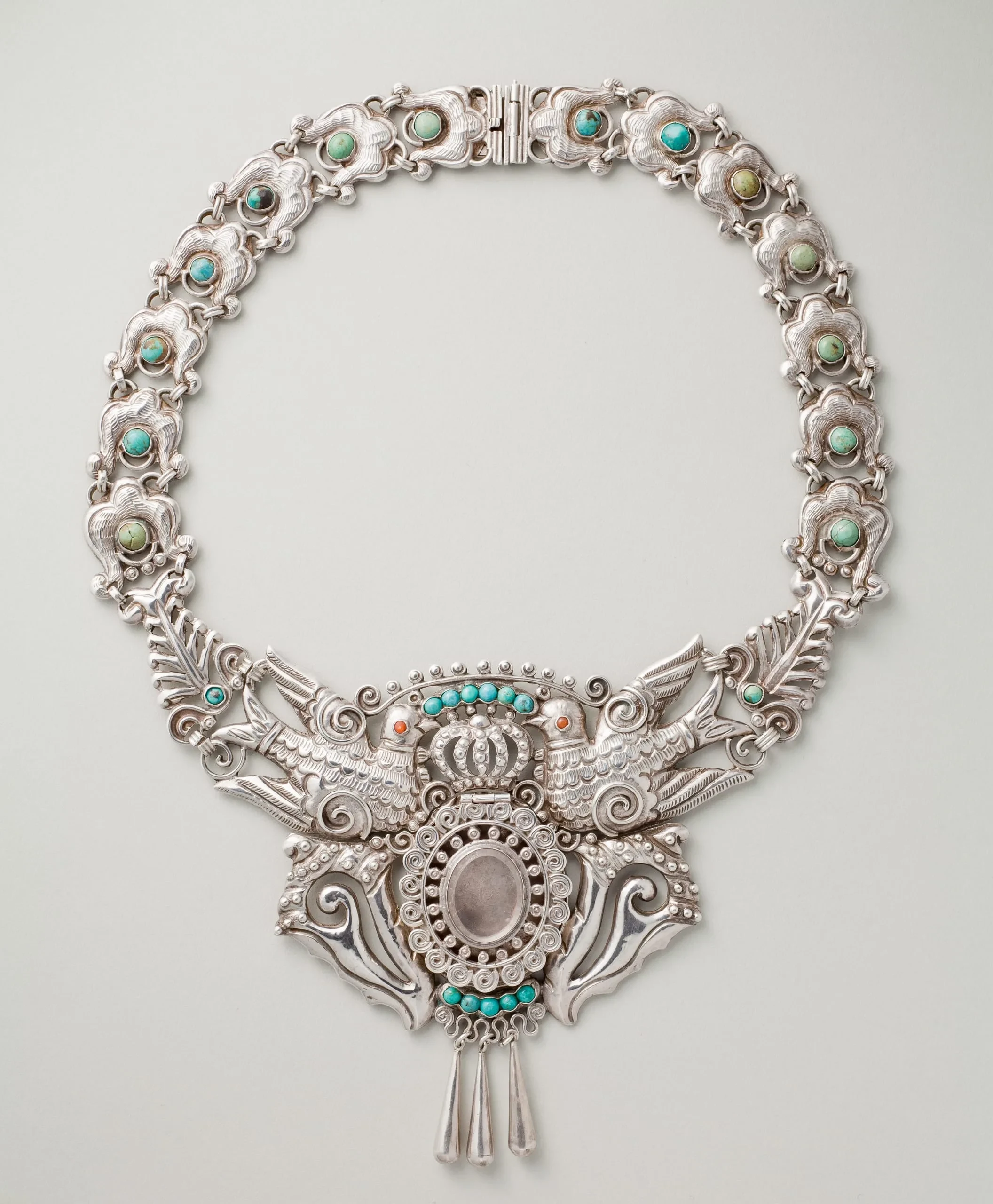
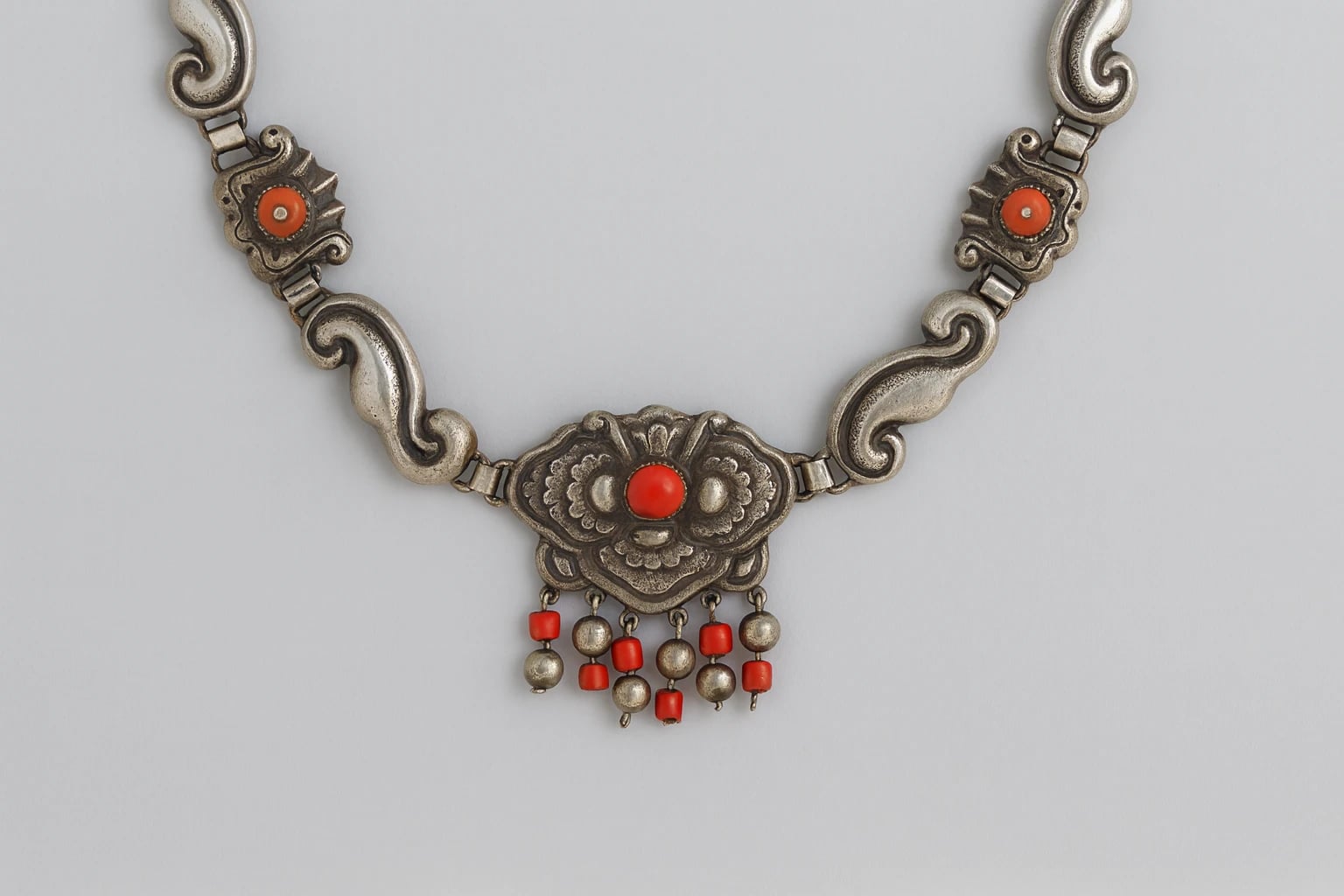
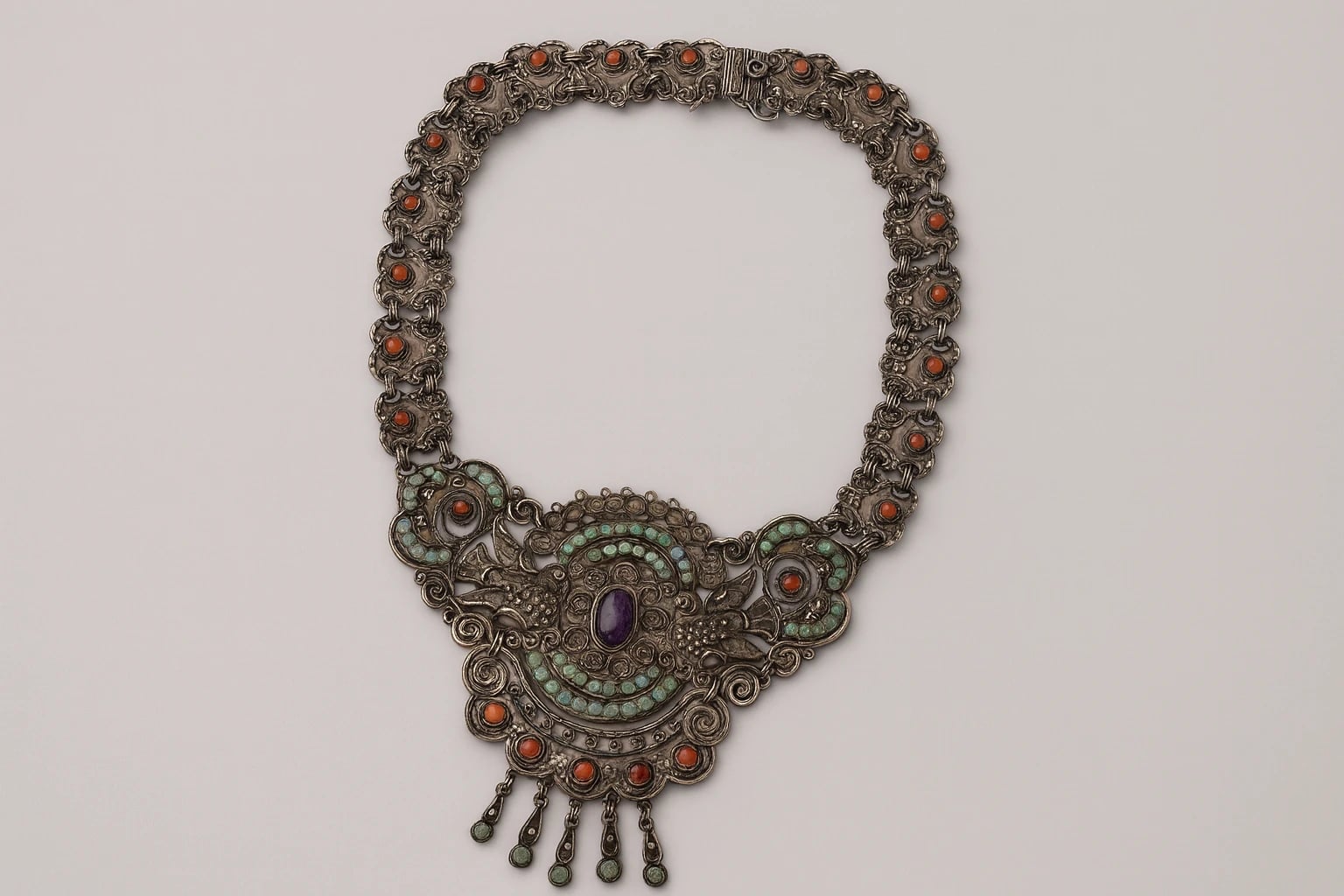
Matilde Poulat built this necklace the way a colonial retablo builds an altar: a rhythmic frame of repeating elements leading the eye toward a densely ornamented center. Around the neck runs a chain of scrolled openwork links, each anchored by a small coral cabochon, so that the collar reads as a procession of warm red points against oxidized silver. At the throat the links give way to a broad pectoral organized around a dove, its body carrying a deep amethyst cabochon and its plumage traced in rows of small turquoise. Below, a graduated fringe of five drops, each tipped in turquoise and punctuated with coral, extends the composition downward and adds a gentle sway when the necklace is worn. At fifteen and a half inches, the piece sits high and close, a true collar rather than a pendant chain, and at 84 grams it is remarkably light for its breadth, a reminder that Poulat's abundance of ornament was achieved through openwork and modeled surface rather than sheer mass.
The dove was among Poulat's most personal motifs, and here it functions as more than decoration. Her vocabulary drew on Mexican colonial and ecclesiastical silver, the world of milagros, crowns, and votive ornament, translated into wearable form through the encrusted color she favored: turquoise for density, coral for warmth, amethyst for a single saturated focal point. The three stones are not incidental luxuries. Turquoise and coral carry long histories in Mexican adornment reaching back well before the viceregal period, while amethyst was a staple of colonial jewelry, and Poulat's habit of combining them let a single object hold both lineages at once. The scrollwork surrounding the bird, with its spiraled volutes and beaded borders, shows how completely she absorbed baroque ornament into a personal style that Hougart's hallmark study aptly calls her unique folk art designs.
The 1934 to 1948 range recorded for this necklace corresponds to the first phase of Poulat's career and to her earliest marks. Trained as a painter at the Academy of San Carlos, where Diego Rivera was a fellow student, she opened her Mexico City shop in 1934 and stamped her work with the script MATL signature, a name adapted from the Nahuatl word for water, in this period paired with fineness marks of 925 or 950 and often the curved legend Hecho en Mexico DF. The registered trademark number 142093 that appears on her later production belongs to marks Hougart dates from 1950 onward, which places a necklace of this period before that registration, in the years when her workshop was establishing the designs her nephew Ricardo Salas would continue faithfully after her death in 1960.
Museum of Mexican Silver. “Dove Fringe Necklace with Amethyst, Coral, and Turquoise.” Catalog no. MoMS-002196. https://museumofmexicansilver.com/pieces/matl-amethyst-coral-turquoise-dove-necklace
See something wrong with this record? Suggest a correction and the piece details fill in automatically.
Within the larger silver renaissance, Poulat occupies a position distinct from the Taxco designers who pursued severe geometry or ancient Mexican abstraction. Working in the capital rather than in Taxco, she demonstrated that the movement could accommodate a maximalist, colonially rooted sensibility with the same seriousness that others brought to modernist reduction. A necklace like this one, with its dove pectoral, coral-studded links, and articulated fringe, shows that sensibility fully formed in her first working decades. It documents both a signature design and the early moment of a workshop whose imagery proved durable enough to be imitated by contemporaries, as the Rivera marks recorded in the style of MATL attest, and to remain in production under her successor for another four decades.
MATL (Matilde Poulat)
Fringe Necklace with Coral
1934 or later
Coral