Saves instantly, no account needed. Already a member? Sign in.
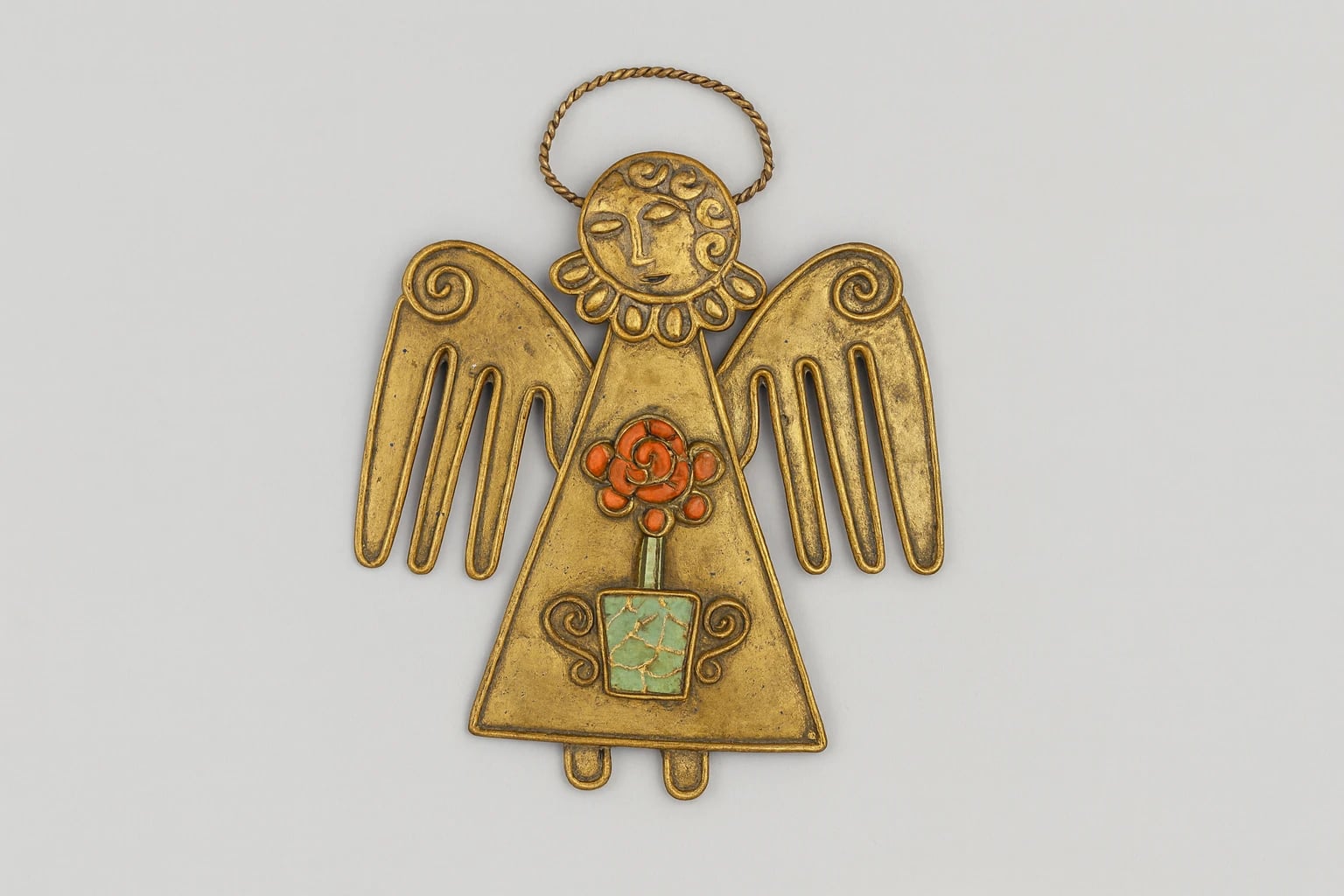
An angel with comb\-toothed wings, a coral rose blooming at its chest, and a twisted wire halo hovering above its head: this pendant condenses the devotional folk imagery of Matilde Poulat into a single wearable figure. Made of copper around 1960 and measuring four by three inches, it belongs to the vocabulary of angels, doves, and flowering plants that defined the MATL workshop, but it translates that vocabulary into a warmer metal and a frankly graphic, almost drawn silhouette. The figure reads at once as a piece of jewelry and as a small votive object, the kind of image that moves easily between adornment and household devotion.
The design is organized around a simple triangular robe flanked by two broad wings, each wing cut with long parallel slots so that it resembles a comb or a fan of feathers reduced to pure pattern. Spiral scrolls curl at the shoulders where the wings meet the body, a punched and stippled face occupies the round head, and a collar of small turquoise beads rings the neck like a ruff. Down the front of the robe runs the pendant's central image: a coral blossom rising on a stem from a square planter set with turquoise. The angel does not simply carry ornament, it frames a picture, a potted flowering plant of the kind that appears throughout Mexican popular art, from painted furniture to tinwork. The halo, formed of twisted wire arching above the head, doubles as part of the suspension, so the sign of sanctity and the means of wearing the piece are one and the same.
Poulat came to silver as a painter and designer. She studied at the San Carlos Academy alongside Diego Rivera before opening her Mexico City shop in 1934 under the mark MATL, a name drawn from the Nahuatl word for water and protected as registered trademark 142093 (Hougart records the sequence of her marks and this history). That training shows here. The pendant is conceived pictorially, as a composition of contour, pattern, and color accents, rather than as a display of metalsmithing bravura. The coral and turquoise are used the way a painter uses touches of red and green against a warm ground: sparingly, and exactly where the eye should rest. MATL work is best known in silver, which makes the copper construction of this piece a point of interest, giving the angel a burnished golden tone closer to the gilded surfaces of colonial church ornament than to the cool brilliance of sterling.
The circa 1960 date places the pendant at the close of Poulat's own career. She died that year, and her nephew Ricardo Salas, who had worked beside her throughout her design and manufacturing life, carried the MATL designs forward for decades afterward. This angel therefore represents the mature workshop idiom at the moment of its transmission: a fully settled design language, rooted in religious folk imagery and stone encrustation, that had become recognizable enough to survive its creator. Within a collection of Mexican silver of this period, the pendant documents a distinct current of the renaissance, one that looked not to ancient geometry or international modernism but to the popular and devotional arts of Mexico, and found in them a style personal enough to be trademarked.
Museum of Mexican Silver. “Angel Pendant with Copper, Coral, and Turquoise.” Catalog no. MoMS-002192. https://museumofmexicansilver.com/pieces/matl-copper-coral-turquoise-angel-pendant
See something wrong with this record? Suggest a correction and the piece details fill in automatically.
MATL (Matilde Poulat)
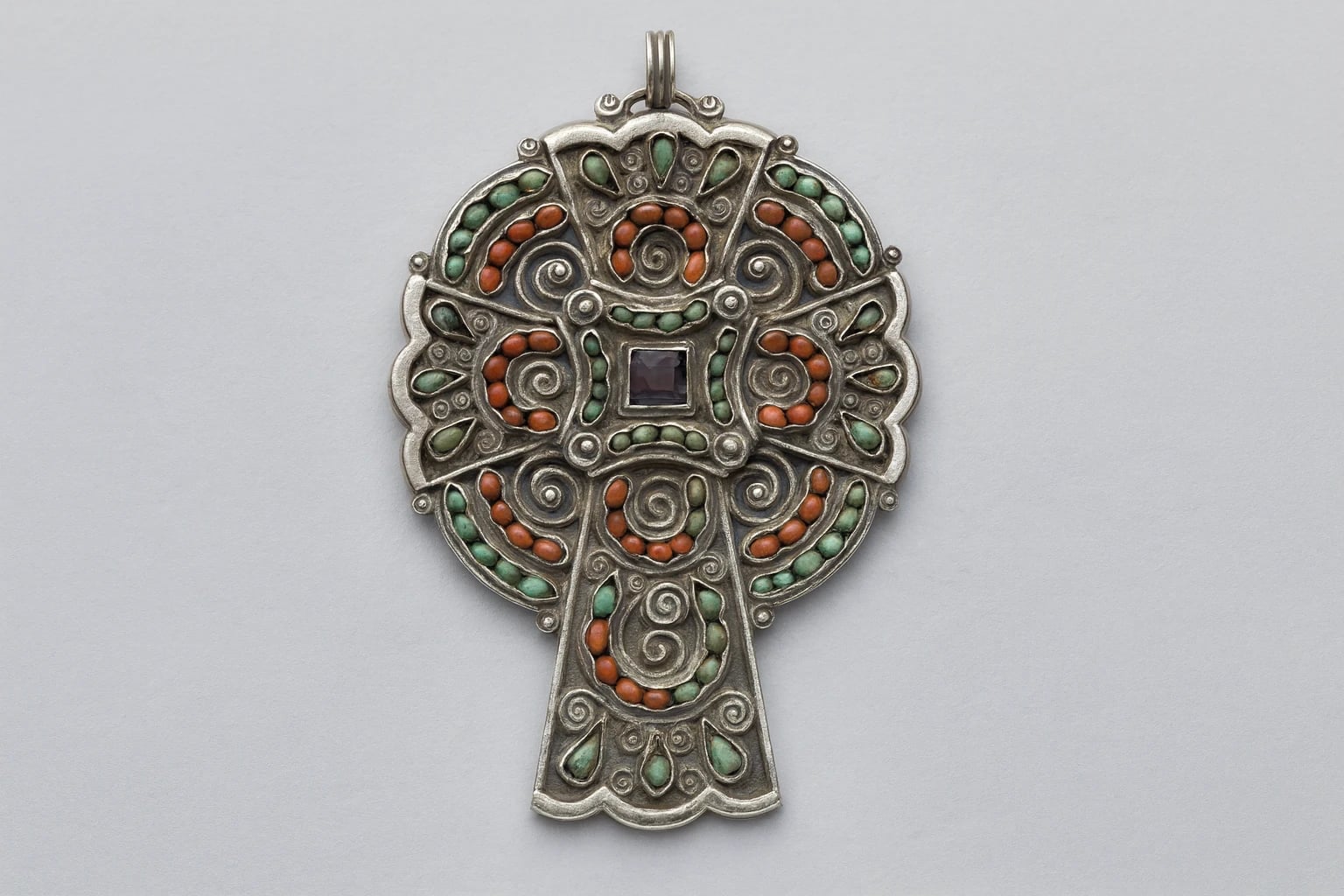
Flat Cross Pendant with Turquoise
1934 or later
Turquoise