Saves instantly, no account needed. Already a member? Sign in.
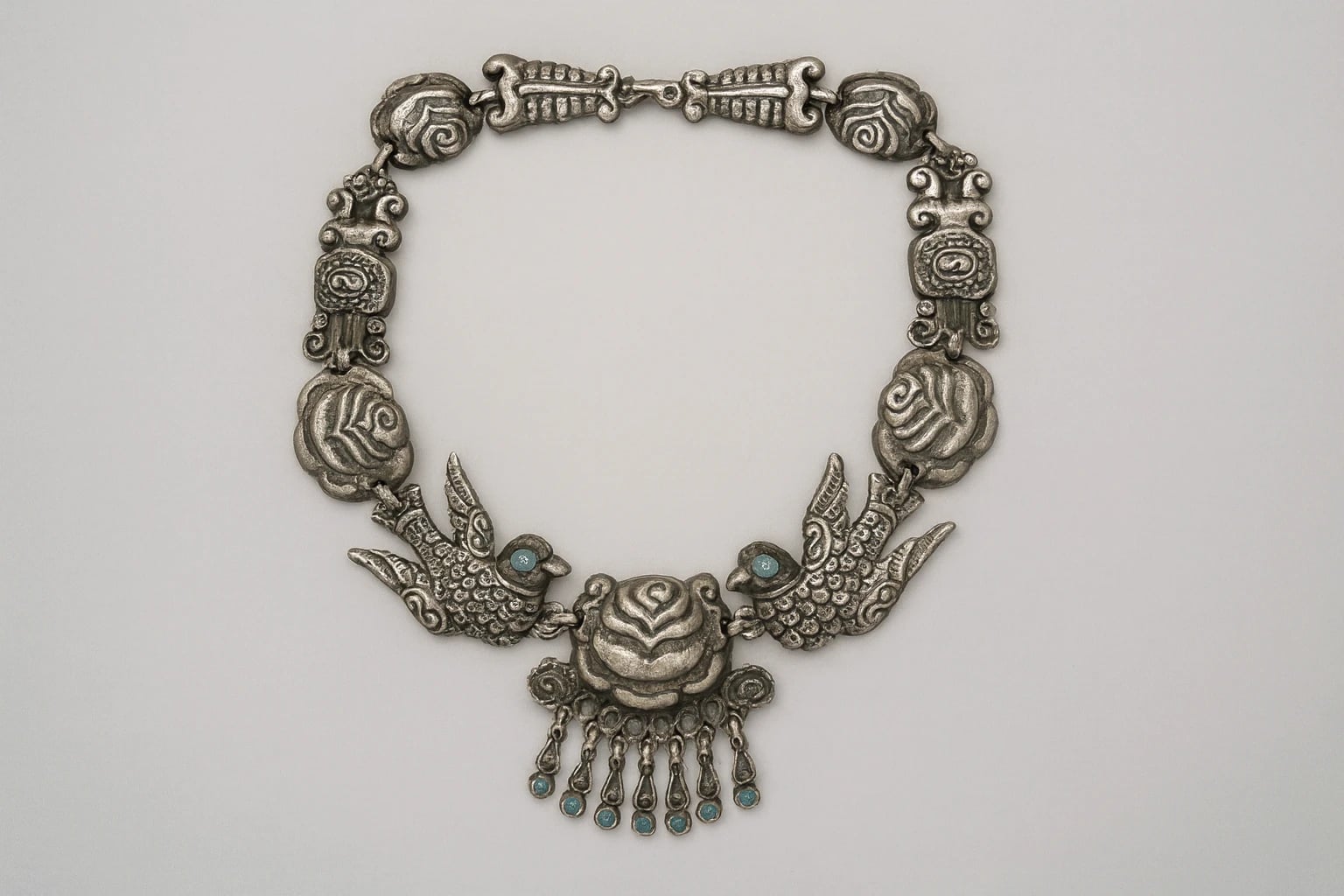
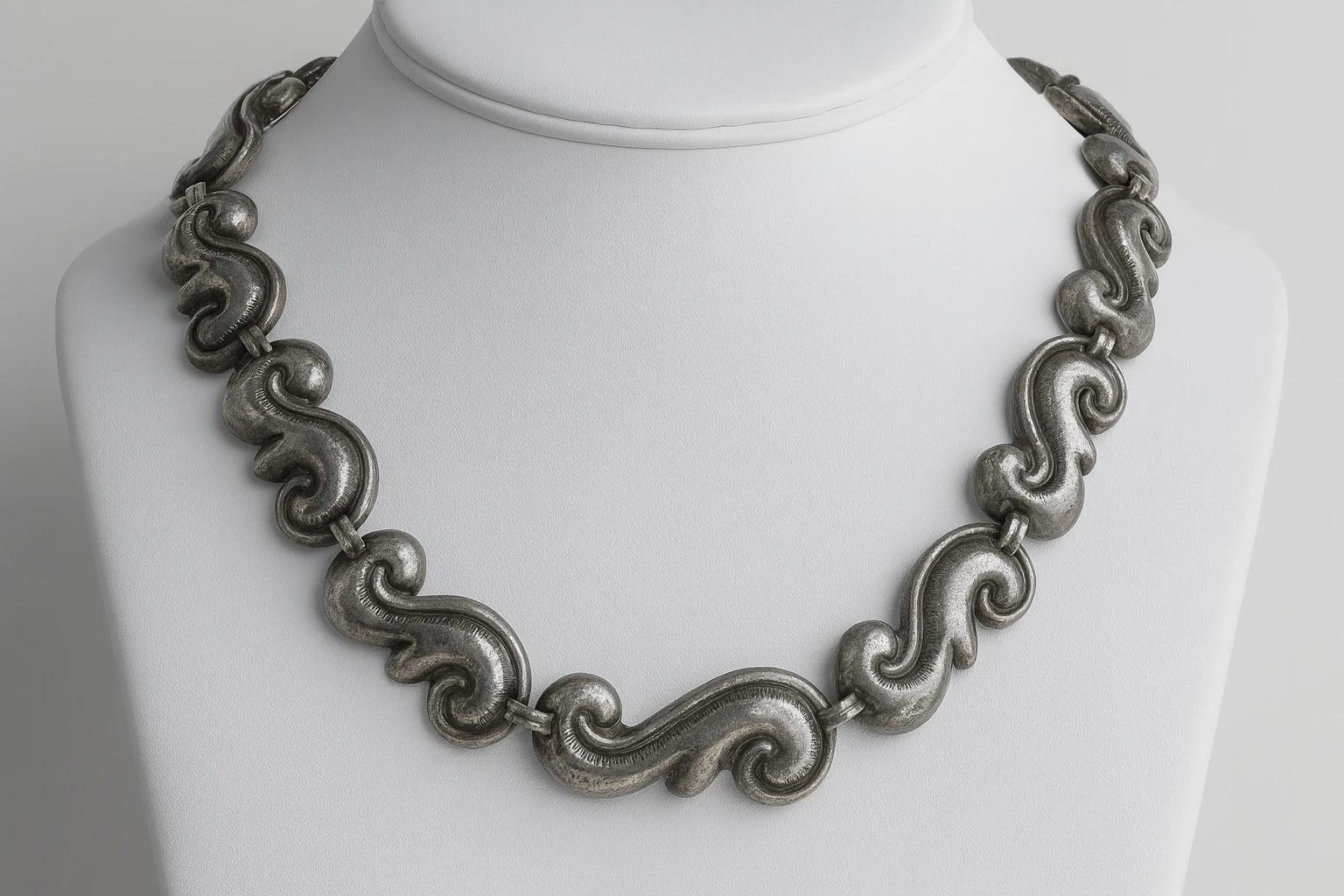
This early Matl necklace organizes silver as a sequence of swelling scroll forms, each link raised into relief and then tightened by chased lines and darkened recesses. The design belongs to the first decade of Matilde Poulat’s work under the Matl name, c. mid 1930s to early 1940, and it already shows the qualities that would make the workshop distinct within the Mexican silver renaissance: dense surface, small variations of handwork, and ornament treated as structure rather than applied decoration. Marked MATL in block letters and 925, and fitted with an old style flat hook closure, the necklace preserves the language of an early studio object rather than a later standardized production.
The necklace measures 19 1/8 inches long and three quarters of an inch wide, a scale that keeps the design close to the body while giving each repoussé element enough height to catch light. The repeated units are not flat silhouettes. They rise, curve inward, and fold back on themselves, so that the dark niello in the deeper passages becomes part of the drawing. Repoussé supplies the rounded volume, chasing clarifies the ridges and inner contours, and the visible tool marks give the surface a lively irregularity without disturbing the disciplined repetition. The small connector rings between the links allow the band to articulate, but the eye reads the necklace as a continuous chain of curling forms. The closure is modest and functional, consistent with the object’s early date, and it lets the principal work remain in the handmade links.
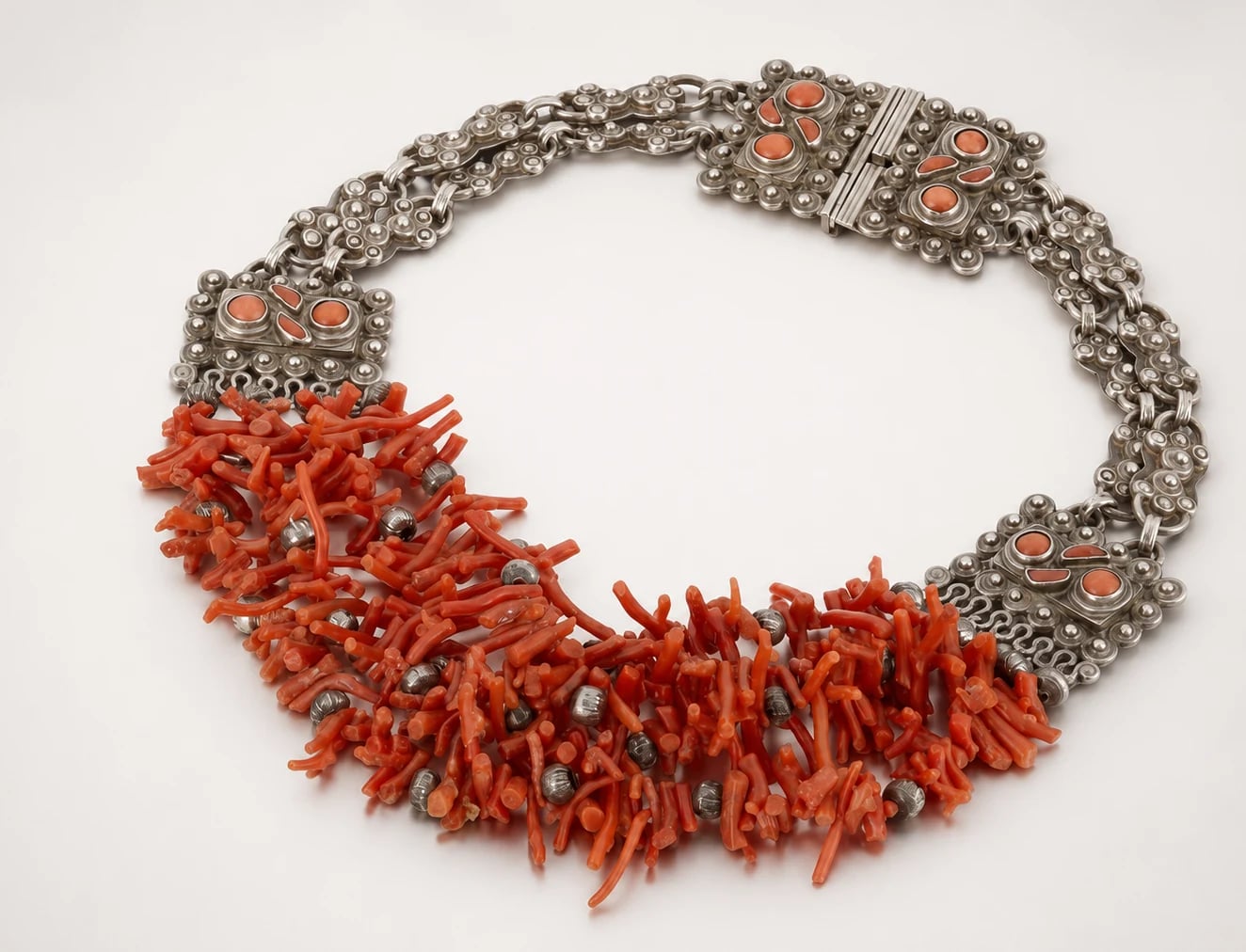
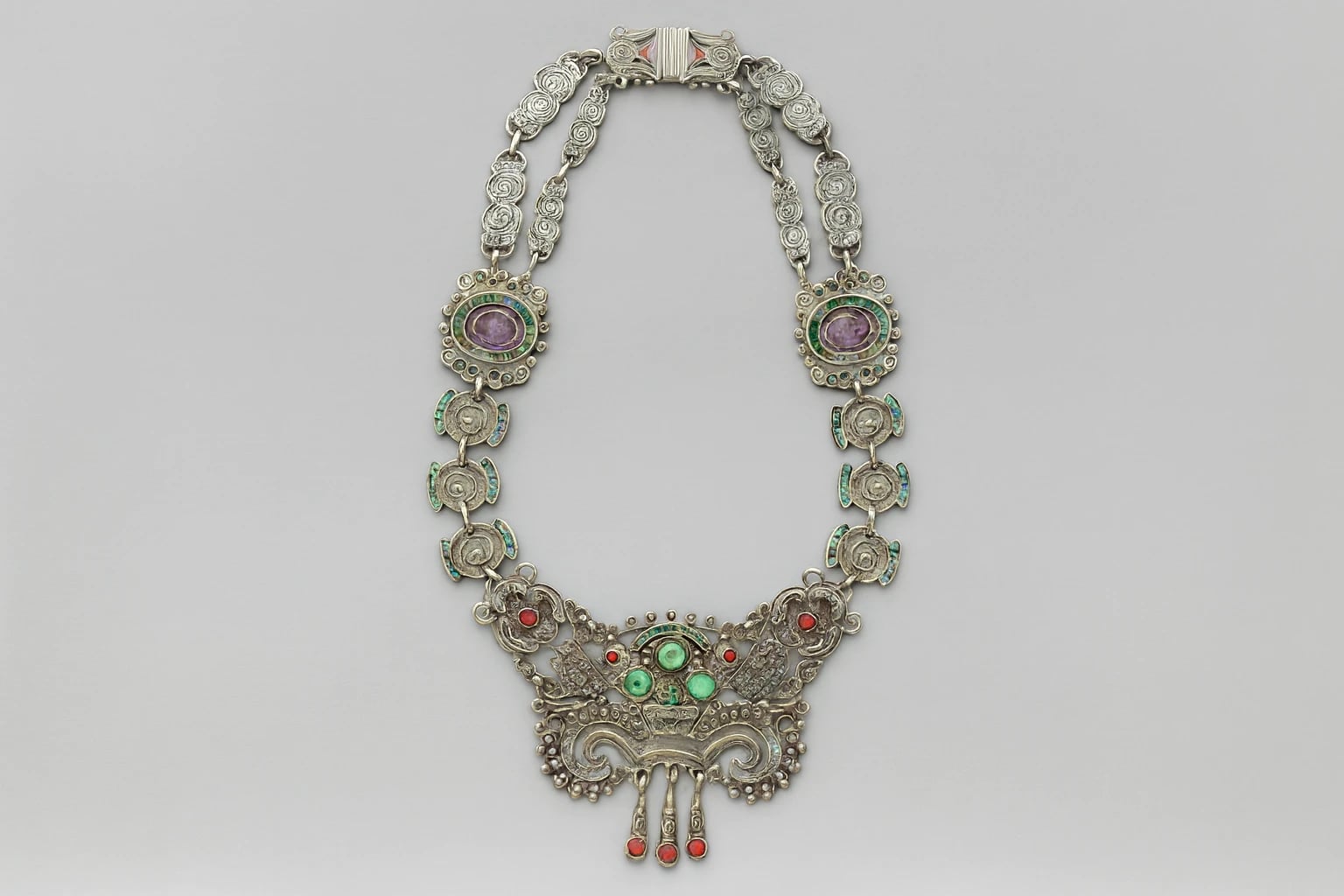
Matilde Eugenia Poulat opened her shop in 1934 after training as an artist in Mexico City, and Hougart records Matl as her registered trademark, number 142093. Morrill and Berk place her jewelry within the postrevolutionary search for a Mexican aesthetic, noting her attention to Mixtec gold from Monte Albán and to subjects associated with Mexican popular art. This necklace is earlier and more restrained than many of the later Matl works with coral, turquoise, amethyst, bells, religious imagery, and dense figural programs. Its importance lies in that restraint. The piece shows Poulat testing how much visual richness could be produced through silver alone: relief, line, shadow, and repeated curvature. The result is not Taxco modernism in the severe geometric mode, nor is it a simple revival of an ancient form. It is a Mexico City contribution to the same larger renaissance, rooted in hand techniques and historical sources while working through the problems of modern jewelry design.
Morrill and Berk describe Matl surfaces as decorated with applied wire and elaborated by embossing and repoussé of great complexity, and this necklace helps explain how that language developed. Before the workshop’s later abundance, the essential grammar is already present: raised silver animated by chased detail, darkness used to deepen relief, and link construction made visually active. As one of Poulat’s earliest designs, it gives the Museum a record of formation rather than culmination. It shows Matl before the mature workshop vocabulary became expansive, and it reminds us that the Mexican silver renaissance was not confined to a single city, workshop, or modernist idiom. In this necklace, early Matl silver finds its modernity through touch, repetition, and the patient shaping of metal into movement.
Museum of Mexican Silver. “Scroll Link Necklace with Niello.” Catalog no. MoMS-002335. https://museumofmexicansilver.com/pieces/matl-necklace-2
See something wrong with this record? Suggest a correction and the piece details fill in automatically.
MATL (Matilde Poulat)
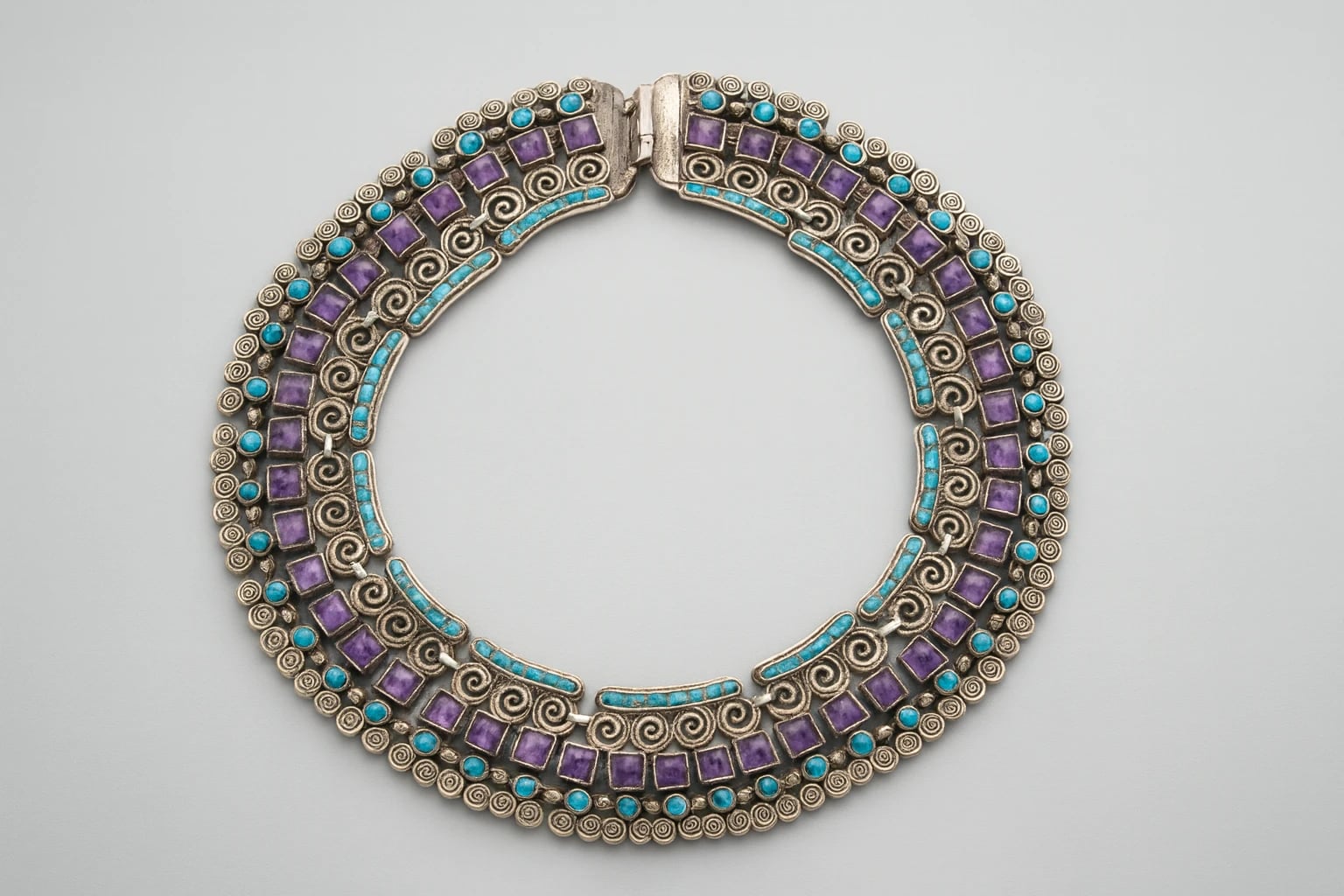
Double-Row Collar Necklace with Turquoise and Amethyst
1934 or later
Turquoise