Saves instantly, no account needed. Already a member? Sign in.
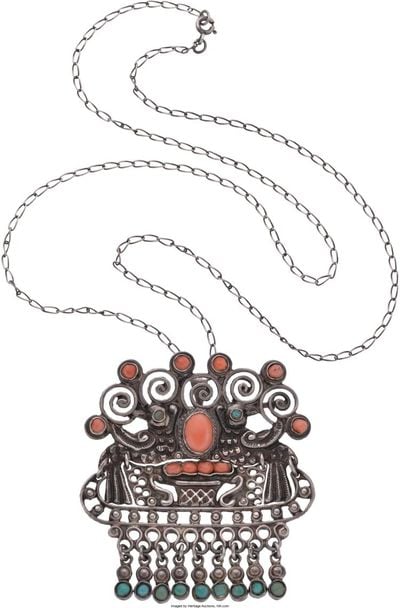
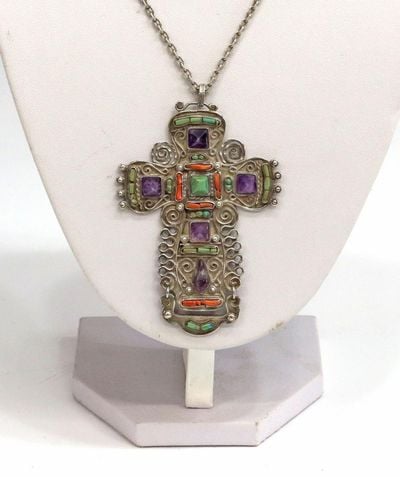
A dense mosaic of turquoise and coral, set close together and bounded by silver, gives this MATL pendant its particular density and glow. The stones are not scattered as isolated accents but massed into fields of color, blue-green against warm red, so that the surface reads as a compressed floral or heraldic composition rather than a frame for a single gem. This is the visual signature that made Matilde Poulat's workshop recognizable: ornament built up from color and repetition, organized around a central axis, with silver serving as both structure and drawn line.
The pendant depends on the interplay between opaque stones and worked metal. Turquoise and coral share a matte, saturated quality that absorbs rather than reflects light, and Poulat's designs set that opacity against the brightness of silver scrollwork, beading, and small cast elements such as birds, flowers, and leaves. The result is a surface with two registers: the color mosaic that holds the eye, and the silver armature that separates, outlines, and enlivens it. Coral supplies the warm counterpoint that keeps a turquoise-heavy composition from cooling into monochrome, and the balance of the two colors, rather than the size of any single stone, carries the design. Weight, exact construction, and the manner of setting are not established here, but the compositional logic of massed stone within silver is characteristic of the workshop's jewelry.
Matilde Poulat trained as a painter and designer at the San Carlos Academy before opening her shop in 1934, and she registered the "MATL" trademark, a name drawn from the Aztec word for water, under number 142093. Her work belongs to the strand of the Mexican silver renaissance that looked toward colonial devotional silver and Mexican popular art rather than toward austere international modernism. The doves, flowering forms, and dense polychrome settings recall retablo ornament and folk imagery, translated into a personal decorative language. After Poulat's death in 1960, her nephew Ricardo Salas continued the MATL designs, at times supervising several dozen silversmiths, and the mark remained in use for decades. The dating of any individual MATL object therefore depends on its specific stamp: the early script and fineness marks correspond to Poulat's own period, while the later registration and MS-12 marks indicate production under Salas from about 1980 onward. Design conception and fabrication can be separated by many years within this workshop, and the mark rather than the style settles which period a given pendant represents.
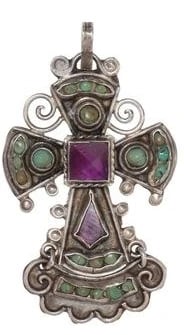
Museum of Mexican Silver. “Cross Pendant with Turquoise, Amethyst, and Coral.” Catalog no. MoMS-001433. https://museumofmexicansilver.com/pieces/matl-turquoise-coral-pendant
See something wrong with this record? Suggest a correction and the piece details fill in automatically.
Within a collection of Mexican silver, a MATL pendant of this kind documents an alternative to the geometric, stone-sparing modernism associated with Taxco. Poulat kept color central and let silver support a dense, image-bearing ornament rooted in Mexican religious and folk sources. The design's continued production and its recurring appearance among collectors reflect steady recognition of that decorative idiom, one that shows how the silver renaissance accommodated a painterly, popular-art sensibility alongside its more severe modernist currents.
MATL (Matilde Poulat)
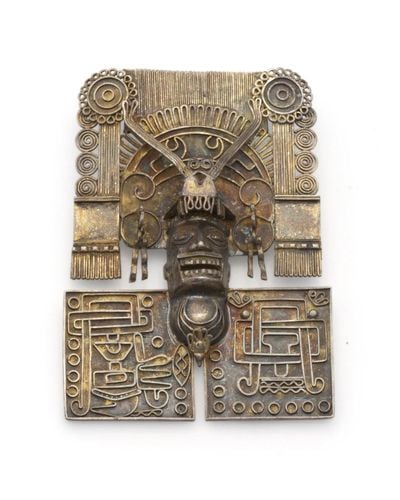
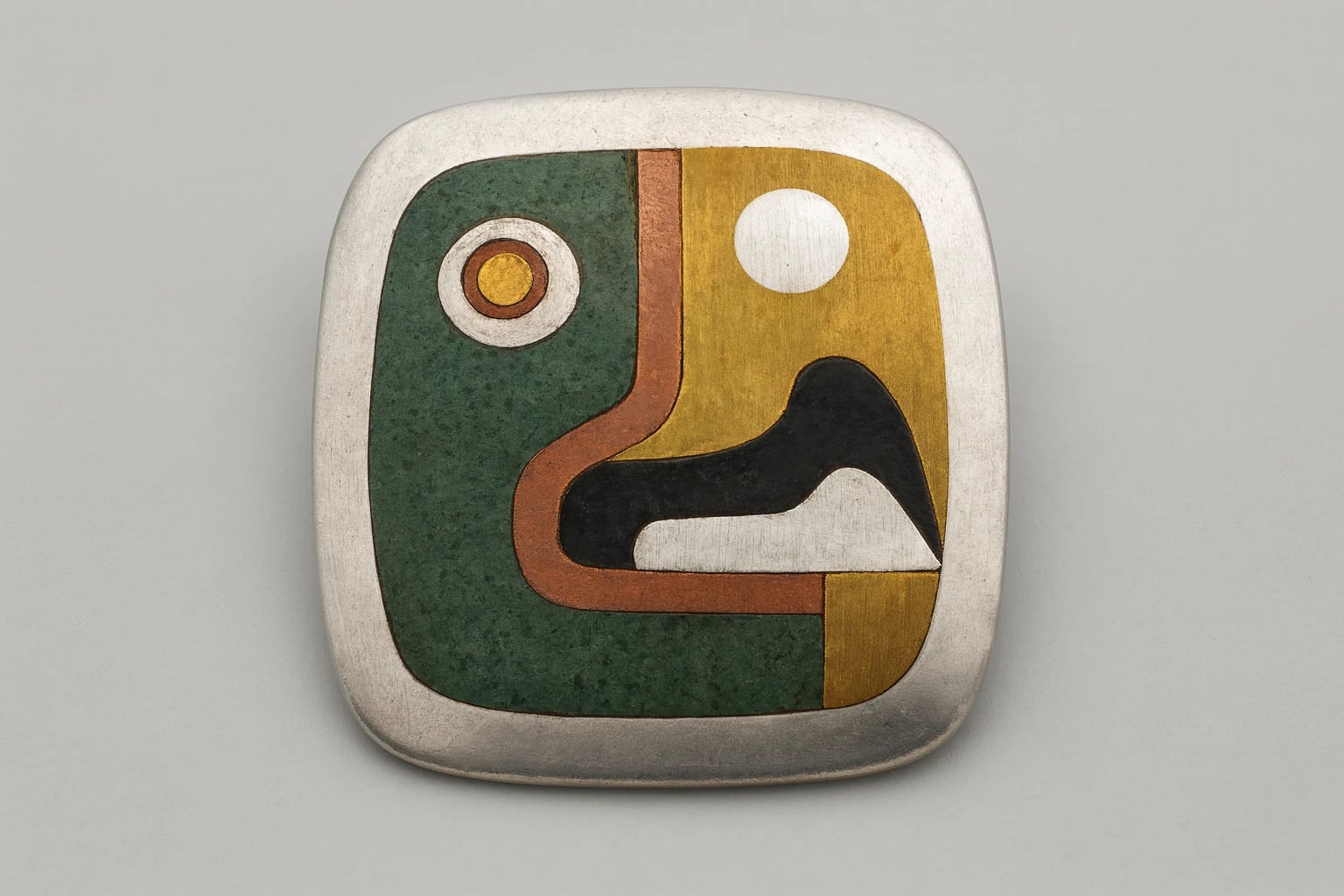
Mask Plaque Pendant
1934 or later
Silver