Saves instantly, no account needed. Already a member? Sign in.
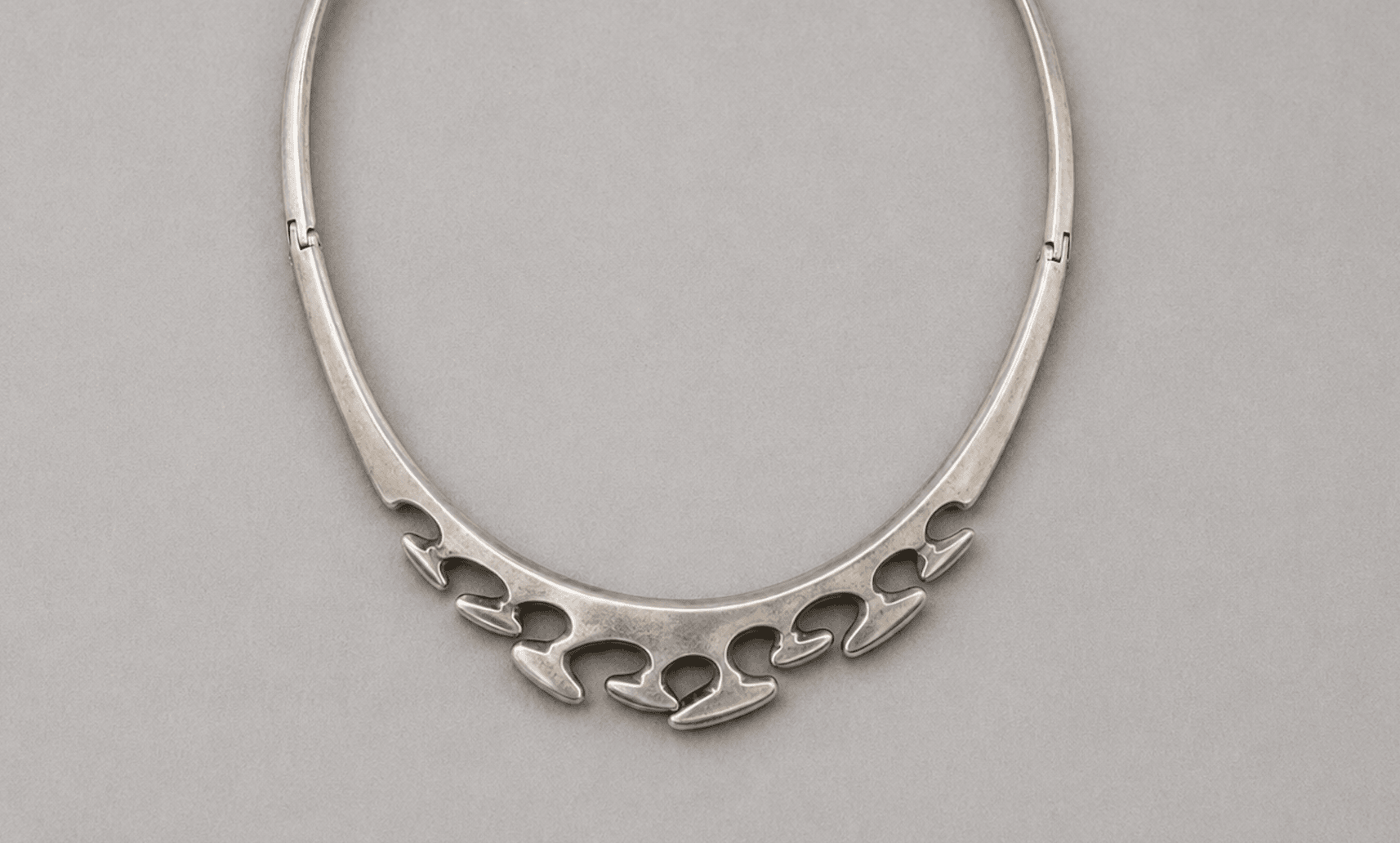
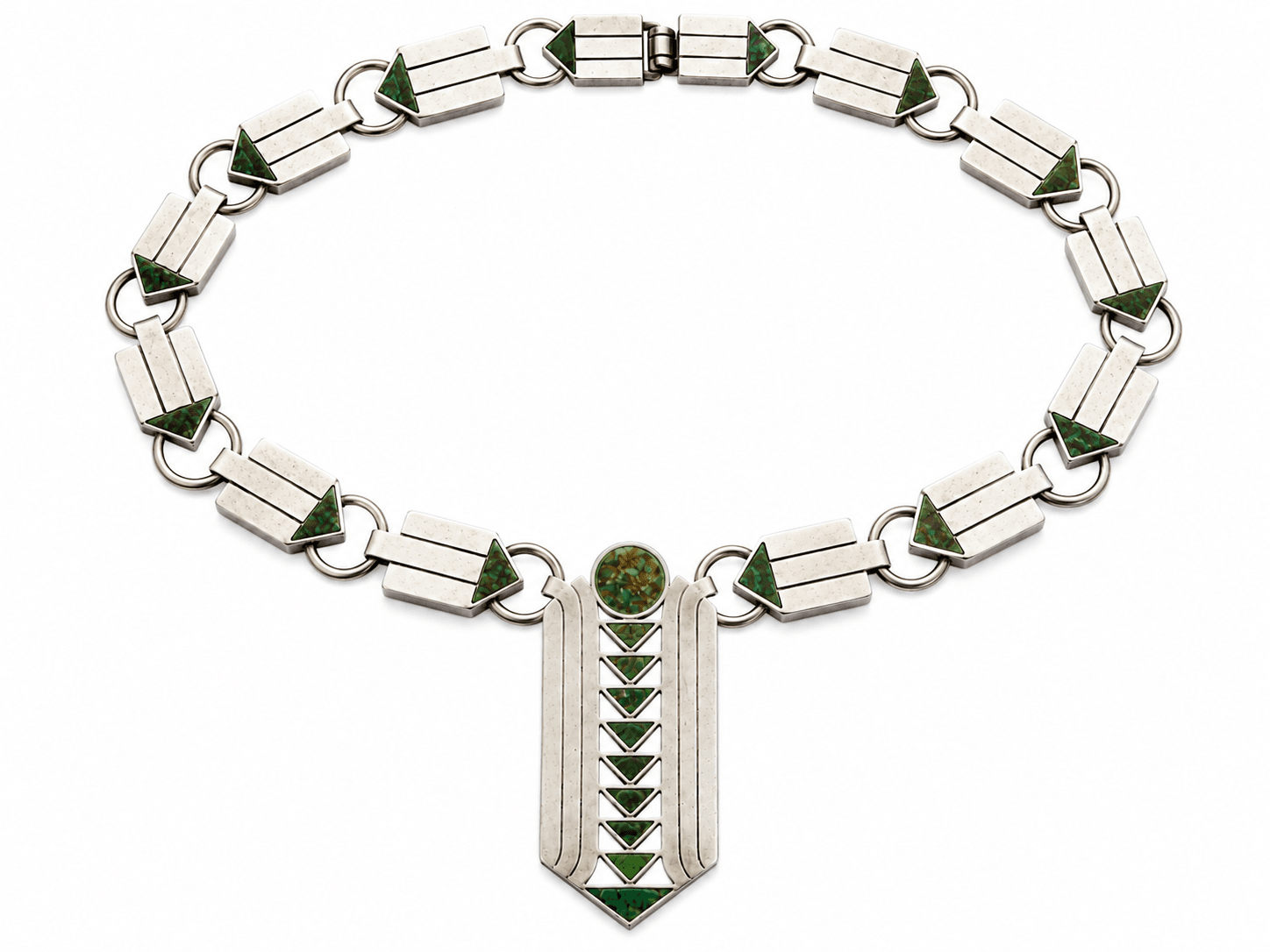
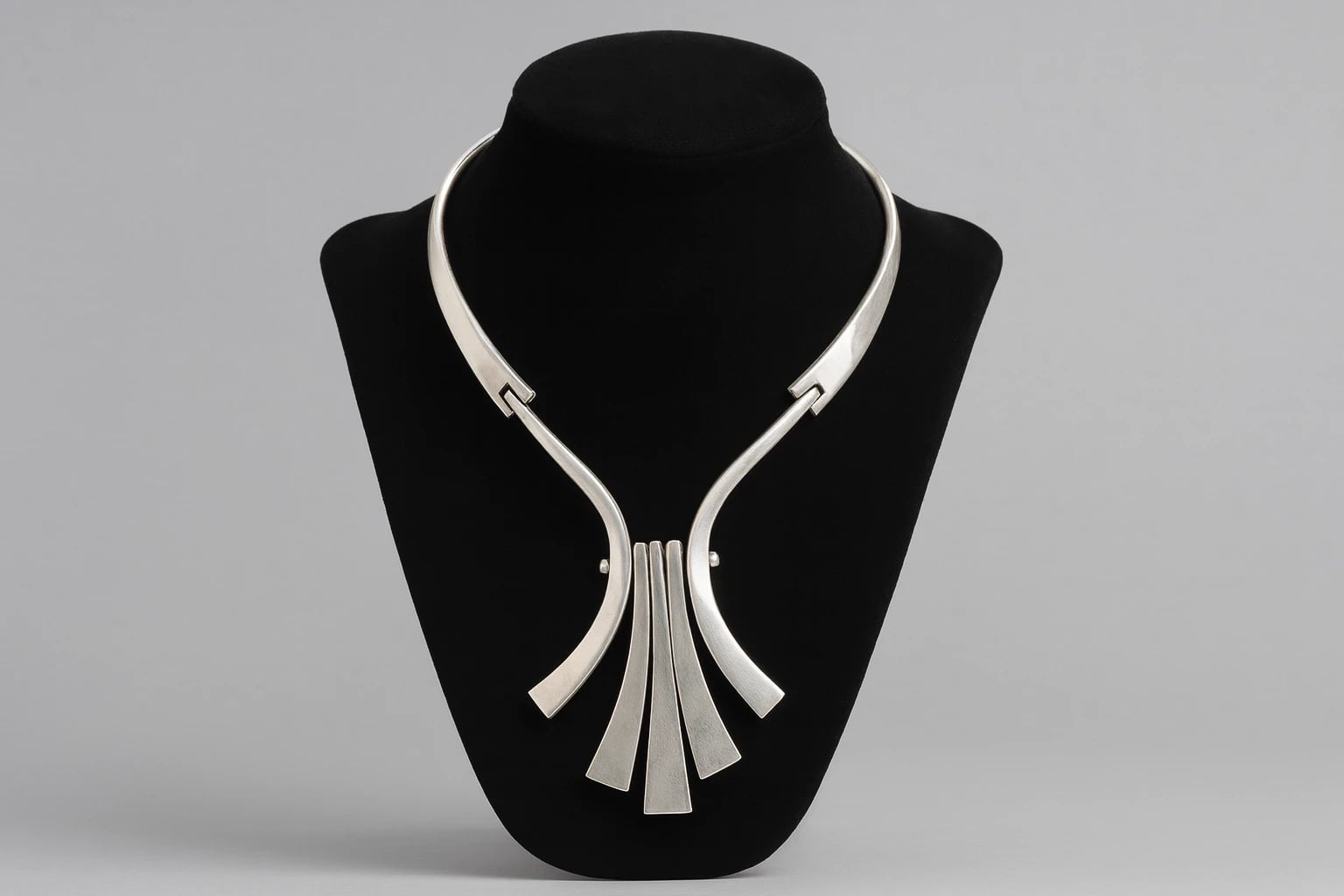
A necklace of irregular silver flanges, hinged so that the joints themselves read as ornament, gives Sigi Pineda's postwar work its characteristic momentum. The forms do not repeat as identical links; they vary in outline and overlap one another, and the hinges that hold them together are not concealed as mechanical necessity but folded into the geometry as visible incident. Penny Morrill, describing a related necklace and earring suite, noted how such oddly shaped bits of silver set up a "jazzy motion," a phrase that captures how Pineda organized asymmetry into rhythm rather than disorder.
The design depends on the relationship between rigid segments and flexible joins. Each flange holds its own shape, catching light across a broad plane, while the articulated connections let the whole piece follow the neck and shift with the wearer. This is a construction problem as much as a drawing problem: the outline of every element has to accommodate the swing of its neighbor, and the placement of each hinge determines both how the necklace lies and how its silhouette breaks. Pineda treats the hinge as a design unit, so that the engineering and the ornament become the same decision. Worked in sterling without stones or enamel, the piece relies entirely on cut silhouette, overlap, and the reflective behavior of polished silver against shadow.
Pineda came to this vocabulary through an unusually dense apprenticeship within the Taxco workshops. He spent three years at Los Castillo as a young teenager, worked with Salvador Terán in Puebla and with Felipe Martínez at Piedra y Plata, and directed the enameling workshop at Margot de Taxco before opening his own shop, first called Plateros and then renamed Sigi, in the early 1950s. Hougart records that his work reflects "great design flow and very creative use of dimension," and the hinged construction here shows what that meant in practice. Where his enamel work at Margot's used color as structure, his independent silver relies on the movement and interlock of cut metal. The piece belongs to that Sigi output rather than to his earlier collaborative roles, and it demonstrates the modernist bent that placed him within the second generation of Taxco designers who built distinct formal languages out of the workshop system rather than simply extending Spratling's example.
Sigi's marks are among those Hougart flags as frequently counterfeited, with fabricated eagle 36 stamps laminated onto Sigi-look pieces, which makes securely marked examples of his articulated silver worth close attention as a record of his authentic construction. The interest in his hinged designs among collectors follows from exactly what this necklace makes legible: an approach to jointing that turns a functional problem into the primary ornament. As a document of Pineda's independent workshop and its handling of movement in silver, the piece clarifies how a Taxco designer of the 1950s could work in an entirely modernist idiom without recourse to stone, color, or ancient Mexican citation, letting cut form and articulation carry the whole design.
Museum of Mexican Silver. “Modernist Sterling Necklace.” Catalog no. MoMS-001561. https://museumofmexicansilver.com/pieces/sigi-modernist-sterling-necklace
See something wrong with this record? Suggest a correction and the piece details fill in automatically.
Sigi Pineda
Sterling Collar Necklace
Date unknown
Silver