Saves instantly, no account needed. Already a member? Sign in.
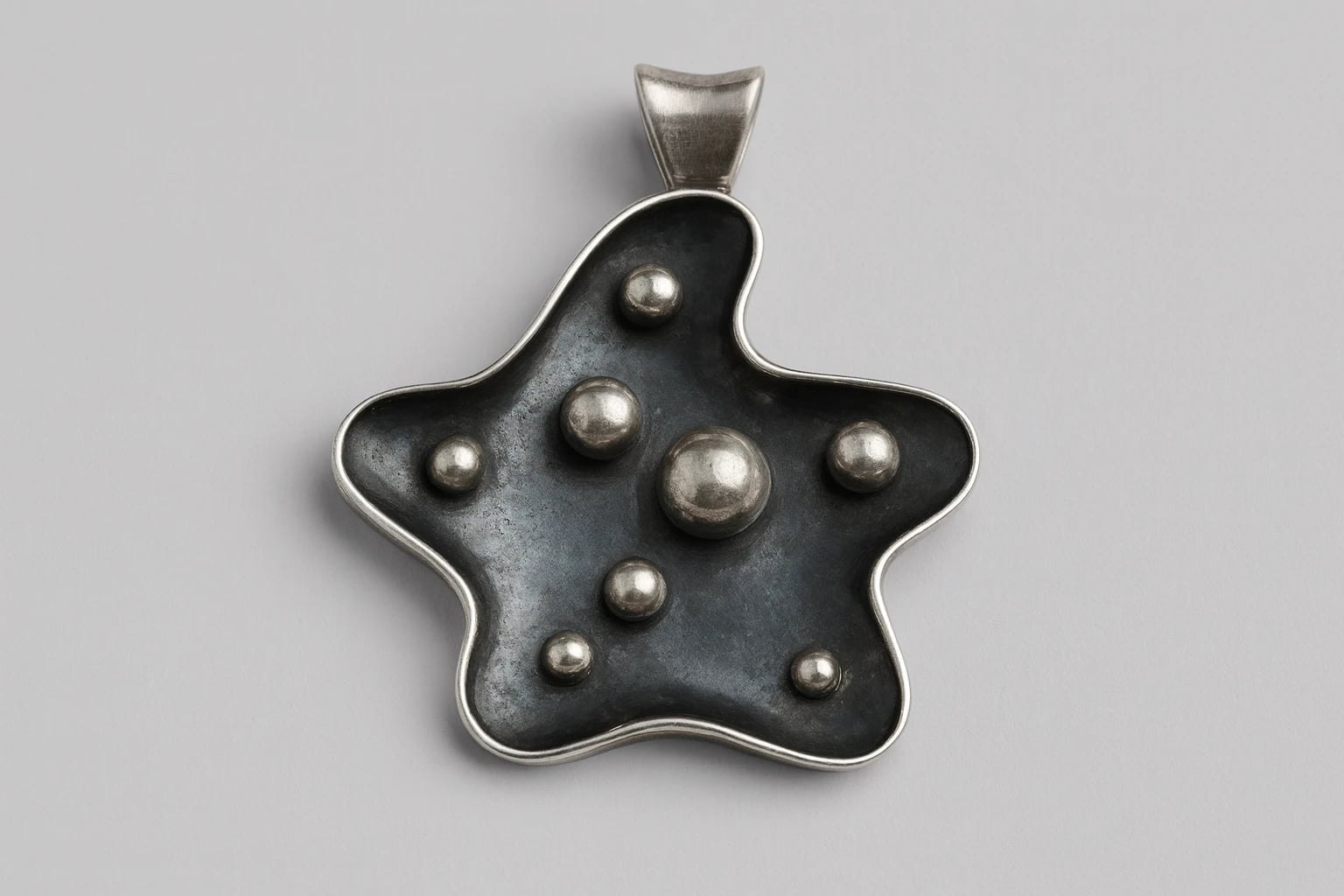
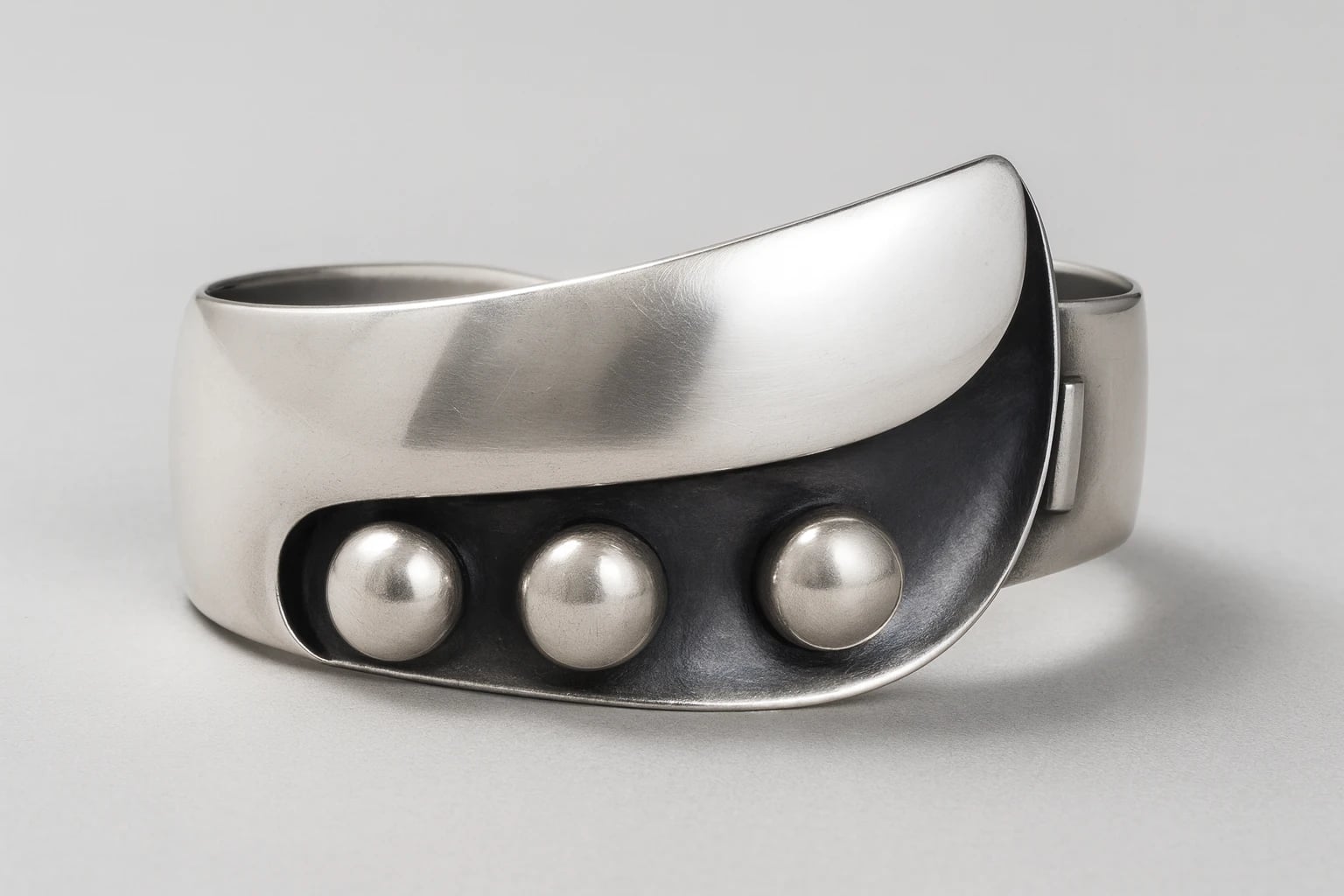
The bracelet organizes a broad cuff around a recessed dark field and three raised silver spheres, using a small vocabulary of forms to produce a surprisingly complex surface. Its front widens to about 1 1/4 inches, enough to give the design a compact architectural presence, while the 6 1/2 inch hinged structure keeps the object close to the wrist rather than letting it read as a flat plaque. The large open area is not empty. It frames the niello ground as an active part of the composition, a dark interval against which the polished balls register as volume, light, and rhythm.
The design depends on controlled contrast. The outer silver wall curves in a smooth, slightly swelling band, then cuts inward to expose the recessed channel. Within that channel, the three sterling balls sit in measured sequence, each one catching light differently against the blackened surface behind it. The bracelet is weighty, but its visual mass is relieved by the opening and by the way the upper silver edge sweeps over the dark ground. Sigi Pineda often favored simplified, flowing forms, and this bracelet shows how that language could be adapted to a hinged cuff: the mechanism serves wearability, but the front treats structure, void, and ornament as one problem.
Marked with the old Sigi marks, Eagle 36, and design number 98, the bracelet belongs to Pineda’s early independent production around 1955. Its design is documented in Sigi’s 1955 catalogue, reproduced by Morrill and Berk in Mexican Silver, where his catalogue pages help place the work within the first mature phase of his shop. Pineda had already passed through important Taxco training grounds before this moment. Morrill and Berk record his work at Los Castillo, his 1950 hiring by Margot de Taxco to oversee silver enameling, and the opening of his own business in 1952, first called Plateros and soon known simply as Sigi. That sequence matters here because the bracelet is not a derivative workshop exercise. It shows a designer absorbing the disciplined production culture of Taxco while moving toward a more international, organic modernist vocabulary.
Within the Mexican silver renaissance, this bracelet is a concise example of how midcentury abstraction entered jewelry without abandoning the body. Morrill and Berk describe Sigi’s 1950s work as closer to international trends than that of many Taxco contemporaries, with simplified biomorphic shapes and integrated surfaces. Stromberg later connected his elegant modernist work to the New York School and Mexican modernism. The present bracelet supports those readings through its own construction. It reduces ornament to a curve, a void, a darkened plane, and three repeated spheres, then lets the wrist supply the final condition of the design: movement. In a museum collection, it clarifies why Pineda’s early cuffs belong not only to the history of Taxco jewelry, but to the broader study of midcentury modern design in silver.
Museum of Mexican Silver. “Hinged Pod Bracelet with Niello.” Catalog no. MoMS-002333. https://museumofmexicansilver.com/pieces/sigi-pineda-modernist-hinged-bracelet-4
See something wrong with this record? Suggest a correction and the piece details fill in automatically.
Sigi Pineda
Interlocking Leaf Hinged Bracelet