Saves instantly, no account needed. Already a member? Sign in.
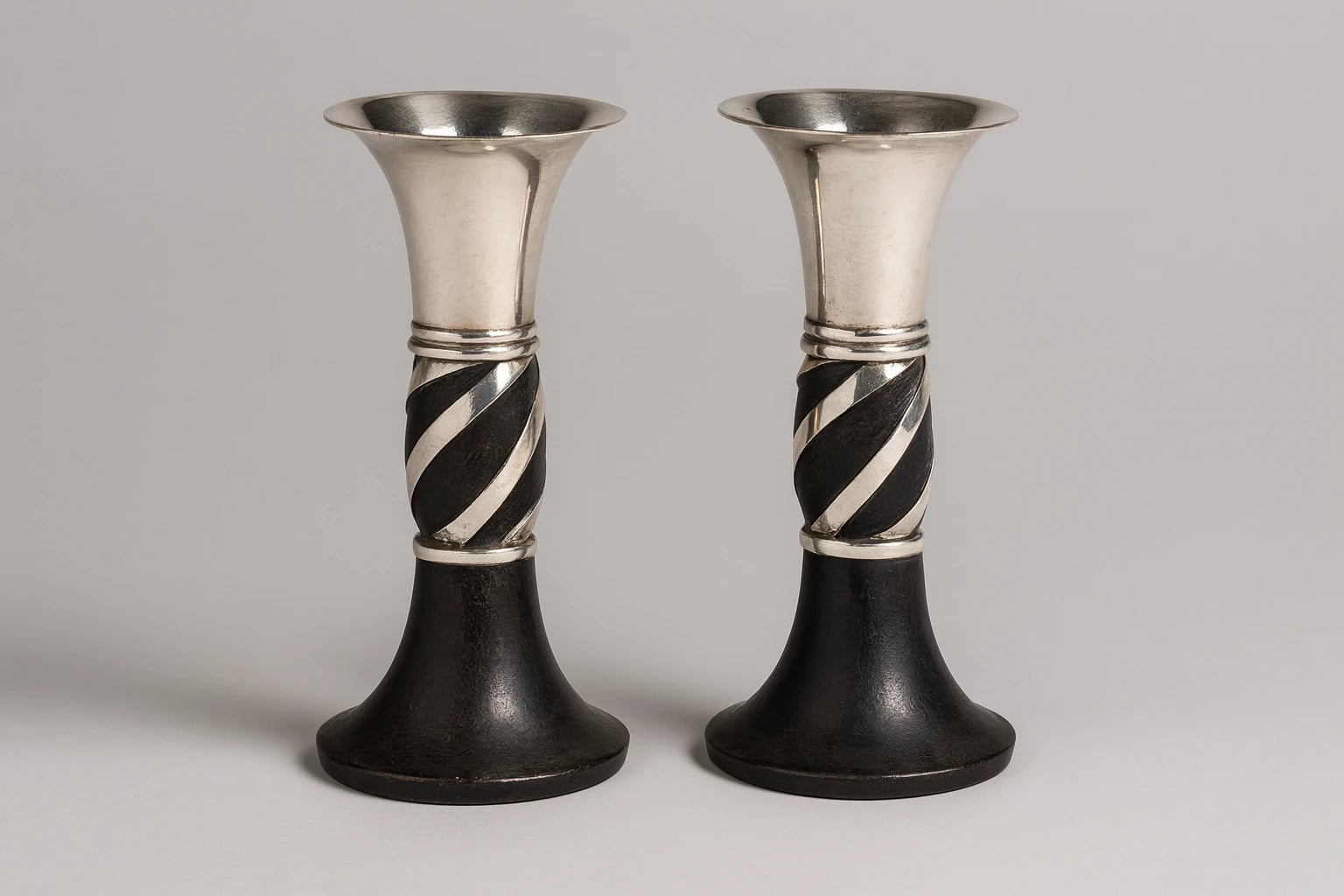
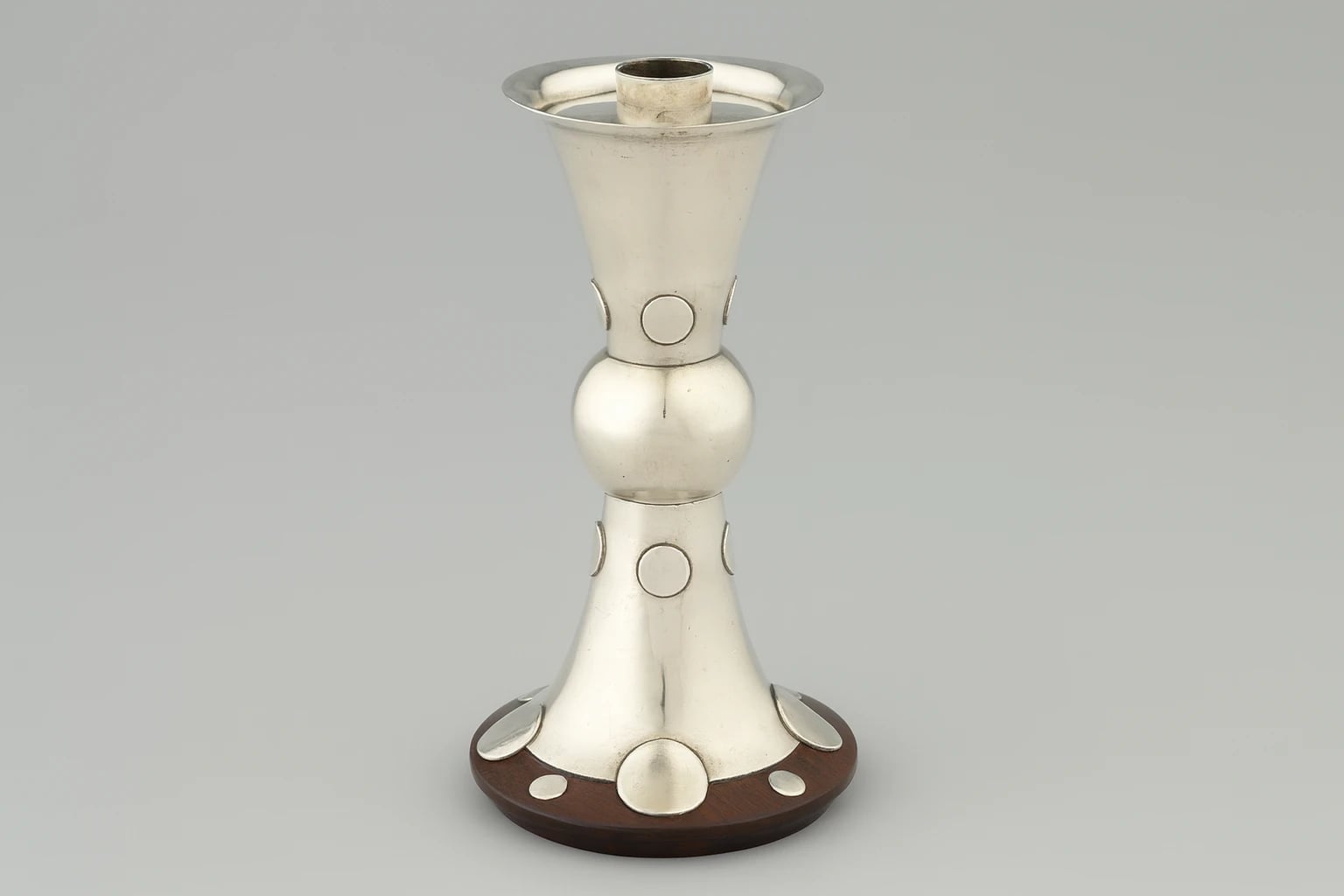
A ring of applied silver circles wraps the shaft of this candlestick, turning a functional object into a study of repetition and reflection. Each disc catches light independently, so the polished column reads as a sequence of bright points rather than a single smooth surface. The circle motif, one of William Spratling's recurring geometric preoccupations, here organizes the whole vertical form, drawing the eye up the shaft from the rosewood base to the socket that holds the flame.
The candlestick pairs the weight and warmth of dark wood with the cool brightness of silver, a contrast Spratling used throughout his work at the Taller de Las Delicias. The rosewood base grounds the tall silver column visually and physically, giving stability to a form that would otherwise appear top-heavy. Silver of substantial gauge lets the applied circles sit proud of the shaft, casting small shadows that vary as the candlestick is turned or as candlelight moves across it. The design depends less on ornament in the decorative sense than on the rhythm of identical elements repeated at measured intervals, a principle Spratling applied to jewelry, hollowware, and tableware alike.
The piece belongs to Spratling's First Design Period, the years between 1931 and 1946 when he was building Las Delicias into a workshop that combined design authority with skilled hand production. That taller system, as scholars including Penny Morrill and Gobi Stromberg have described, allowed a designer to concentrate on form while master smiths translated drawings into finished silver. Spratling drew on Mexican sources ranging from ancient geometry to colonial silver, but the reduction of ornament to a single repeated circle here reflects the modernist clarity that made Taxco silver of these years distinct from earlier decorative traditions. The candlestick's appearance in the core Spratling literature, including Cederwall and Riney's Spratling Silver and Goddard's field guide, places it within the documented body of work from this formative period.
Candlesticks occupy a particular place in Spratling's output, less common than his jewelry and requiring a different command of proportion and structural balance. This one demonstrates how he carried a small vocabulary of geometric forms across object types, using the same circle that appears in his brooches and bracelets to articulate a tall functional object. It records both the design intelligence of the First Design Period and the material pairing of silver with native Mexican wood that Spratling favored, offering a clear example of how the workshop translated a simple motif into hollowware of real presence.
Museum of Mexican Silver. “Silver Circle Candlestick on Rosewood Base.” Catalog no. MoMS-000294. https://museumofmexicansilver.com/pieces/spratling-158
See something wrong with this record? Suggest a correction and the piece details fill in automatically.
Tall Tin Candlestick
Tin