Saves instantly, no account needed. Already a member? Sign in.
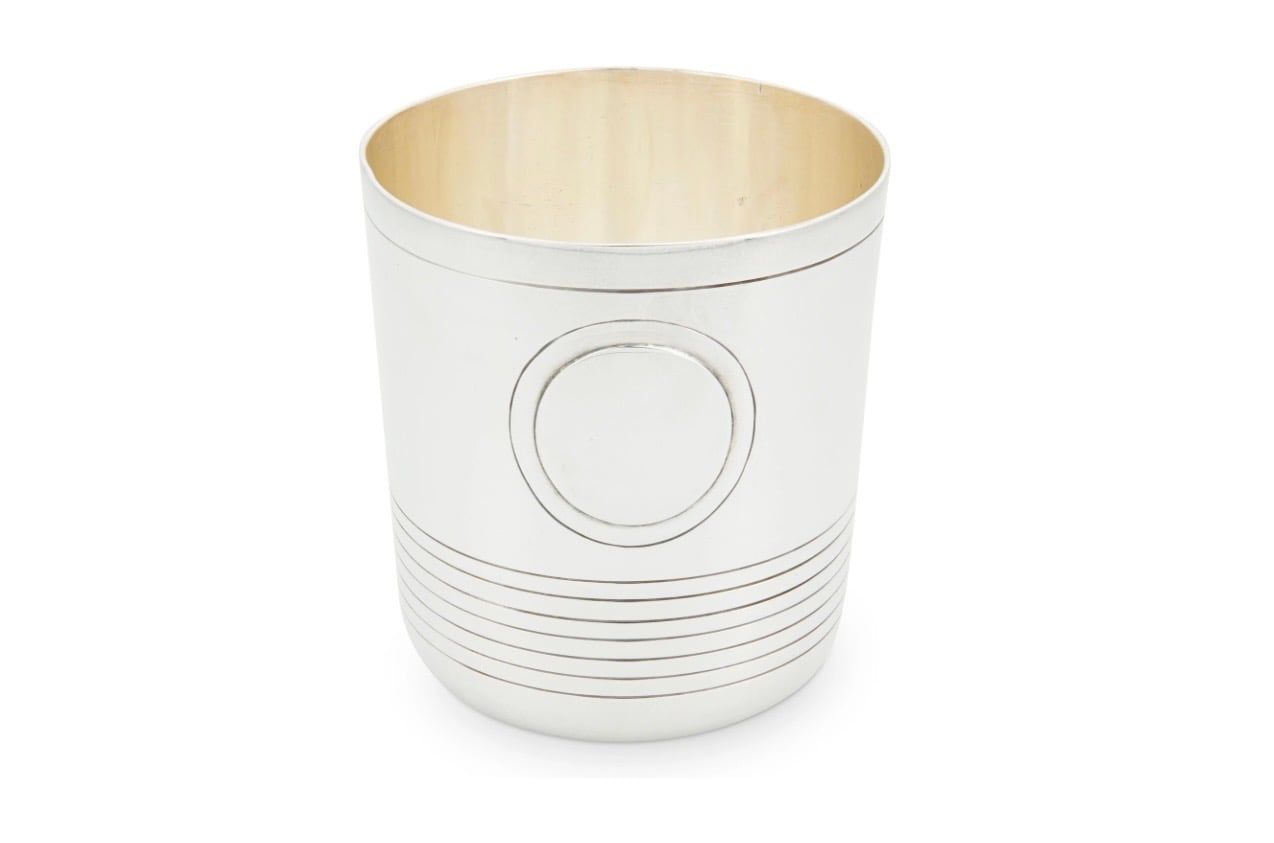
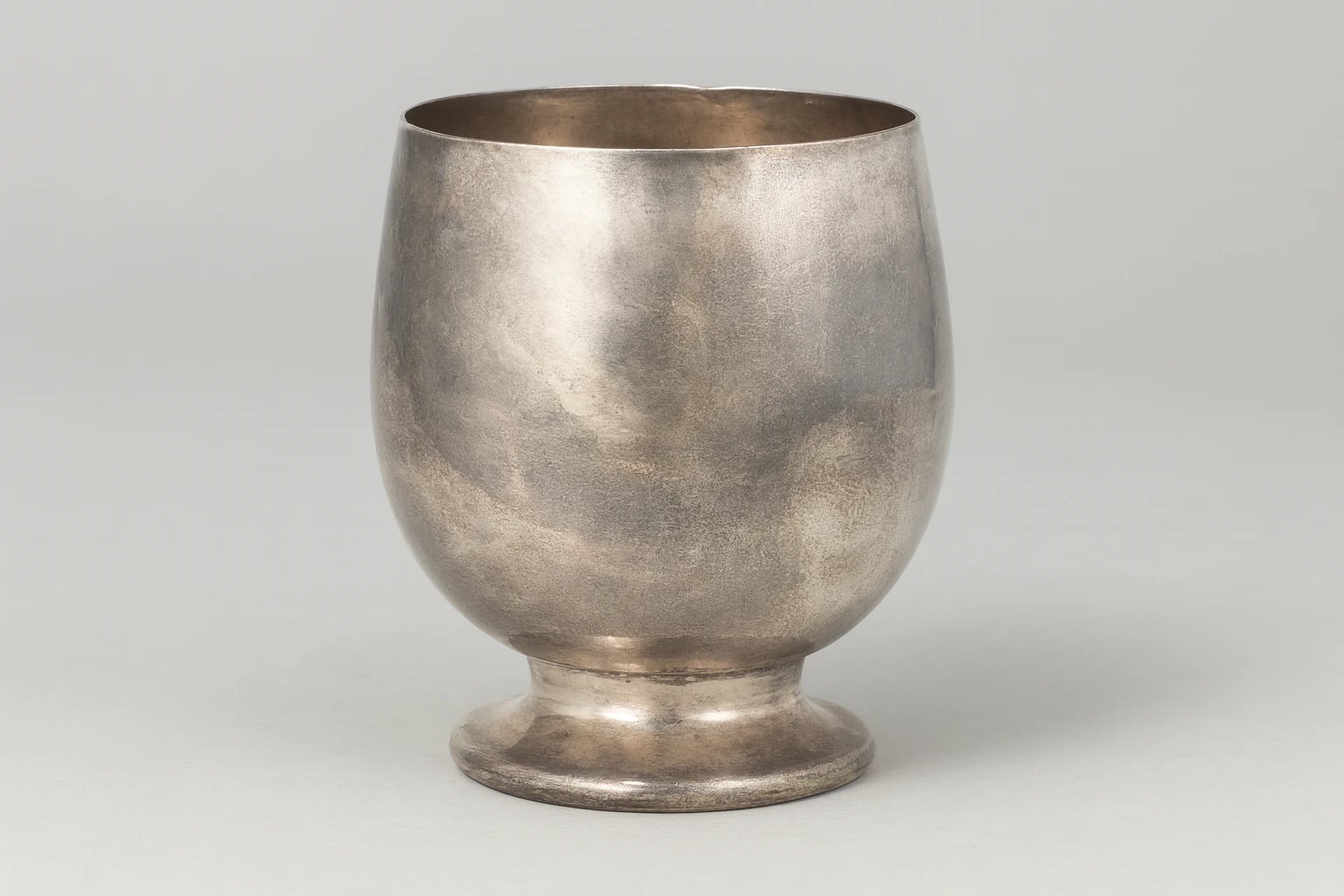
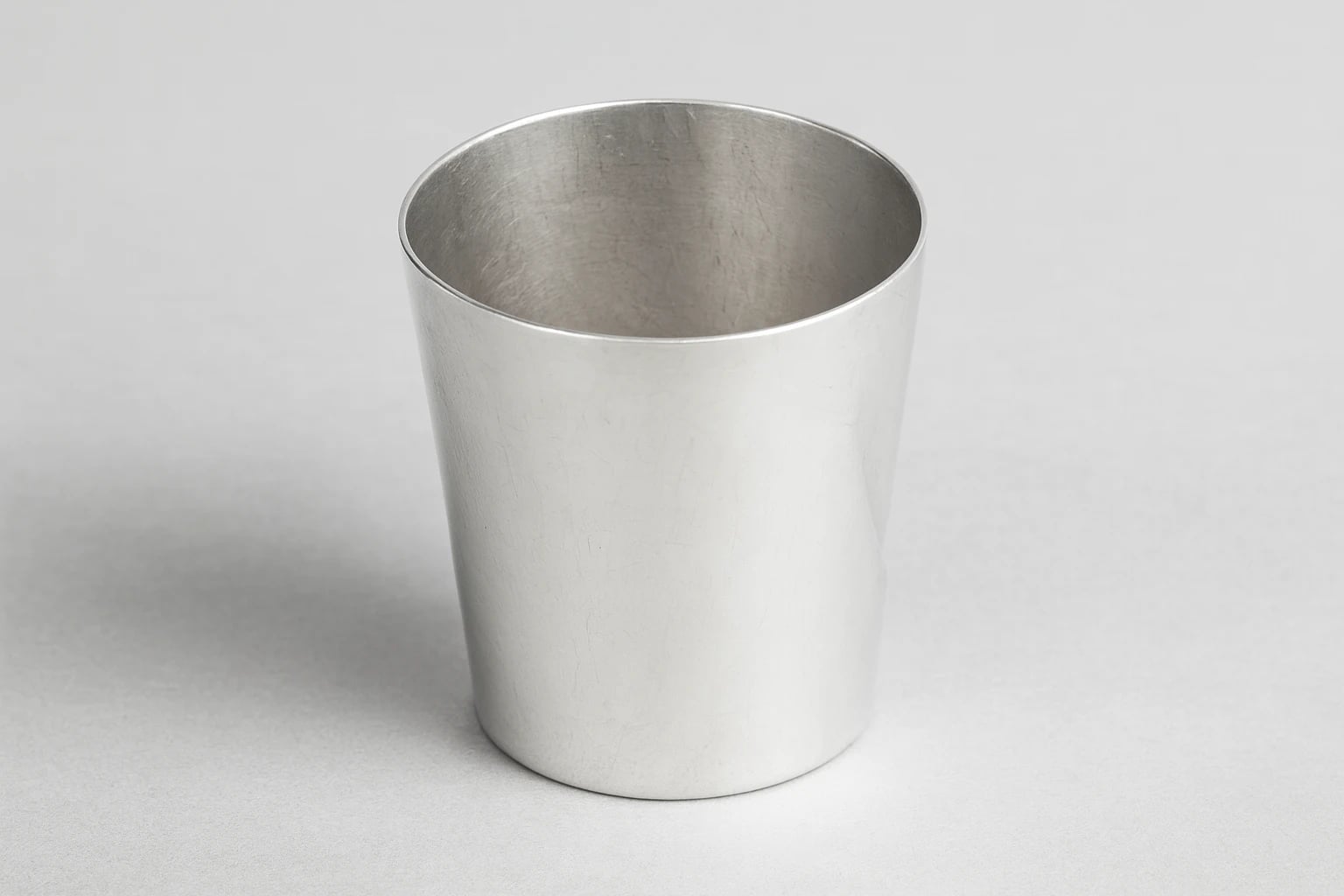
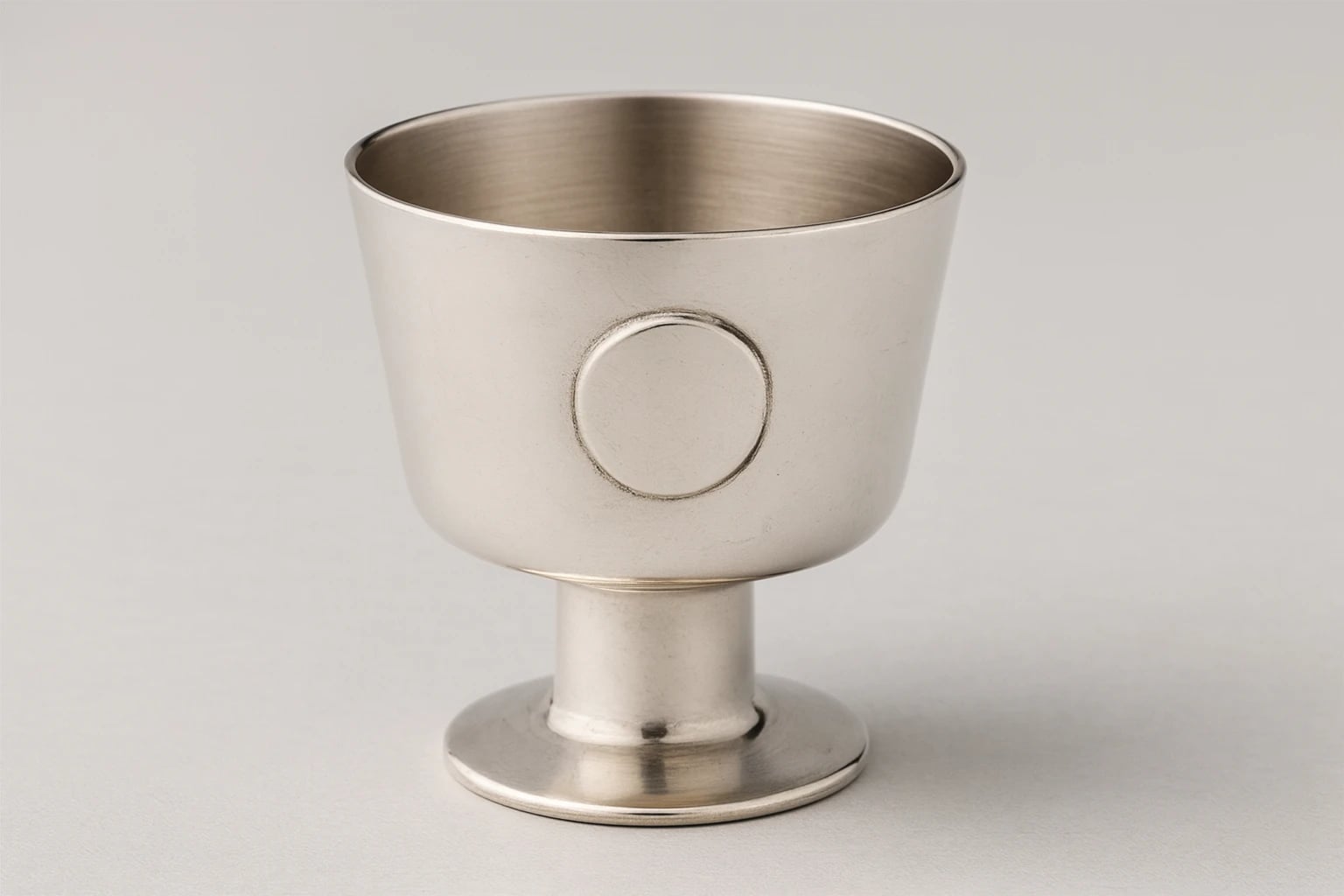
At less than two inches in either dimension, this footed liqueur goblet compresses William Spratling's late tableware vocabulary into one of its smallest formats. The design is reduced to three elements: a flaring cup, a cylindrical stem, and a stepped circular foot, with a single applied silver button as the only ornament visible from any one angle. Three of these buttons are spaced evenly around the perimeter, one at each third, so that the goblet reads the same however it is set down or turned in the hand. The button is not engraved, chased, or set with stone. It is simply a disc of silver soldered to a silver wall, raised just enough to catch light differently from the surface around it. Ornament here is a matter of shadow line and slight relief rather than added material or added imagery.
The proportions do most of the work. The cup is broad relative to its height and tapers gently inward toward the stem, giving the small vessel a stable, almost architectural stance. The foot repeats the circular logic of the buttons and the rim, so the whole object is built from one geometric idea at three scales. This economy is characteristic of Spratling's hollowware in his final decades, when he was designing goblets, candlesticks, flatware, and bells as coherent families of forms (Morrill records this range of models in Mexican Silver). A liqueur goblet of this size, sometimes used as a jigger, had to survive daily handling, and the thickened rim and heavy foot answer that practical demand without disturbing the design's plainness.
The Spratling workshop produced this catalogue number in at least two versions: the present form, with a single button at each third of the perimeter, and a variant carrying a vertical row of three buttons at each of the same three positions. The design appears in Cederwall and Riney's Spratling Silver, and the workshop's own wholesale catalogues track its steady commercial life, priced at $6.40 in 1958 to 1959, $6.80 in 1961, and $7.60 in 1967, the year of Spratling's death. The mark on this example, the round William Spratling legend with Taxco Mexico, script WS, and 925 fineness, corresponds to the circular marks Hougart documents for the workshop's last dozen years, which agrees with those catalogue dates. The design has since been reissued under the post-Spratling revival of the workshop, so the period mark matters for placing this example within the original production.
Objects like this one clarify a side of Spratling's achievement that the famous jewelry can overshadow. He built a workshop that could sustain a full line of useful silver at modest wholesale prices, and he gave even the least expensive items in that line a considered design identity. The goblet's applied button, repeated three times around a plain body, is a complete design decision at the scale of a few dollars. In the Museum's collection it documents both the reach of the taller's production and the consistency of its design standards near the end of Spratling's life.
Museum of Mexican Silver. “Footed Liqueur Goblet.” Catalog no. MoMS-000751. https://museumofmexicansilver.com/pieces/spratling-230
See something wrong with this record? Suggest a correction and the piece details fill in automatically.
William Spratling
Perfectly Plain Shot Cup
First Design Period: 1931 - 1946
Silver