Saves instantly, no account needed. Already a member? Sign in.
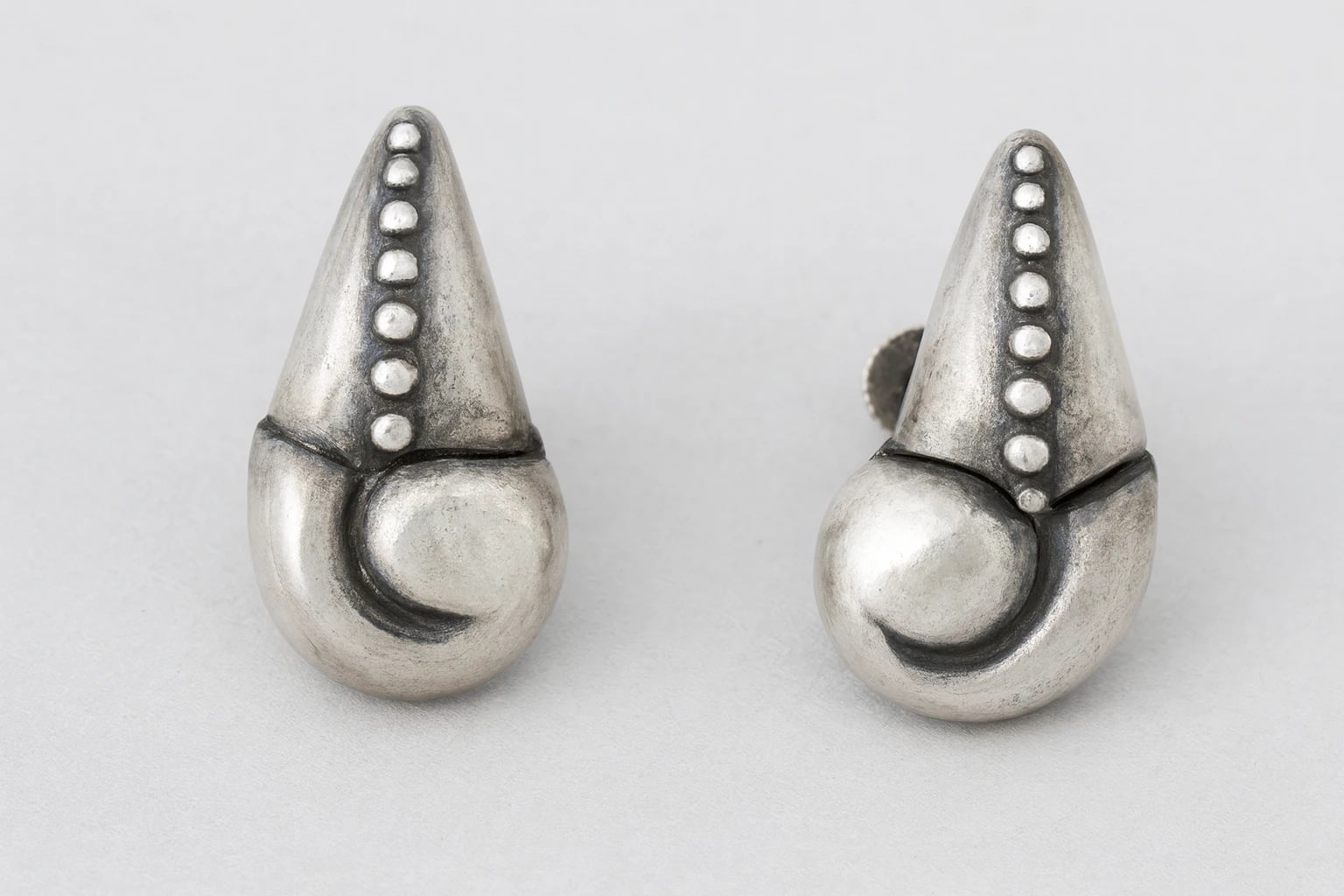
A snail shell, seen from the side and reduced to two joined volumes, gives these small earrings their entire architecture. Spratling built each earring from a tapering cone, the spire of the shell, set against a swelling hemispherical body whorl, and let the junction between the two read as a deep shadowed seam. Along the ridge of the cone runs a graduated line of applied silver beads, largest at the base and diminishing toward the point, so that the granulation traces the same logic of growth that governs a real shell. On the rounded lower volume a single incised spiral curls into itself, oxidized in its recess so the line stays dark against the polished dome. At one inch by five eighths of an inch, the design concentrates a surprising amount of sculptural incident into a form scaled comfortably to the ear, and the screw-back fittings place it within the conventions of mid-century wear.
The earrings belong to Spratling's First Design Period, 1931 to 1946, the years in which the vocabulary of the Taller de Las Delicias was formed. Penny Morrill records that the earliest products of the workshop were simple half-dome earrings, made in the first year from melted 0.925 silver coins, and Spratling himself later described those early designs as almost literal copies of Aztec and Colonial motifs, "a point of departure" for the new work. The Snail Shell design shows what that departure looked like in practice. The half dome persists here as the body of the shell, but it has been joined to a second volume, given a naturalistic subject, and articulated with applied beadwork and engraved line. Rather than transcribing a pre-Columbian seal, the design observes a natural form and translates it into the workshop's emerging language of full, weighty silver volumes with selectively darkened detail.
That combination of techniques is itself informative about how the taller worked. The design requires forming two hollow volumes, joining them cleanly enough that the seam becomes an intentional dark line rather than a flaw, applying a row of individually placed beads in careful gradation, and controlling oxidation so that shadow falls exactly where the design needs it. These are the skills of trained silversmiths executing a designer's conception, the collaborative structure that, as the scholarship on Taxco's Silver Age has emphasized, made innovation and experimentation central to the workshops rather than incidental to them. The Spratling hallmark with the conjoined initials and the Made in Mexico legend places the pair firmly within the workshop's production and its export market, the growing audience of American visitors and buyers whose appetite for Mexican design the taller both served and helped create.
Museum of Mexican Silver. “Snail Shell Earrings.” Catalog no. MoMS-000096. https://museumofmexicansilver.com/pieces/spratling-2404
See something wrong with this record? Suggest a correction and the piece details fill in automatically.
Within a collection tracing the Mexican silver renaissance, the Snail Shell Earrings document a specific and important moment: the point at which Spratling's designs moved from archaeological quotation toward independent invention grounded in observed form. The spiral, the graduated bead, and the swelling dome would remain constants of Taxco design for decades, in Spratling's own later work and in that of the designers who passed through Las Delicias. Here those elements appear early, at intimate scale, and already fully coordinated, a compact record of a design language in the act of becoming its own.
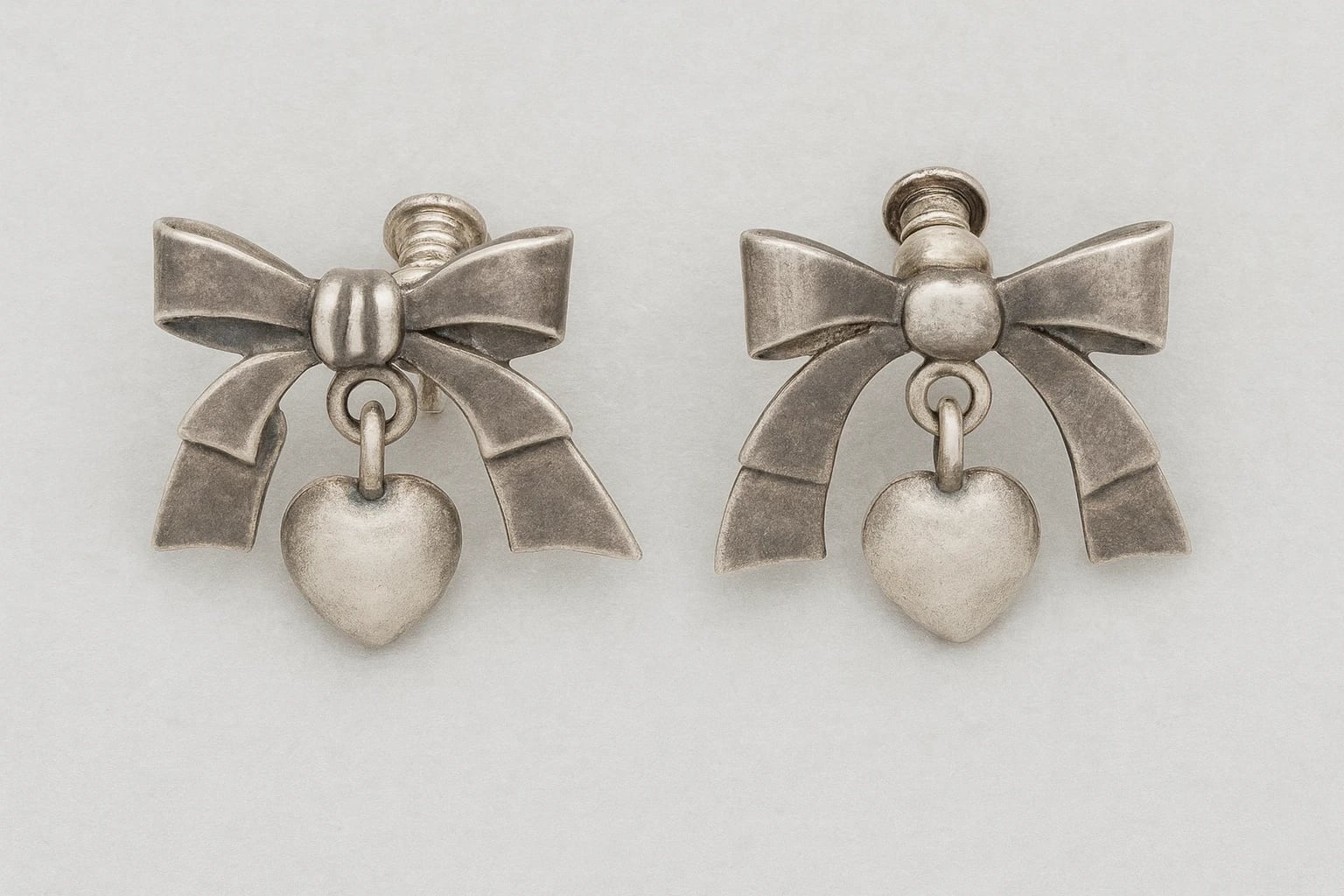
Bow and Heart Earrings
Silver