Saves instantly, no account needed. Already a member? Sign in.
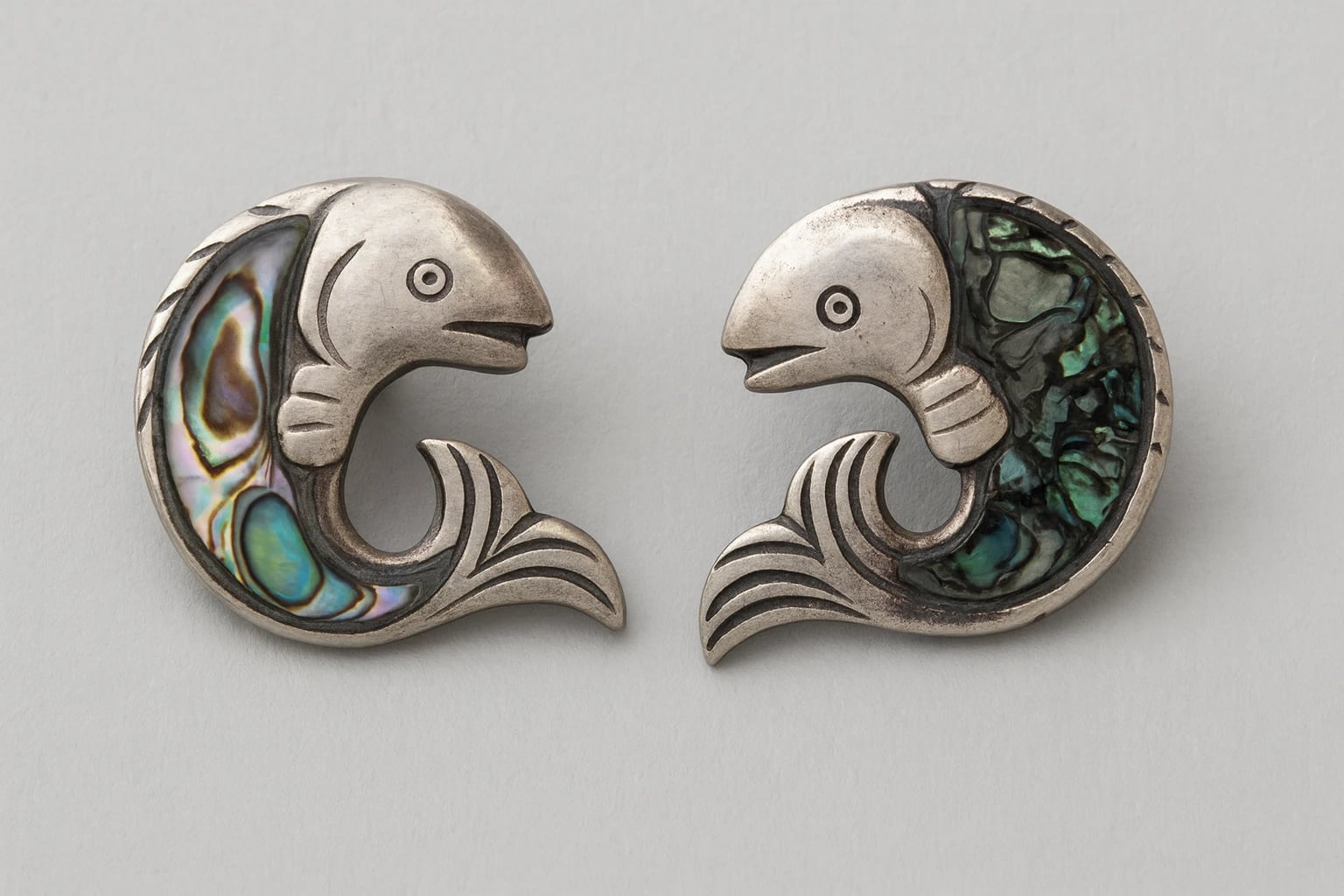
A carved abalone fish, its body set into a slim silver frame and fastened with a toggle back, gives these cuff links their character. The shell does the work of both color and drawing: its shifting blue and green iridescence supplies the scales and sheen of a living fish, while the silver reads as a spare outline holding the form together. Spratling used this fish motif across several small objects during his Third Design Period, adapting it to cuff links, earrings, and a pin, and offering it in two material registers, tortoise shell with silver or abalone with silver. The abalone version was priced higher than the tortoise shell in his wholesale catalogues, a distinction that reflects the material rather than any change in the design itself.
The toggle back is the practical intelligence of the pair. Rather than a fixed post or a hinged bar, the toggle pivots to pass through the cuff and then settles crosswise to hold, a fastening that stays flat against the wrist and keeps the ornamental face forward. This lets the fish sit as a clean, self-contained image on each side, with the shell filling the whole of the visible field and the silver confined to its edge. Abalone, unlike an opaque stone, changes with the angle of light, so a small movement of the hand shifts the color across the fish. The design depends on that responsiveness: the shell is not a decorative infill but the element that animates the motif.
Spratling's fish belongs to the vein of animal subjects he pursued alongside his better known Aztec-derived work, the parrots, owls, and jaguars that Penny Morrill sets apart from the colonial-flavored jewelry designed for him by others. Where those larger pieces trade on mass and silhouette in silver, the fish cuff links show him working at the scale of a men's furnishing accessory, where the shell carries the image and the metal recedes. The Third Design Period placed such objects within an expanding wholesale operation, and cuff links were among the small, repeatable forms that talleres across Taxco produced in quantity for American and tourist buyers during these years. Spratling's decision to offer the same fish in two materials at two price points is consistent with that catalogue-driven practice.
Within a collection, the pair documents how Spratling translated a single motif into a wearable, serially produced object and let an inexpensive local shell, rather than silver alone, define its color and light. The higher catalogue price for the abalone version records a real preference among buyers for the iridescent shell over tortoise. As a compact example of the fish design in its more costly material, executed with a toggle back suited to daily wear, the cuff links show the Taxco renaissance operating at the modest scale of men's accessories, where design and material choice mattered as much as they did in the workshop's larger pieces.
Museum of Mexican Silver. “Abalone Fish Cuff Links.” Catalog no. MoMS-000620. https://museumofmexicansilver.com/pieces/spratling-3072
See something wrong with this record? Suggest a correction and the piece details fill in automatically.
William Spratling
Obsidian Oval Cuff Links
Silver