Saves instantly, no account needed. Already a member? Sign in.
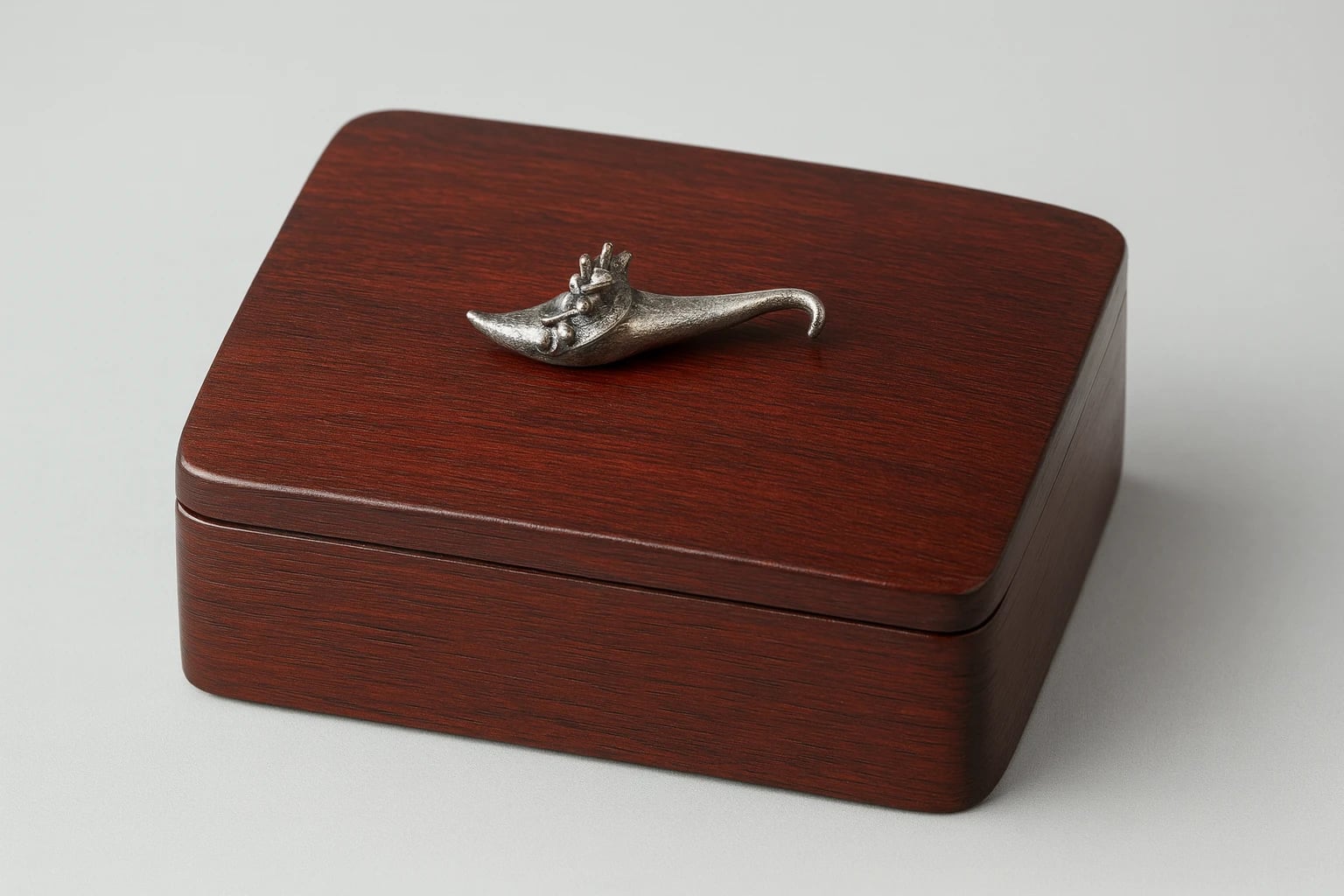
A shallow concave well cut into the top of the box gathers the eye toward a single inset ornament: a conch shell worked in silver and set with amethyst. Everything else is quiet. The rosewood is left to speak through its own grain and density, and the lid lifts free without hinge or clasp, so the box is held together by fit and weight rather than mechanism. The concentration of incident at the center, against so much unbroken wood, is the design's central proposition. Spratling withholds decoration everywhere so that one passage of silver and violet stone can carry the whole surface.
The material contrast does the work here. Rosewood is warm, dense, and opaque, and it absorbs light where silver returns it, so the inset shell reads as a bright event surrounded by shadowed grain. Setting the ornament into a concave depression rather than raising it above the surface is a deliberate reversal: the eye falls inward toward the shell instead of climbing over a boss, and the amethyst sits protected within the hollow. The conch itself is a spiral form, a natural logarithm of growth, and rendering it in silver against wood turns a soft organic subject into a hard reflective one. The detachable lid keeps the object honest to its purpose. It is a container first, and the ornament is the reward for opening it.
This combining of rosewood and silver belongs to a specific current in Spratling's third design period, when he pared objects to their simplest outline and let contrasting materials carry the meaning. Nicholas Morrill has described the tortoiseshell and silver boxes of these years, the silver dots inlaid on wood, and the butter dish reduced to its plainest form, all evidence of a designer more interested in textural interplay than in narrative. The same instinct for material warmth against reflective metal aligns Spratling with Jean Puiforcat, whose French silver of the 1920s and 1930s used rosewood and alabaster finials to soften geometric form. Morrill draws that comparison directly, noting the geometric approach to form the two men shared. The conch shell also connects the box to Spratling's long habit of drawing on Mexican sources without illustrating them literally, treating a motif as pattern and surface rather than as symbol.
For a collection, the box demonstrates that Spratling's modernism extended well beyond jewelry into the domestic object, and that his most disciplined statements often came through restraint rather than display. It records a moment when a Taxco workshop could treat a wooden box as a serious design problem, resolving it through the meeting of two materials and a single ornament placed with exactness. The result asks the viewer to value silver not for its quantity but for the precision of its placement, which is among the harder lessons the Mexican silver renaissance had to teach.
Museum of Mexican Silver. “Rosewood Box with Detachable Lid.” Catalog no. MoMS-000739. https://museumofmexicansilver.com/pieces/spratling-806
See something wrong with this record? Suggest a correction and the piece details fill in automatically.
William Spratling
Rectangular Box with Gold Beads
Silver