Saves instantly, no account needed. Already a member? Sign in.
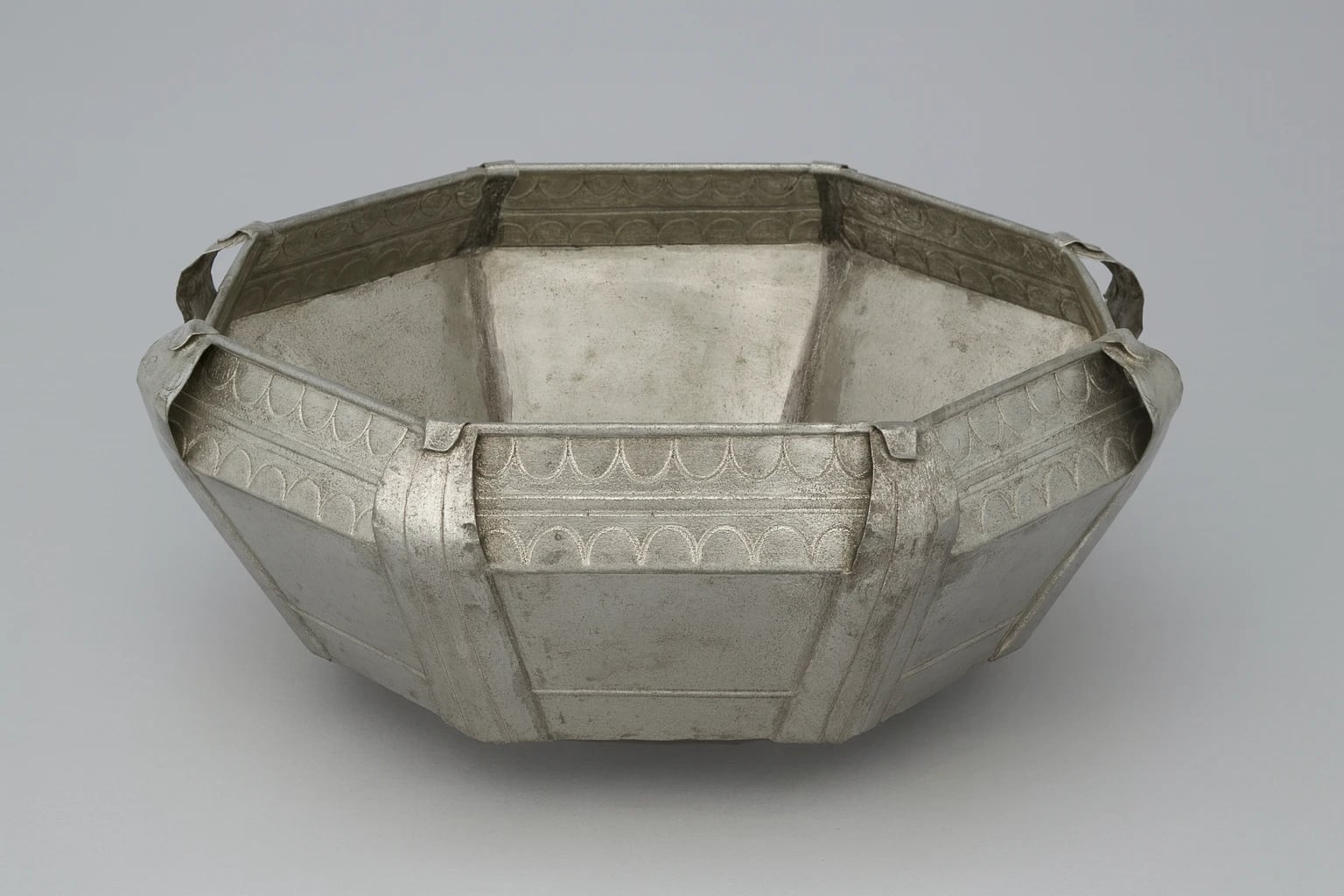
Spratling's tin bowl converts an inexpensive, ductile metal into a disciplined eight sided form, holding the octagon steady across a wide, shallow vessel. The choice of tin over silver places the object at the working edge of the Taller de Las Delicias, where Spratling extended his design vocabulary into copper, wood, and tin alongside the silver that made his reputation. In a shallow bowl of this size, the eight sided plan is not a decorative flourish. It organizes the entire rim into a sequence of straight segments that meet at angled joints, so that the piece reads as faceted geometry rather than as a turned circle.
The form depends on how the flat facets resolve into a functional basin. Each of the eight sides rises from the base as a distinct plane, and the transitions between them give the wall a rhythm of shallow angles instead of a continuous curve. Tin takes and holds this kind of planar shaping well, and its soft, low reflectivity suits a surface built from broad flats rather than the mirror finish associated with polished silver hollowware. The result is a bowl whose interest lies in silhouette and the play of light across angled planes, an approach consistent with the interplay of curved and faceted surfaces that Mexican designers of this period pursued in vessels of many materials.
The mark for Spratling tin, recorded by Hougart as reading Taxco WS Mexico, was in use across the years 1931 to 1946, the span the Museum assigns to Spratling's first design period. That places this bowl within the founding decades of the taller, when Spratling was building both a market and a workshop system capable of producing silver and non silver objects to a consistent standard. The taller operated as a collaborative structure in which Spratling set the designs and directed execution while trained smiths carried out the fabrication. A tin bowl of this scale belongs to that program of extending a single design sensibility across materials of very different cost and status, a practice that helped the workshop reach a broader public than silver alone could serve.
Tin objects from the first period survive less often than the silver that collectors have long tracked, in part because tin was treated as everyday material rather than as something to be preserved. Documented in Goddard's field guide to Spratling's work, this bowl records how the Taller de Las Delicias applied its geometric discipline to a humble metal, and it enlarges the account of Spratling's output beyond the jewelry and hollowware for which he is best known.
Museum of Mexican Silver. “Large Eight Sided Tin Bowl.” Catalog no. MoMS-000899. https://museumofmexicansilver.com/pieces/spratling-81
See something wrong with this record? Suggest a correction and the piece details fill in automatically.
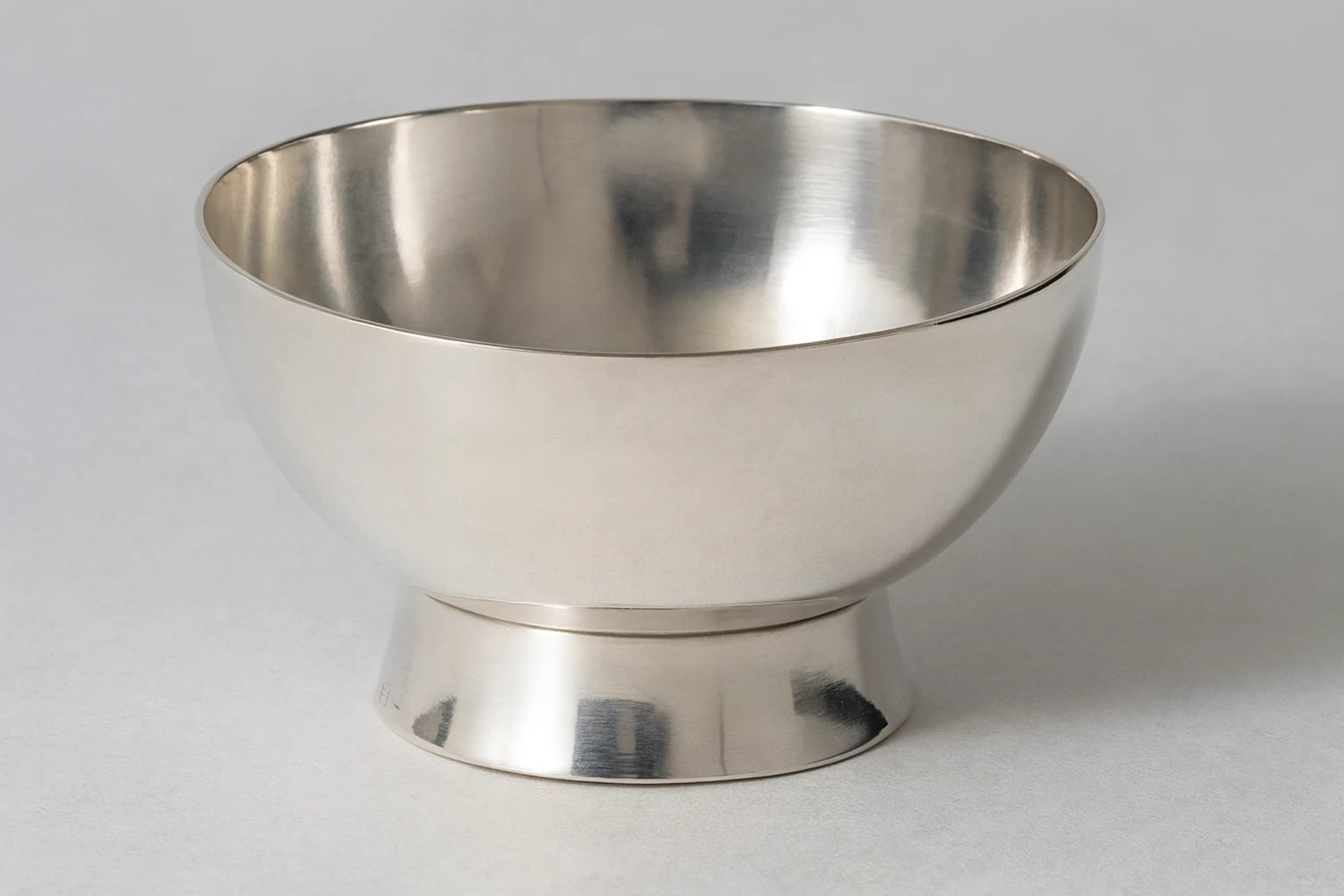
Three Tab Silver Bowl
First Design Period: 1931 - 1946
Silver