Saves instantly, no account needed. Already a member? Sign in.
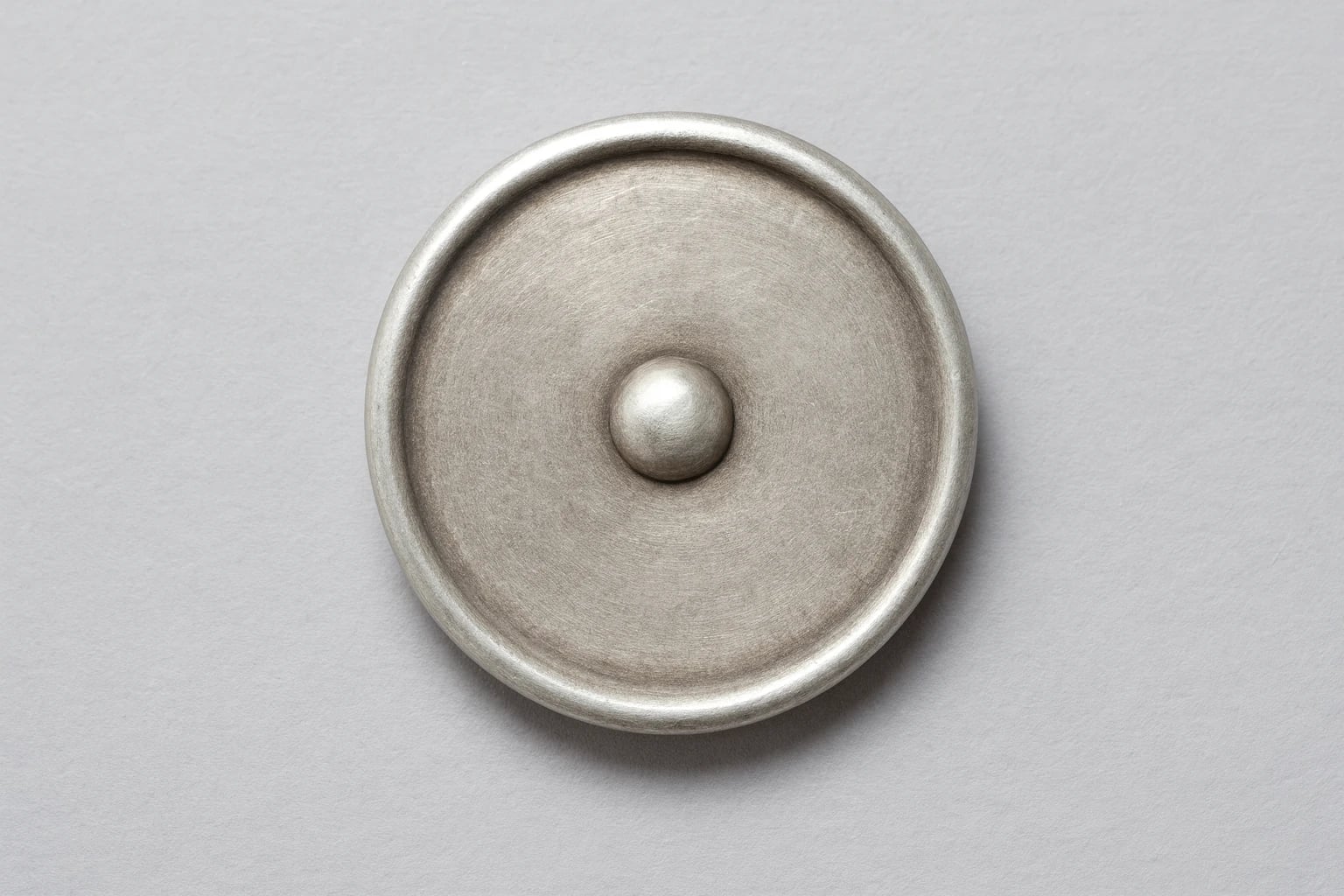
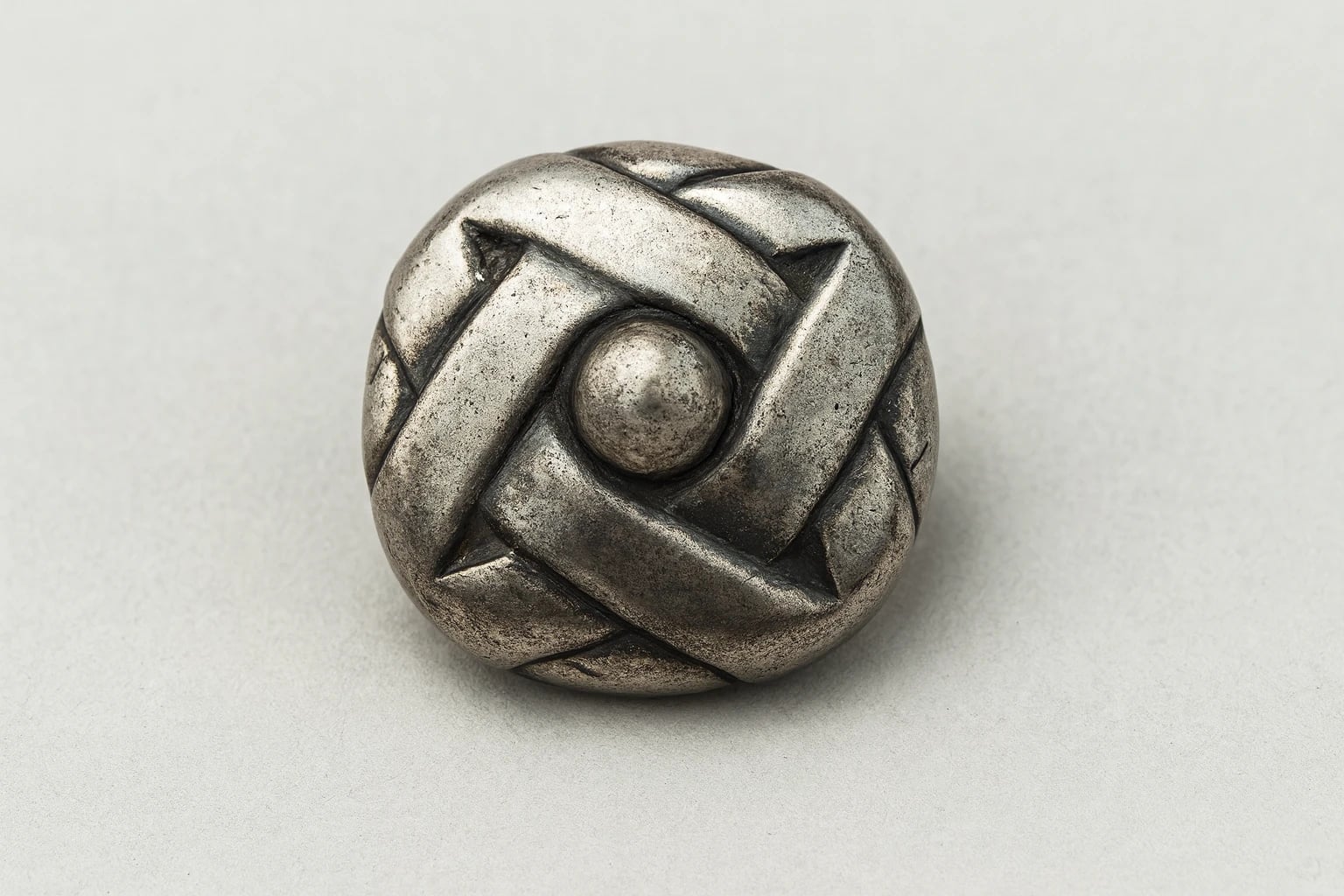
A single button holds a woven basket of silver straps closed around a raised ball at its center, a design that treats a functional fastener as a small exercise in geometry and reflection. The straps cross over and under one another in a tight plaited grid, and the polished ball at the middle interrupts that flat weave with a curve that catches light differently from every angle. The result is an object that reads as ornament and mechanism at once, resolving a practical problem through pattern rather than concealing it.
The weave is the design's organizing idea. Each strap passes across its neighbors in a regular over-under rhythm, so the surface breaks light into a fine checker of bright and shadowed facets. Against that busy, low-relief field, the central ball supplies a single dominant highlight and a clear focal point, giving the eye somewhere to rest. The straps appear to gather toward the center and terminate at the ball, which both anchors the composition visually and marks the button's working center. Silver suits this treatment well: its reflectivity turns the alternating planes of the weave into a play of light that a matte material could not produce, and the contrast between the flat plaited ground and the rounded boss depends entirely on how the metal takes and returns illumination.
The button belongs to William Spratling's first design period, the years between the 1931 founding of the Taller de Las Delicias and the mid-1940s, when the workshop was reorganizing and expanding silver production in Taxco and building the international markets that helped catalyze the broader silver renaissance. Spratling's work in these years frequently drew on braided, plaited, and woven motifs adapted from Mexican popular craft, translating forms familiar from textiles, leather, and basketry into silver. A button was rarely an isolated object in this practice: it functioned as a component of larger garments and accessories, and Spratling's attention to such fittings reflects the taller system in which designers worked closely with master smiths who could execute a small, exacting form in quantity. The plaited strap here should be understood as part of that vocabulary rather than as a singular invention.
Small fittings like this one are easy to overlook in accounts of the Taxco School, which tend to concentrate on ambitious necklaces, bracelets, and hollowware. Yet a button carries the same design intelligence at reduced scale, showing how a workshop applied a consistent formal language across objects of every size and purpose. This example documents Spratling's early interest in woven pattern and his willingness to make ornament out of a purely functional element, and it preserves a modest but characteristic instance of how the first-period taller thought about surface, light, and structure.
Museum of Mexican Silver. “Woven Strap Button.” Catalog no. MoMS-000079. https://museumofmexicansilver.com/pieces/spratling-835
See something wrong with this record? Suggest a correction and the piece details fill in automatically.
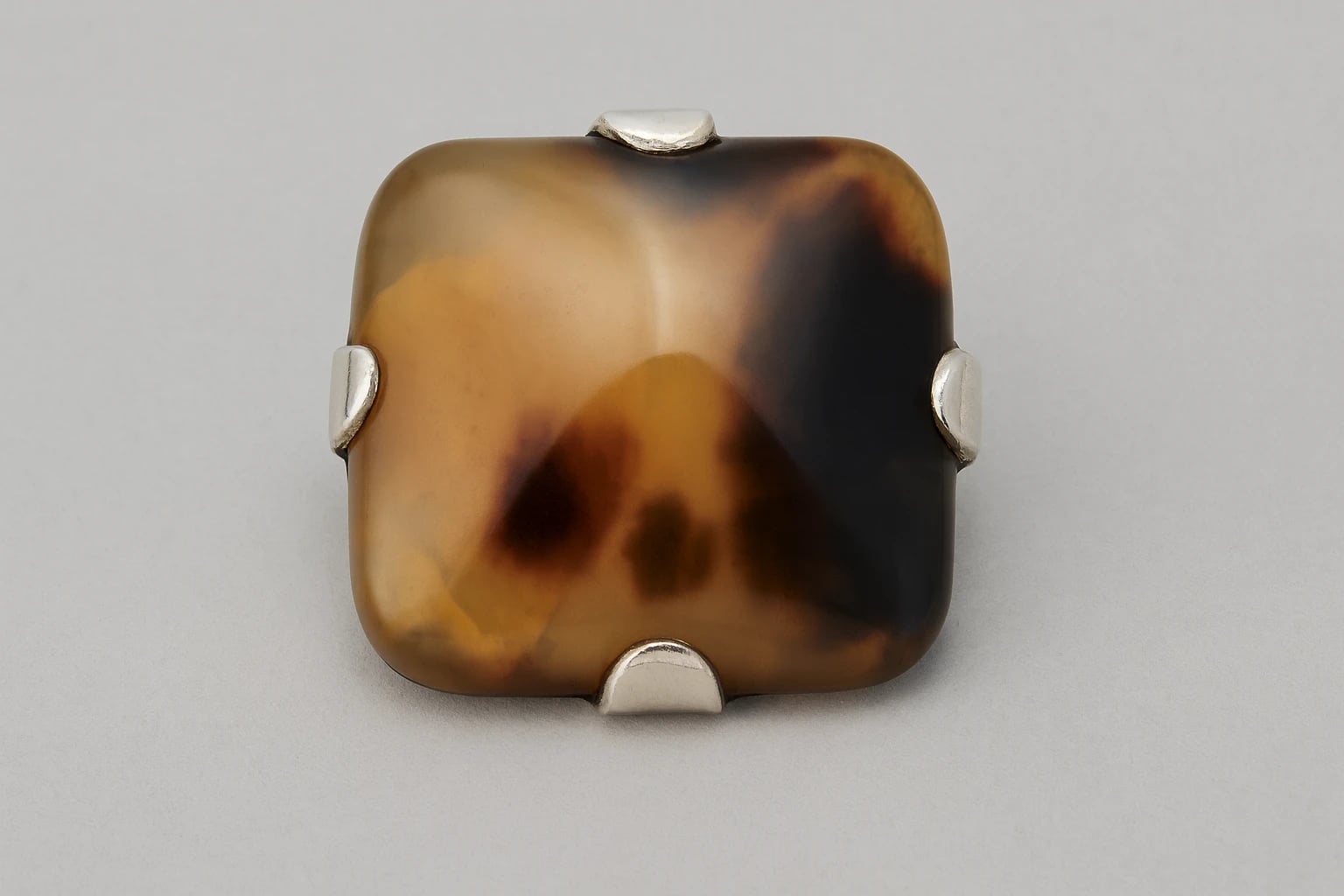
Square Tortoise Shell Button
Tortoise Shell