Saves instantly, no account needed. Already a member? Sign in.
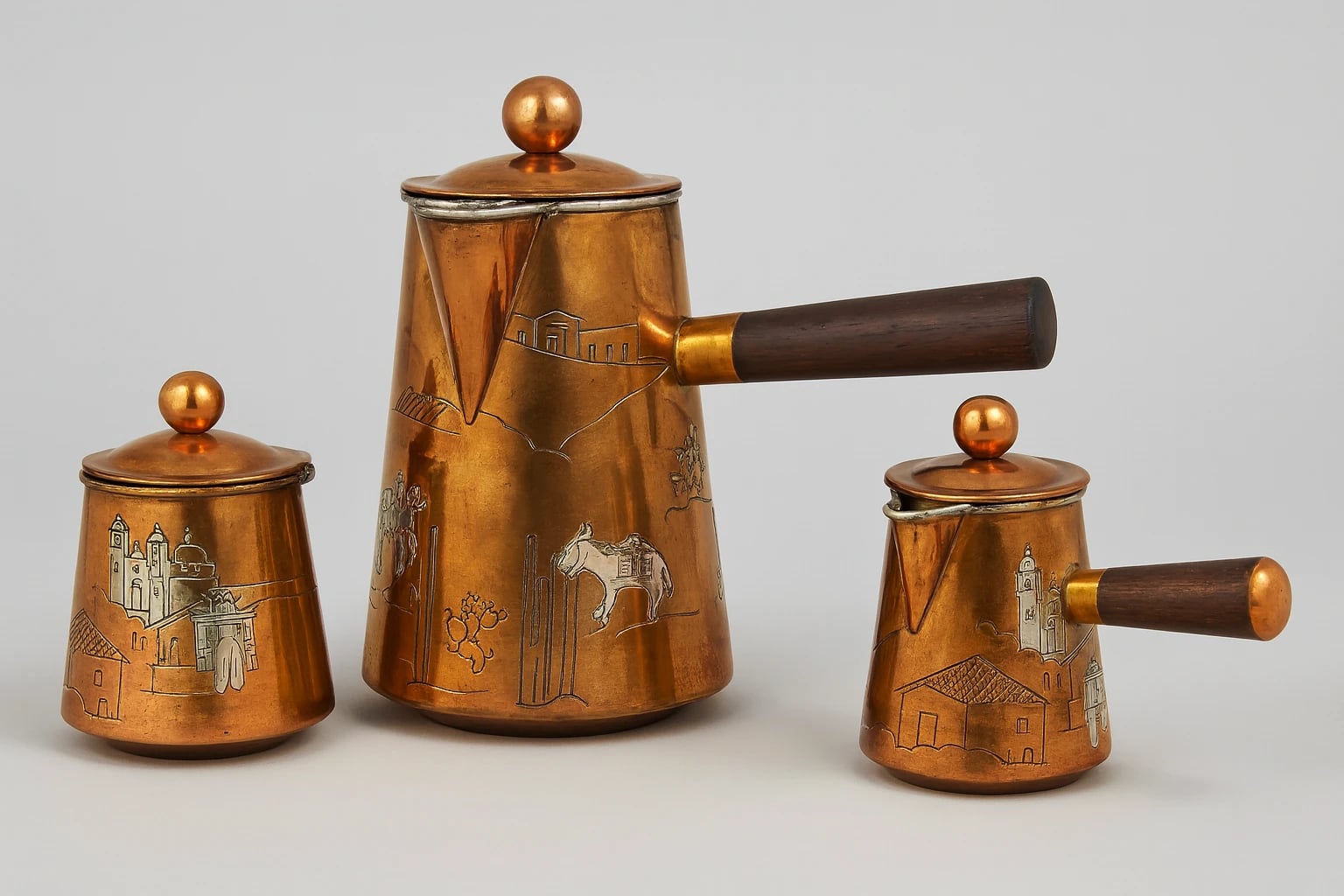
The tea set turns the daily rituals of pouring, sweetening, and serving into a small copper panorama of Taxco. Across the tapered bodies of the teapot, creamer, and sugar bowl, engraved streets, church towers, figures, animals, and hillside buildings wrap the vessels as continuous scenes rather than isolated decoration. Santa Prisca appears as part of this civic imagery, placed within the same visual world as a horse, a pedestrian, roofs, plants, and mountain paths. The result is not a souvenir view transferred onto hollowware, but an inhabited landscape organized around the forms of the set.
The bodies depend on clear modern geometry. Each vessel rises from a broad base to a narrower mouth, with lids set low and spherical knobs catching the same warm reflection as the copper walls. The teapot and creamer extend horizontally through cylindrical wooden handles, which cool the hand and visually steady the burnished metal. Sterling figures and engraved line work interrupt the copper surface with bright passages of silver, so that Taxco is drawn through contrast: pale metal against red metal, incision against reflection, narrative detail against disciplined volume. The decoration follows the vessels without denying their function. It bends around curvature, pauses at handles and lids, and lets the steep sides carry the town like a turning frieze.
Marked with the circular Victoria Taxco stamp, the Cony script mark, and design number 269, the set belongs to the Victoria and Cony period of Ana Núñez de Brilanti’s production, dated in the museum record to 1958 to 1975. That later Victoria history matters here. Brilanti had opened Platería Victoria in Taxco in 1940, and the workshop became especially associated with silver on copper and other mixed-metal work. Contemporary and later accounts emphasize that her designs were executed by trained silversmiths under her direction, a reminder that Victoria hollowware came from a taller structure in which design authority, technical skill, and controlled production were closely joined. Cony, named for Brilanti’s daughter, continued that vocabulary in the period when this set was issued.
Within the Mexican silver renaissance, the set is especially useful because it expands the history of Taxco modernism beyond jewelry. Its ambition lies in applying Victoria’s material intelligence to domestic hollowware at a scale large enough for architectural and figural narrative. The teapot measures 7 1/4 inches, the creamer 5 1/2 inches, and the sugar bowl 5 1/4 inches, a compact service, but one that carries a full urban identity. Copper supplies warmth and breadth, sterling supplies sharpness and highlight, and wood gives the pouring pieces a measured horizontal extension. Together they show how Brilanti’s workshop could make the table a site of modern Mexican design: functional, pictorial, technically controlled, and rooted in the place whose silver renaissance it helped define.
Museum of Mexican Silver. “Santa Prisca Scenes Copper Tea Set.” Catalog no. MoMS-002336. https://museumofmexicansilver.com/pieces/victoria-brilanti-tea-set
See something wrong with this record? Suggest a correction and the piece details fill in automatically.
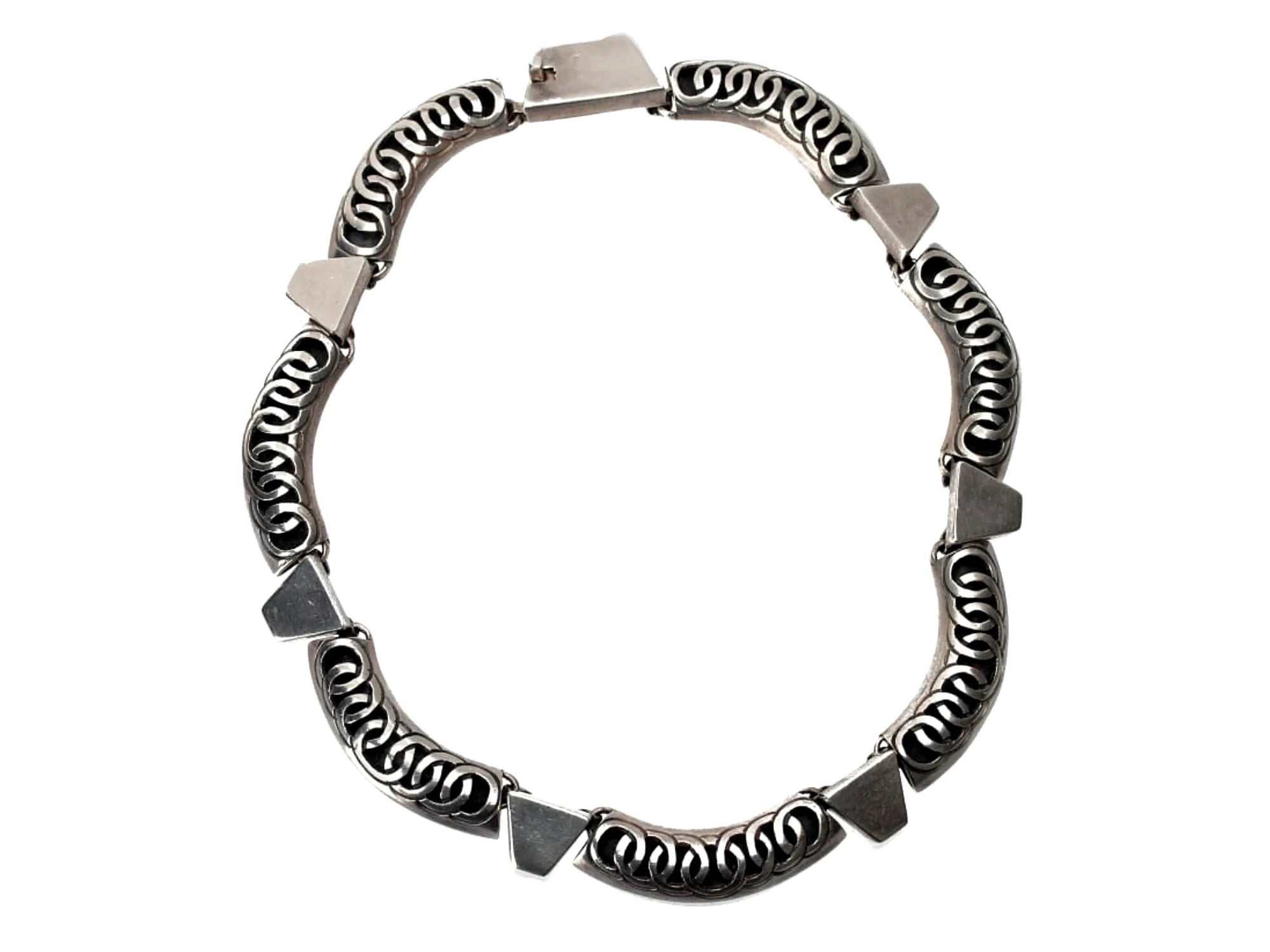
Ana Núñez Brilanti (Victoria de Taxco)
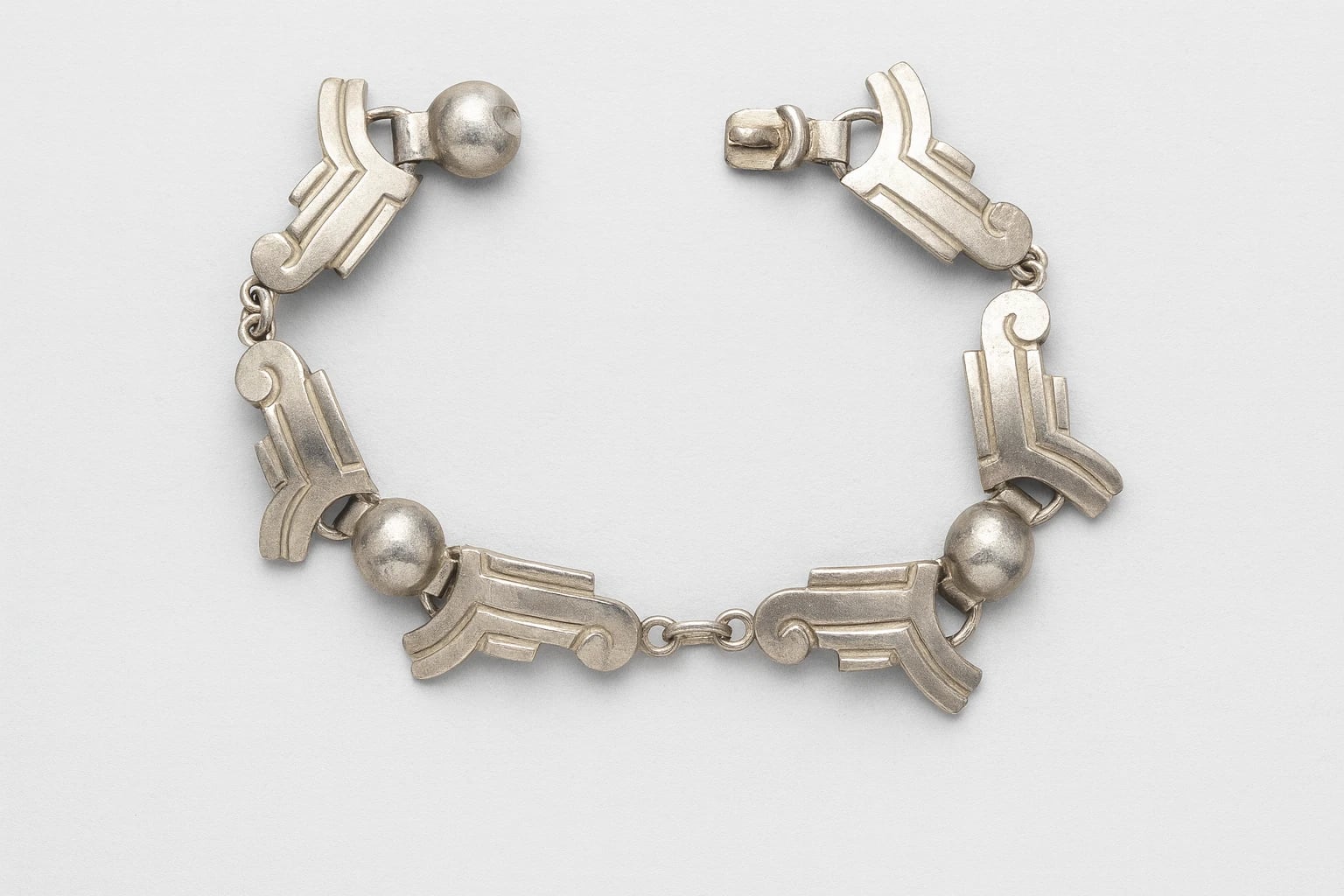
Design 62 Scroll Link Necklace
Sterling silver