Saves instantly, no account needed. Already a member? Sign in.
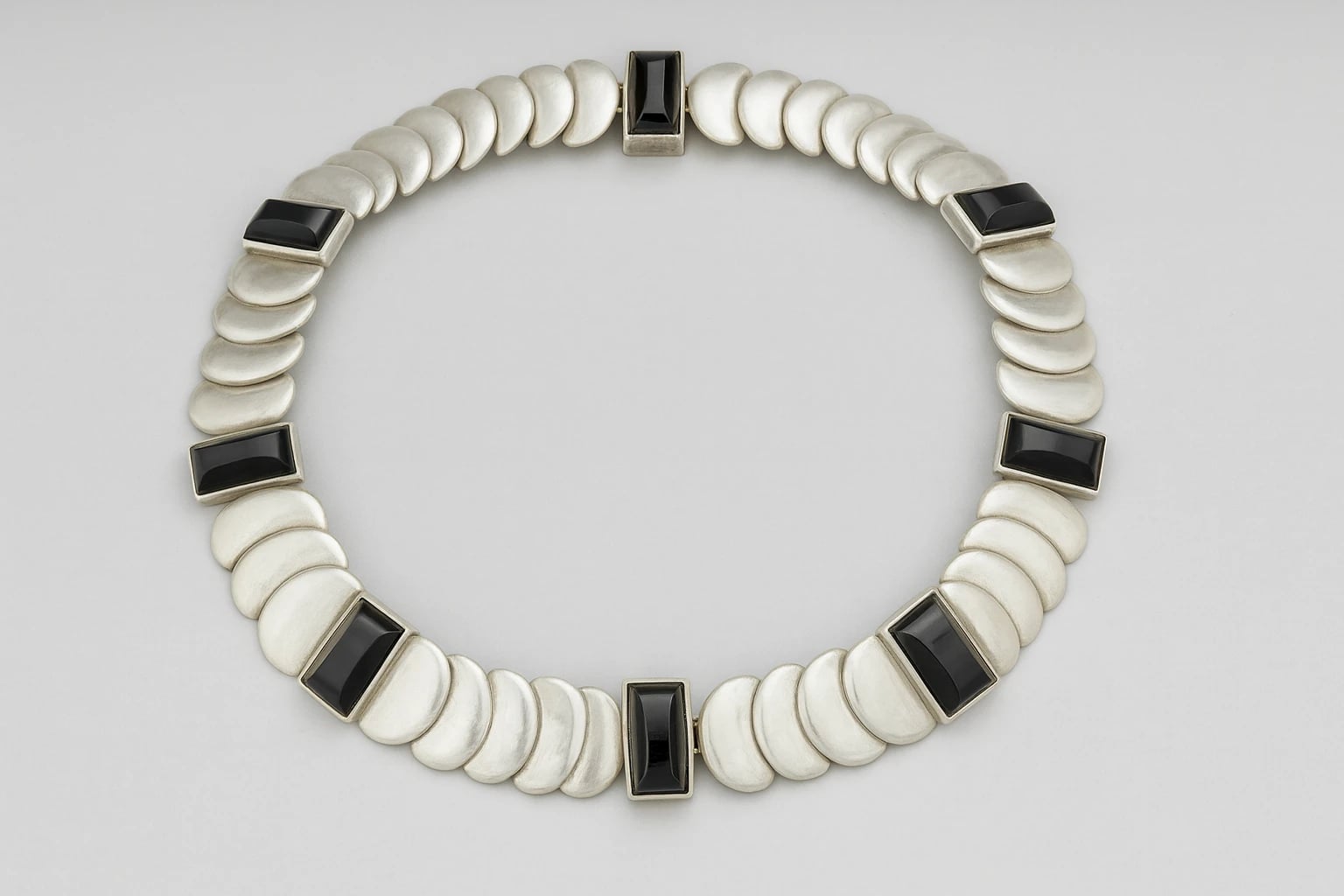
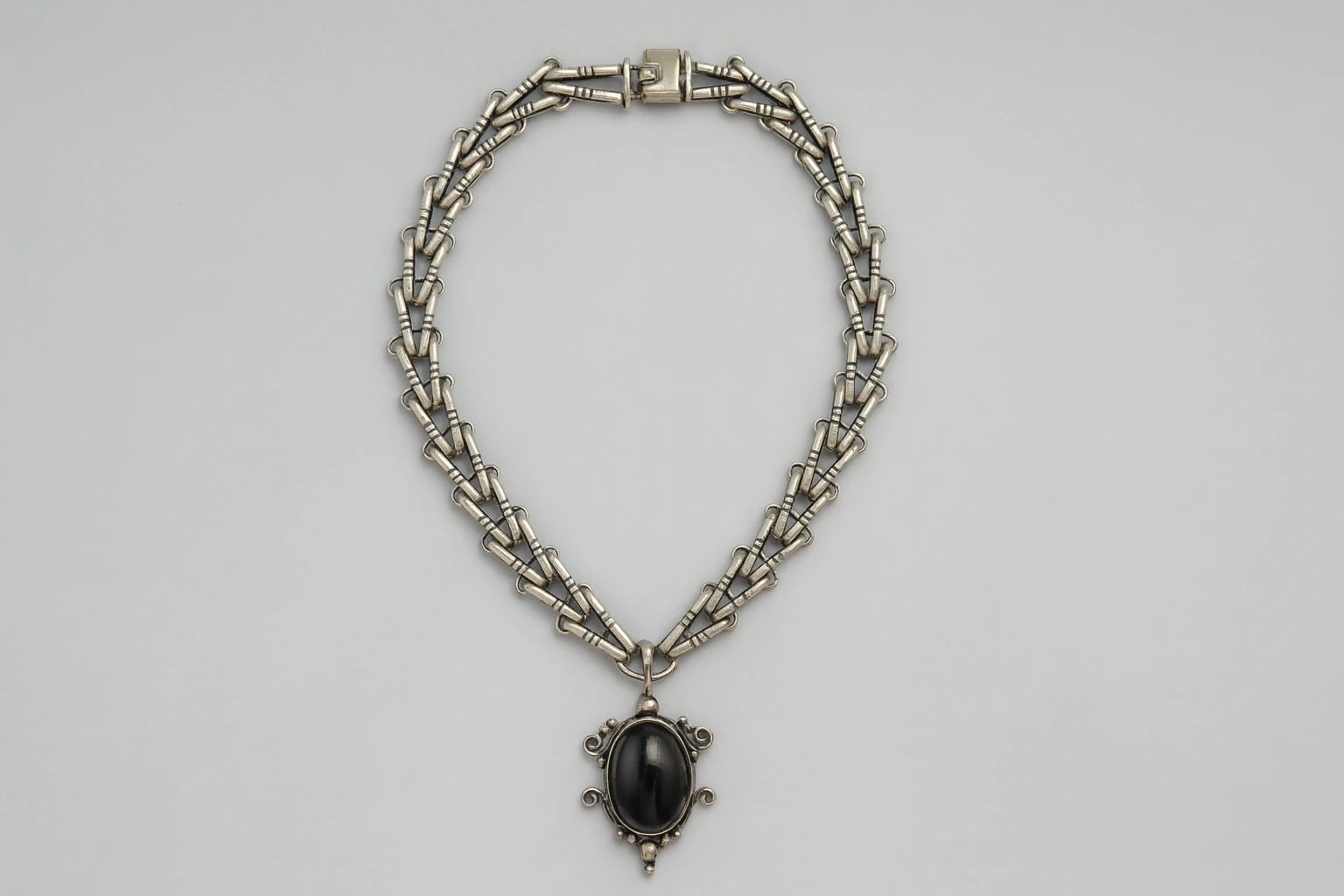
A row of onyx masks, each carved with the flat cheekbones and lidded eyes of a Mesoamerican face, alternates with plain silver links to form this necklace by Héctor Aguilar. The stone is worked as sculpture rather than as a mounted gem, and the black onyx sets its matte darkness against the reflective metal in a steady visual beat. What distinguishes the design is its restraint. The masks are stylized to a few carved planes, and the silver that joins them is left broad and simple, so the necklace reads as a procession of quiet faces rather than as an assembly of ornament.
The construction is organized around alternation and hinge. Carved onyx elements and silver flanges are linked in sequence so that the piece follows the curve of the neck and moves with the wearer. This alternating mask-and-flange principle has a documented precedent in the Taxco circle: Frances Grant Morrill records necklaces of alternating carved masks and embossed, hinged silver forms associated with Fred Davis and the designer Valentin Vidaurreta, whom Aguilar knew and later described as a designer and producer for Davis. Aguilar's version translates that idea into his own vocabulary, favoring weight and plain surface over embossed detail. The onyx carries the imagery while the silver carries the rhythm, and the two materials divide the labor of the design between color and structure.
Aguilar left William Spratling's Taller de Las Delicias in 1939 to open his own shop, Taller Borda, in Taxco, and the design period assigned to this necklace spans the working life of that enterprise. His documented marks move across those years from the early conjoined-HA and Taxco stamps of the early 1940s to the eagle 9 assay marks used from 1948 onward, with 940 silver a recurring fineness in the authentic record. The mask motif belongs to the broader postrevolutionary interest among Taxco makers in ancient Mexican imagery, drawn here toward the sculptural face rather than toward architectural fret or glyph. Aguilar's characteristic preference for solid, plainly finished silver gives the design a heavier, more grounded presence than the lighter embossed treatments of the Davis workshop.
Within a collection, the necklace documents how a single design idea, the alternation of carved stone masks with silver links, traveled and changed hands among the makers of the Taxco renaissance. It also records Aguilar's independent handling of a motif with roots in the Davis and Vidaurreta orbit, showing his own emphasis on mass and material contrast. Because Aguilar designs have been reproduced in recent years with legitimately acquired hallmarks affixed to new work, evidence of genuine age and long handling matters for any example of this type, and the museum record for this necklace should be read with that caution in mind.
Museum of Mexican Silver. “Onyx V Necklace.” Catalog no. MoMS-001362. https://museumofmexicansilver.com/pieces/aguilar-necklace-onyx
See something wrong with this record? Suggest a correction and the piece details fill in automatically.
Héctor Aguilar
Maguey Necklace
Sterling silver