Saves instantly, no account needed. Already a member? Sign in.
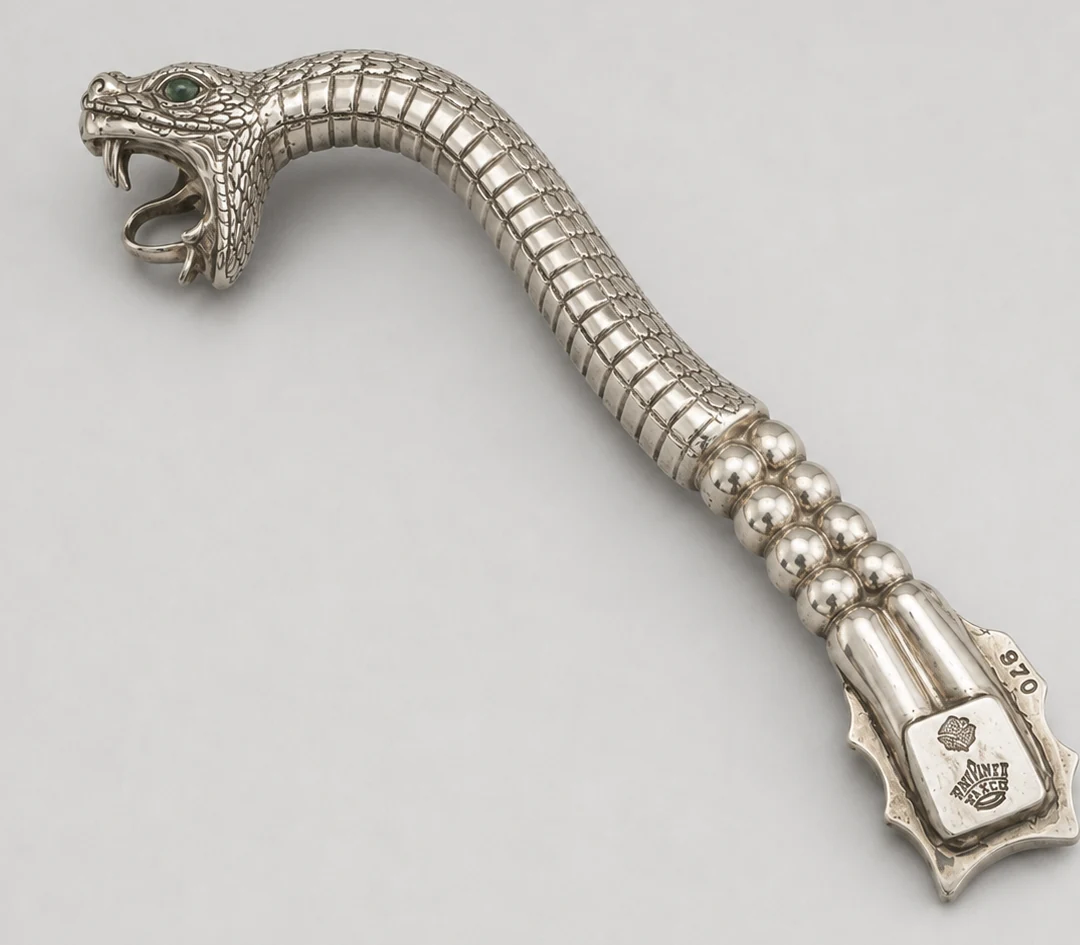
The rattlesnake here is worked in the round as a single curved body, its head lifted and mouth open to show fangs, the tail resolving into a beaded segment and a fluted terminal that stands in for the rattle. Antonio Pineda is known primarily for jewelry, and sculptural objects from his workshop are far less commonly encountered than his bracelets, necklaces, and pendants. That alone gives this piece interest, but the more telling point is how a designer trained on the modernist vocabulary of wearable metal approaches a figurative subject, controlling the reptile through rhythm and surface rather than naturalistic imitation.
The body carries a textured scale pattern across most of its length, then shifts to a run of discrete beads before the terminal, so the eye reads the animal as a sequence of repeated units rather than a continuous skin. This is a sculptor thinking in modules, the same instinct that organizes Pineda's linked bracelets into cartouches, waves, and concave ovals. The green cabochon eyes supply the only color and the only rounded, polished interruption in an otherwise matte and worked surface. Their placement at the raised head concentrates attention where the form is most active, at the open mouth and fangs. The 970 silver, an alloy Pineda used consistently and marked openly, is denser and slightly warmer than sterling, and it holds the fine textured chasing without the brittleness that a higher-copper alloy can bring.
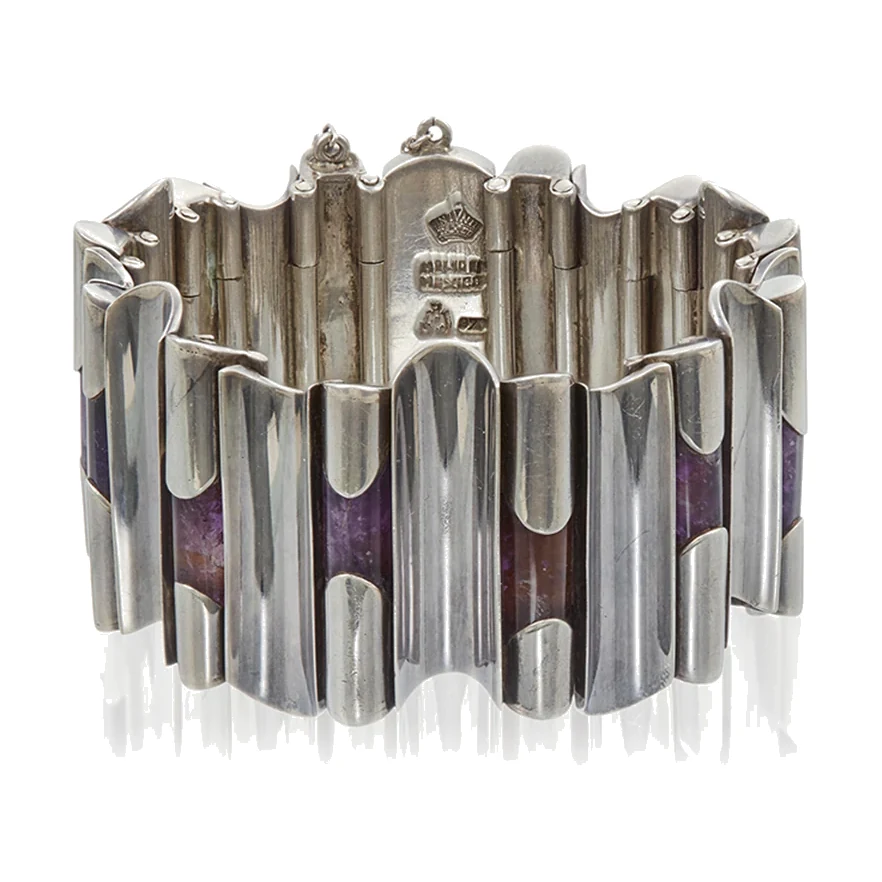
The underside carries an eagle assay mark together with the ANTONIO TAXCO signature and the 970 fineness. The Antonio crown and the ANTONIO TAXCO stamps run across many of the workshop's documented marks in the museum's hallmark reference, several of them paired with an eagle assay stamp and the 970 standard, as on the Squares with Bands of Tortoise and Leaf bracelets recorded by Morrill. The eagle confirms assay-era production rather than an exact year, and the mark identifies the shop under which the object was produced and sold. Pineda's taller by this period worked through named subcontractors such as Mota, Hilda, and María Pineda, so the signature locates design authority and workshop responsibility rather than certifying the hand that raised and chased this particular body.
Snakes belong to a long visual lineage in Mexican silver, from the feathered serpent of Central Mexican sculpture to the coiled rattlesnakes carved in stone, and Pineda's version neither copies an ancient prototype nor sentimentalizes it. He treats the rattlesnake as a problem in repeated form and controlled surface, the same discipline he brought to his jewelry, and lets a pair of green stones do the work of the eye. As a sculptural object from a maker celebrated for wearable work, it records a less-documented side of one of the central workshops of the Mexican silver renaissance.
Museum of Mexican Silver. “Rattlesnake Sculpture.” Catalog no. MoMS-002180. https://museumofmexicansilver.com/pieces/antonio-pineda-rattlesnake-sculpture
See something wrong with this record? Suggest a correction and the piece details fill in automatically.
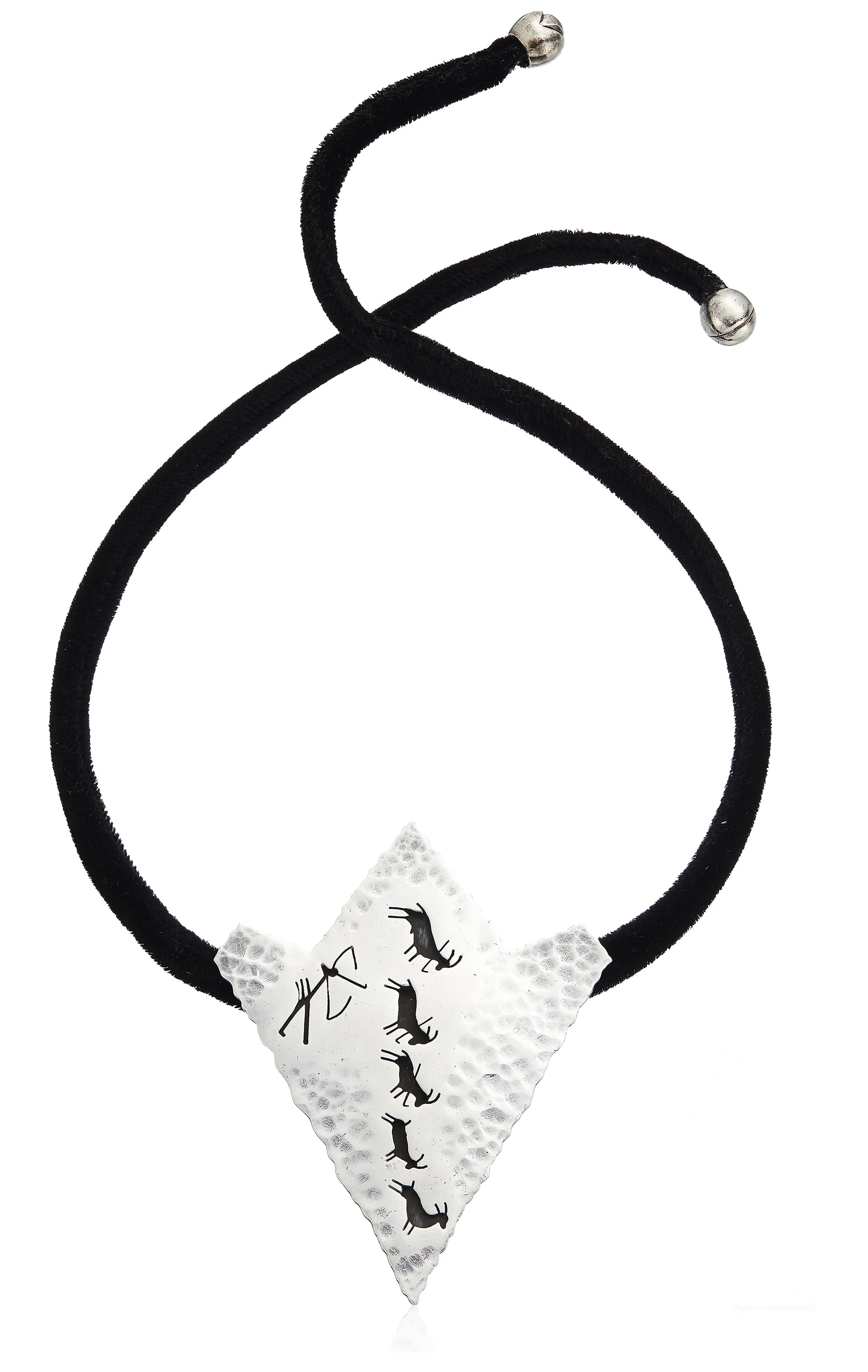
Antonio Pineda
Spear Head Pendant
Silver