Saves instantly, no account needed. Already a member? Sign in.
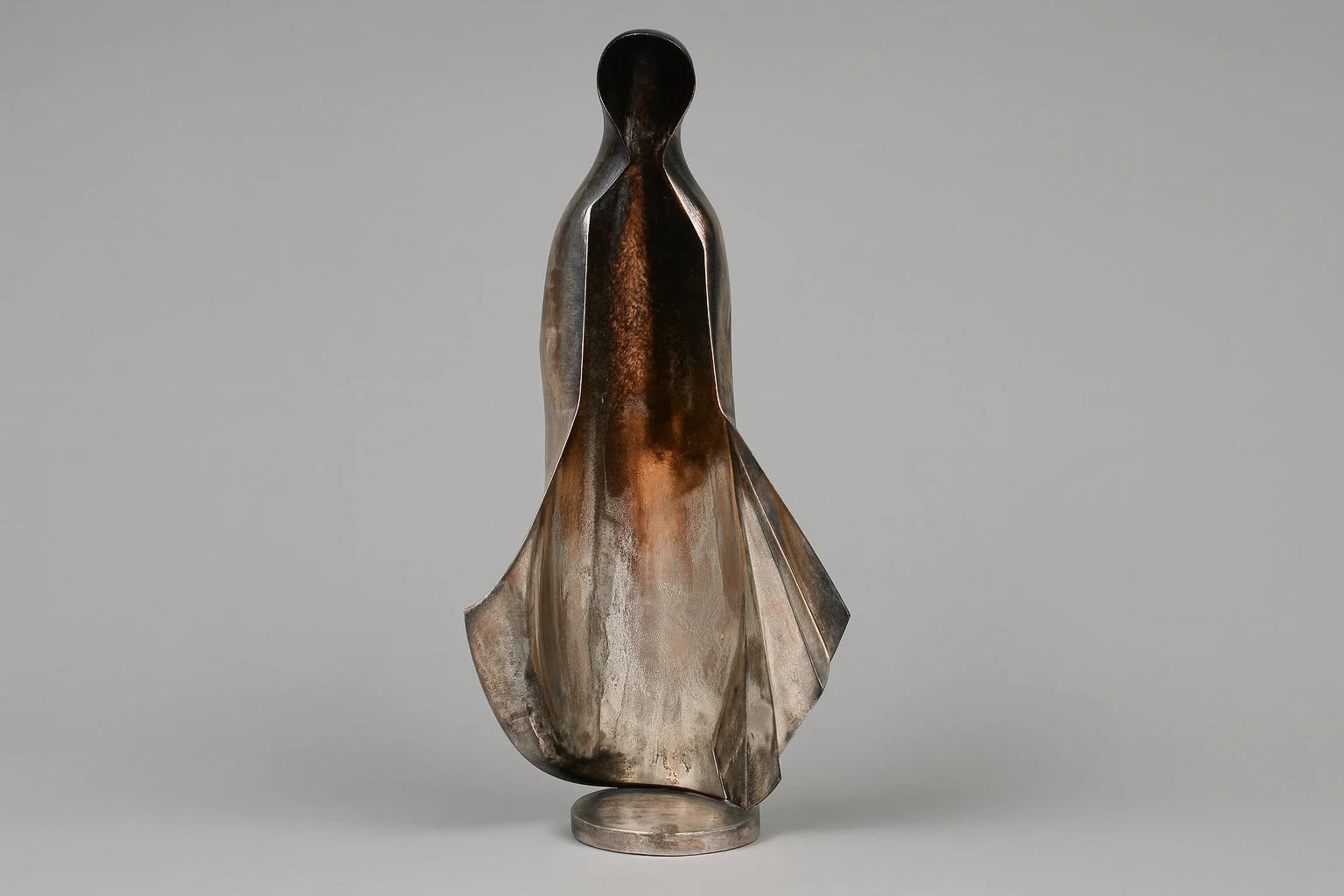
A standing Virgin Mary rendered in silverplate rather than sterling belongs to a side of the Los Castillo workshop that collectors of the firm's inlaid jewelry often overlook: its production of devotional and decorative objects for a broad domestic market. The figure carries the marian iconography familiar from Mexican colonial and folk sculpture, the downcast head, the enveloping mantle, the hands drawn together in prayer, translated into the smooth reflective surfaces the Castillo brothers favored. In plate, the workshop could give a religious subject the sculptural presence of silver without the cost of solid metal, which situates the piece within the accessible tier of a taller better known for luxury inlay.
The design depends on the play of light across curved planes. The mantle falls in long unbroken folds that gather reflection down the length of the figure, while the face and joined hands interrupt that flow with smaller, quieter passages. This is a mode of modeling that reads well in a highly polished surface, where deep undercutting would fracture the reflections the material is meant to hold. The silhouette is closed and vertical, a column of drapery resolving into the bowed head, and the sculptor has kept ornament subordinate to that overall contour. Because the object is silverplate, a layer of silver deposited over a base metal core, its weight and internal construction cannot be read from the surface alone, and the medium points toward a serial rather than a one-off production.
Los Castillo, founded in Taxco in 1939 by Antonio Castillo and his brothers after their years at Spratling's Taller de Las Delicias, built its reputation on technical invention: the fired-enamel, feather-mosaic, and stone-inlay lines documented across the workshop's many marks in the Hougart hallmark reference. Alongside those signature techniques, the firm carried plateado (silverplate) production, recorded in marks such as the plain "Los Castillo, Plateado" stamp and the later "TA-01, Plateado" mark used from roughly 1980 onward. A devotional figure fits naturally within that range, connecting the workshop to the long tradition of Mexican religious silver that predated the twentieth-century renaissance and continued to supply household and church demand throughout it. Hougart also cautions that classic Los Castillo designs have been reproduced in recent years bearing legitimate hallmark stampings, so genuine patina and handling wear remain the surest guide to age for pieces in this vein.
As a museum object, the Virgin illustrates a part of Los Castillo's output that rarely enters the published literature, which concentrates on the inlaid jewelry and hollowware. It records how a leading Taxco taller applied its command of surface and silhouette to inexpensive plate and to religious subject matter aimed at everyday buyers rather than international collectors. Held alongside the firm's Mosaico Azteca and Onix Negro work, the figure marks the breadth of a single workshop, from experimental technique to devotional sculpture produced for the general market.
Museum of Mexican Silver. “Virgin Mary Sculpture.” Catalog no. MoMS-001180. https://museumofmexicansilver.com/pieces/los-castillo-sculpture-virgin-mary-silverplate
See something wrong with this record? Suggest a correction and the piece details fill in automatically.
Los Castillo
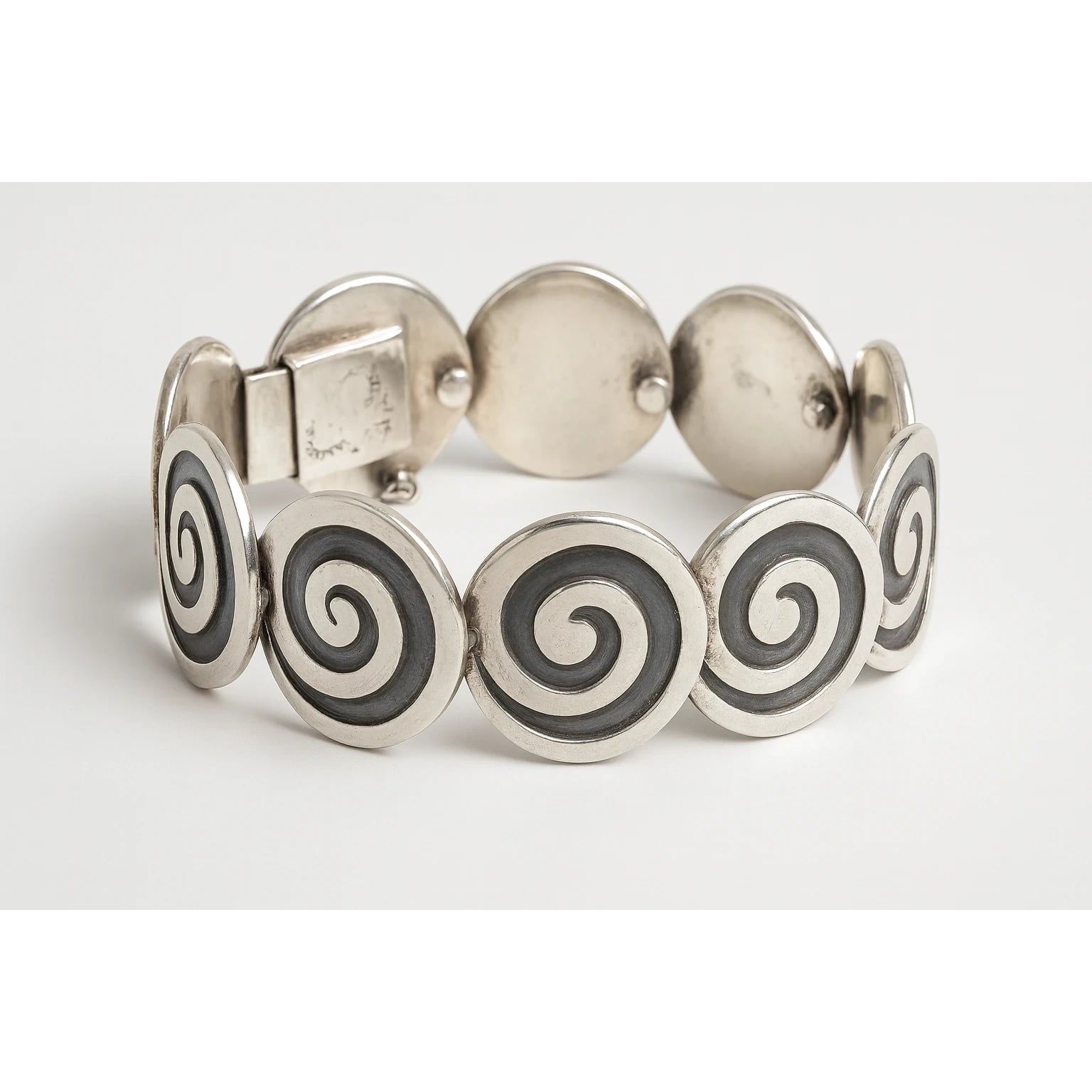
Spiral Disc Bracelet