Saves instantly, no account needed. Already a member? Sign in.
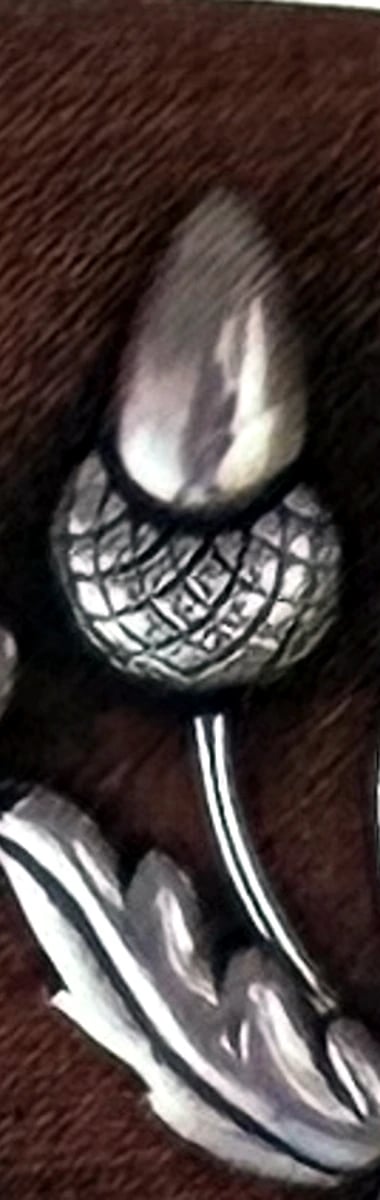
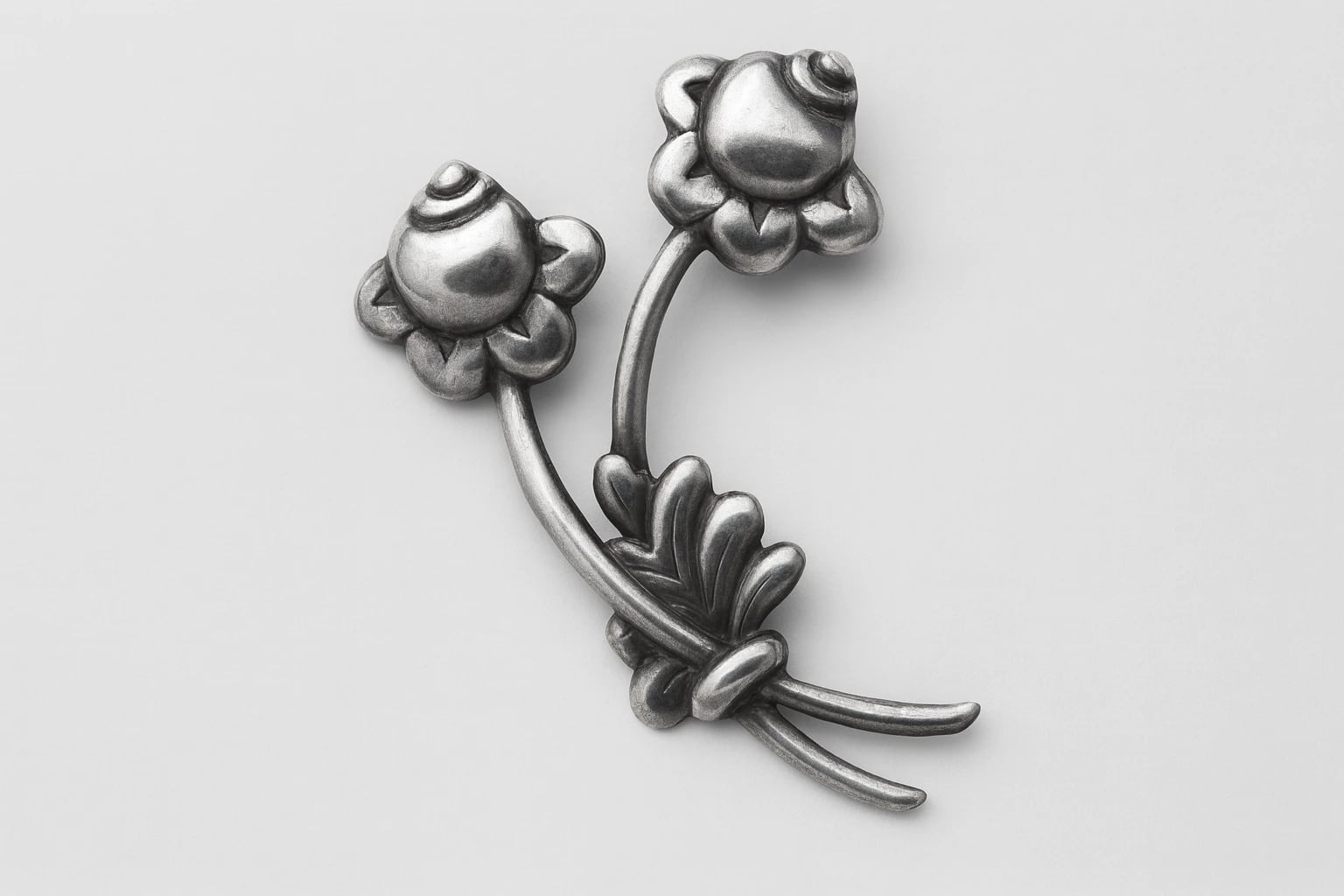
The brooch turns two flowers and a small cluster of leaves into a compact study of swelling volume and lean, curving line. Made at Taller Borda around 1945, it measures three inches by two inches and carries an early Héctor Aguilar mark: Taxco, the heavy joined HA, and 940 silver. Its hollow flowers and leaves give the form a buoyant surface rather than a flat silhouette. Each blossom is modeled as a raised cup with rounded petals pressed outward from a polished center, while the stems bend in long arcs that keep the composition open. The design is floral, but its effect depends less on naturalistic description than on the control of mass, spacing, and reflected light.
The pin is organized around a gentle diagonal. One flower sits higher and slightly to the right, the other lower and to the left, joined by stems that cross through the leaf cluster before extending into two fine tails. That crossing point gives the brooch its structure. The leaves at the center are not background foliage. They act as a hinge between the rounded blossoms above and the narrow stems below, gathering the movement before releasing it again. The hollow construction matters because it allows the raised forms to read as full and ample without turning the brooch into a heavy block of silver. Polished convex surfaces catch light broadly, while the recessed seams around petals and leaves give definition to the forms.
Penny Morrill identifies Héctor Aguilar as the principal designer for the work he signed, while also noting that Valentín Vidaurreta provided many of the elaborate floral designs for which Taller Borda became known. Vidaurreta arrived in Taxco in 1941 and collaborated with Aguilar until his death in 1955, a chronology that places this brooch within the workshop’s most fertile period for large, sculptural floral jewelry. Morrill also records Aguilar’s early hallmark as the attached HA flanked by Taxco and 940, and Hougart likewise documents the Taxco, HA, 940 mark among Aguilar’s early marks. This brooch does not need a separate inscription naming Vidaurreta to belong to that floral current. Its rounded petals, full centers, and asymmetrical stems are consistent with the Borda vocabulary that transformed Taxco’s surrounding flora into modern silver ornament.
The brooch also belongs to a broader moment in the Mexican silver renaissance when jewelry could carry the ambitions of sculpture at intimate scale. Aguilar established Taller Borda in 1939, and by the 1940s the workshop was producing silver for a wide international audience while maintaining a strong Taxco identity. Morrill describes the Taller Borda’s variety, including jewelry, flatware, hollowware, copper, brass, tin, and domestic objects, all brought into the restored Borda Palace complex. This pin shows the jewelry side of that system at a high level of resolution. Its flowers are not simply applied decoration. They are volumes joined to lines, with the pin mechanism serving a composition intended to sit clearly against fabric and move with the wearer’s body.
Museum of Mexican Silver. “Flowers and Leaves Brooch.” Catalog no. MoMS-002301. https://museumofmexicansilver.com/pieces/hector-aguilar-flowers-and-leaves-brooch
See something wrong with this record? Suggest a correction and the piece details fill in automatically.
The object is also documented beyond the Museum’s own file. It is featured in Penny Morrill’s Mexican Masters, page 91, and illustrated in C. Jeanenne Bell’s Old Jewelry, sixth edition, page 450. That publication history is useful because small silver jewels from Taxco often circulated first through wear, workshop memory, and collector knowledge before entering formal design history. Here the record is unusually concrete: an early Aguilar mark, a c. 1945 date, documented dimensions, hollow floral construction, and publication in two reference works. Within a collection, the brooch helps show why Taller Borda’s floral designs remain essential to understanding Mexican modernism in silver: they made botanical form architectural, tactile, and distinctly suited to the body.
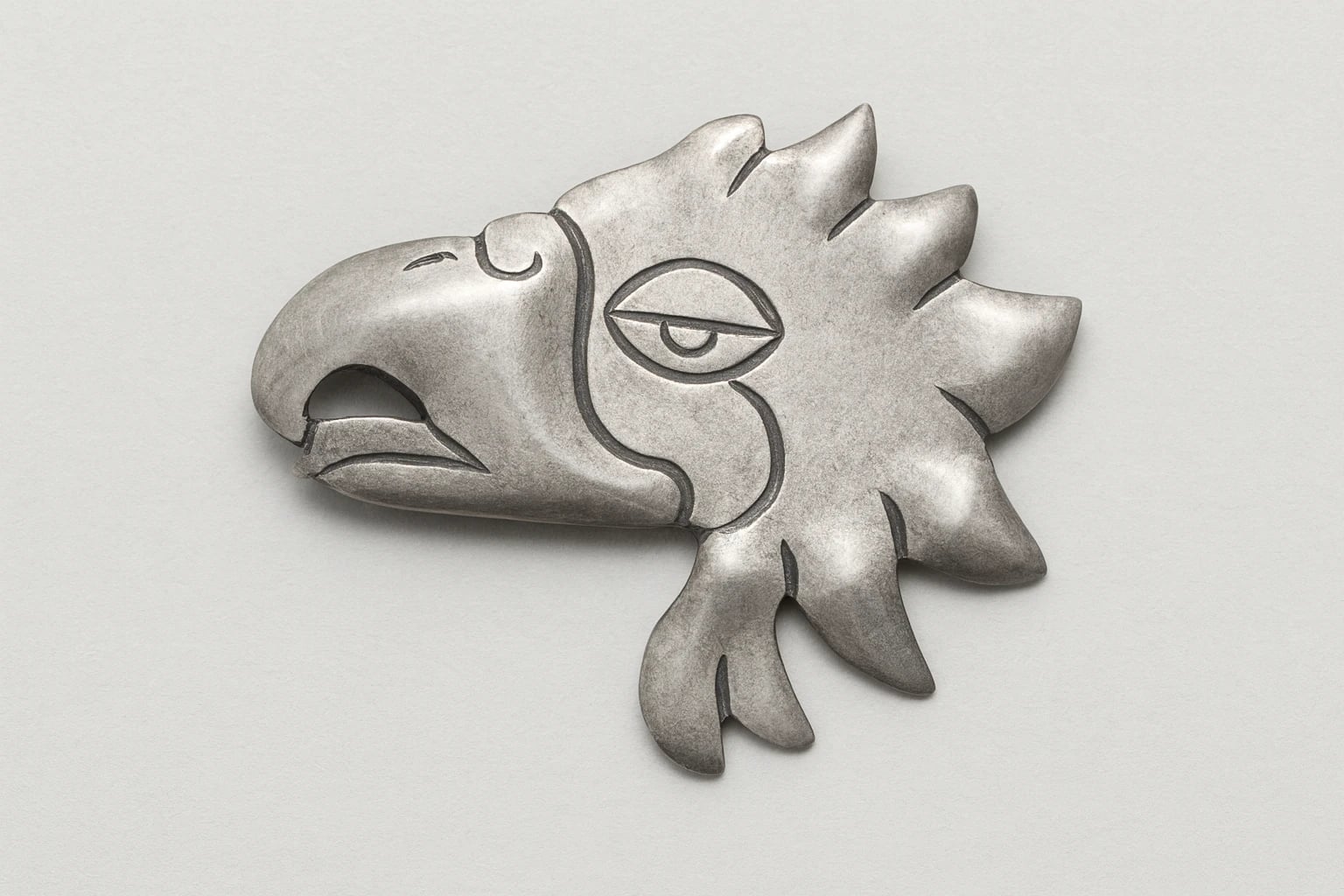
Héctor Aguilar
Pre-Columbian Bird-Glyph Brooch
1945-1948
Silver