Saves instantly, no account needed. Already a member? Sign in.
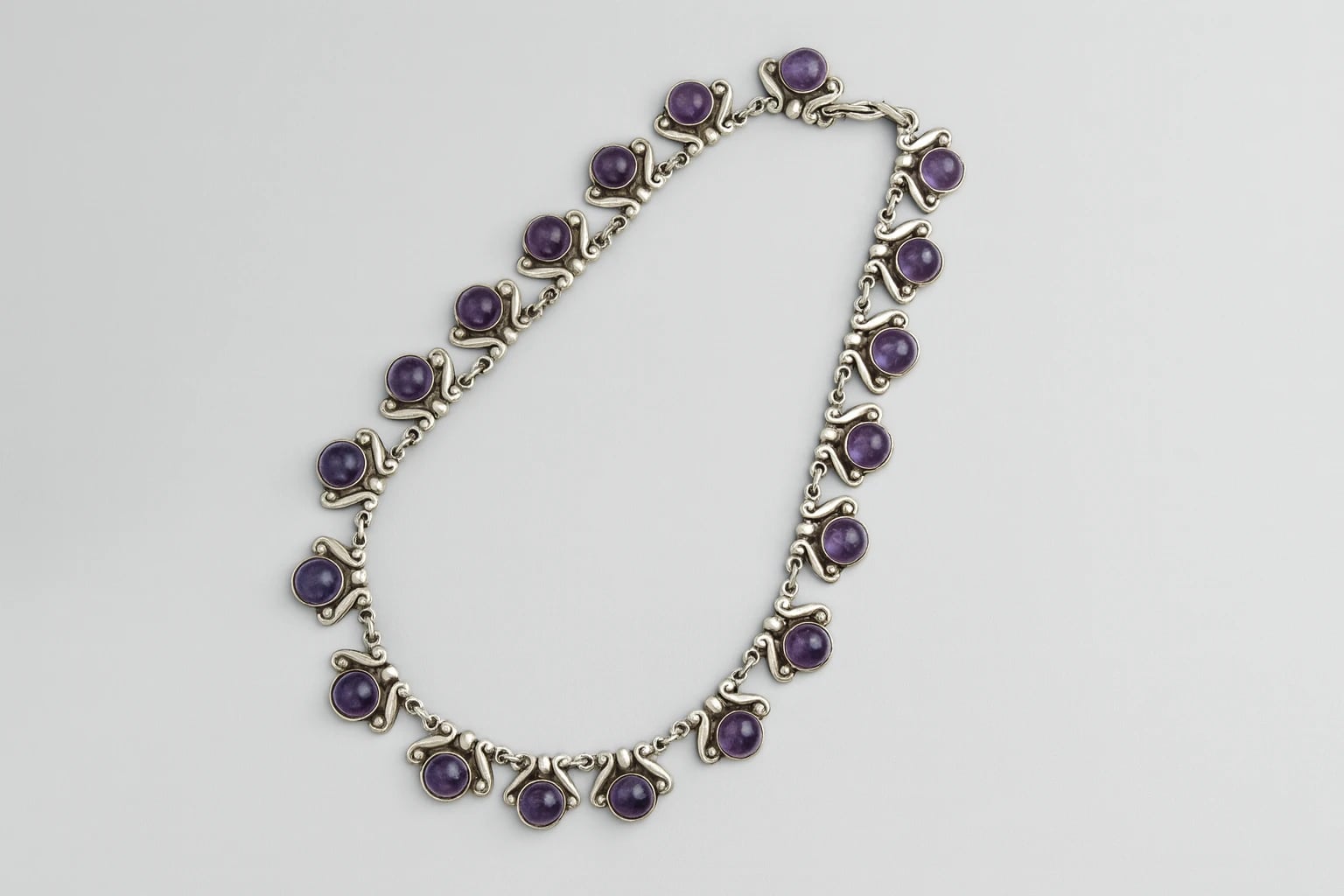
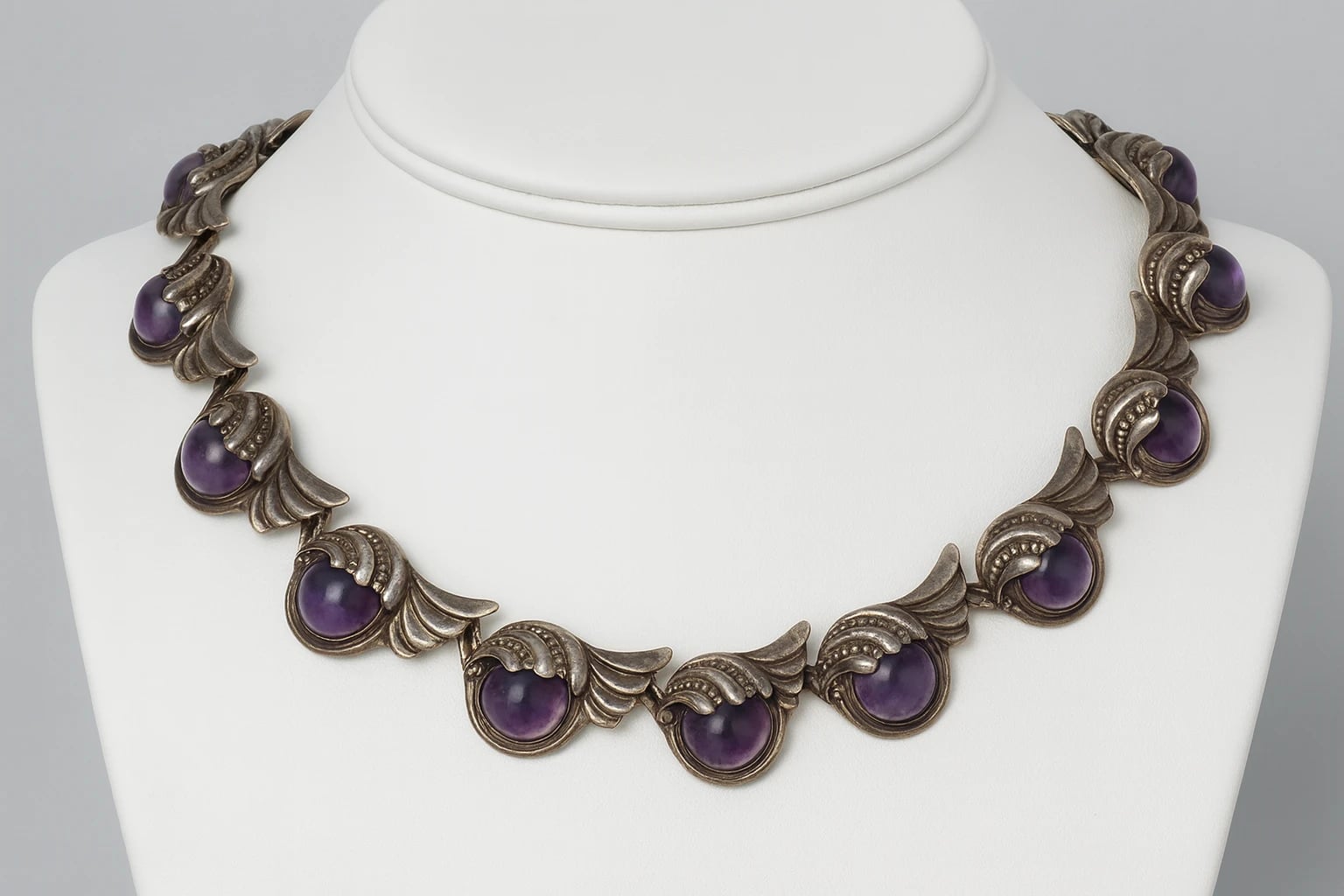
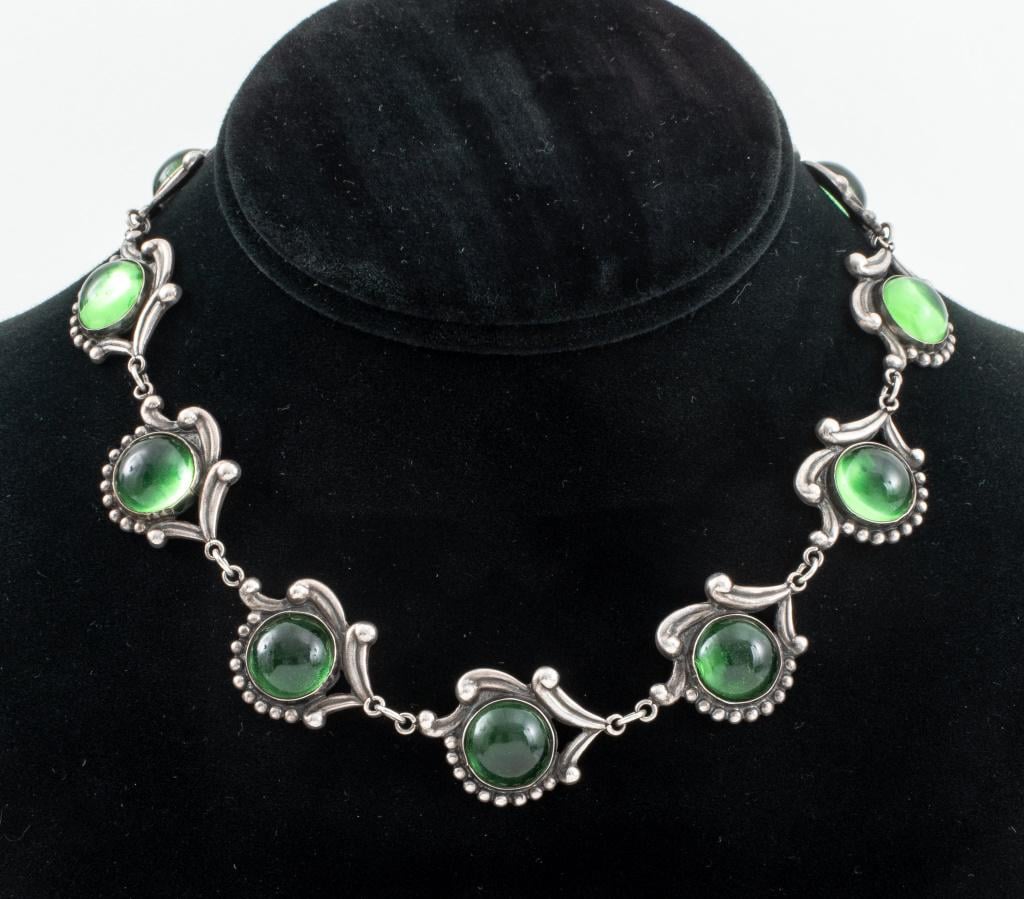
This necklace sets nine domed green glass cabochons within a repeating framework of silver scrolls and beaded borders, and its interest lies in how consistently the metalwork subordinates itself to the stones. Each link is built as a small asymmetrical cartouche: a curling scroll rises on one side, sweeps under the bezel, and terminates in a row of applied silver beads along the lower edge, so that every green dome sits inside a cradle of ornament rather than on a plain mount. The links join through simple round jump rings, which keeps the necklace flexible at the throat while allowing each unit to read as a complete composition. The glass itself does much of the work. Cut as high, polished domes and set in closed bezels, the cabochons gather light into a deep bottle green at the center and a paler, almost luminous rim, a color effect that a transparent faceted stone would not produce against silver.
The design belongs to the vocabulary Los Castillo developed after Antonio Castillo and his brothers, with their cousin Salvador Terán, opened their taller in Taxco in 1939. Antonio had trained under William Spratling at the Taller de Las Delicias, and the beaded borders and scrolling silver of this necklace carry that early Taxco language, in which applied shot and sculptural repoussé forms framed local and inexpensive materials with real seriousness. Glass was one of those materials. Morrill and Berk document a Los Castillo suite of swirling silver fish set with blue glass domes from the workshop's later production, evidence that the firm treated colored glass not as a substitute for gemstones but as a legitimate design element whose saturation and translucency could be specified as precisely as any stone. The green glass here works the same way: the material is chosen for its optical behavior, and the silver is composed around it.
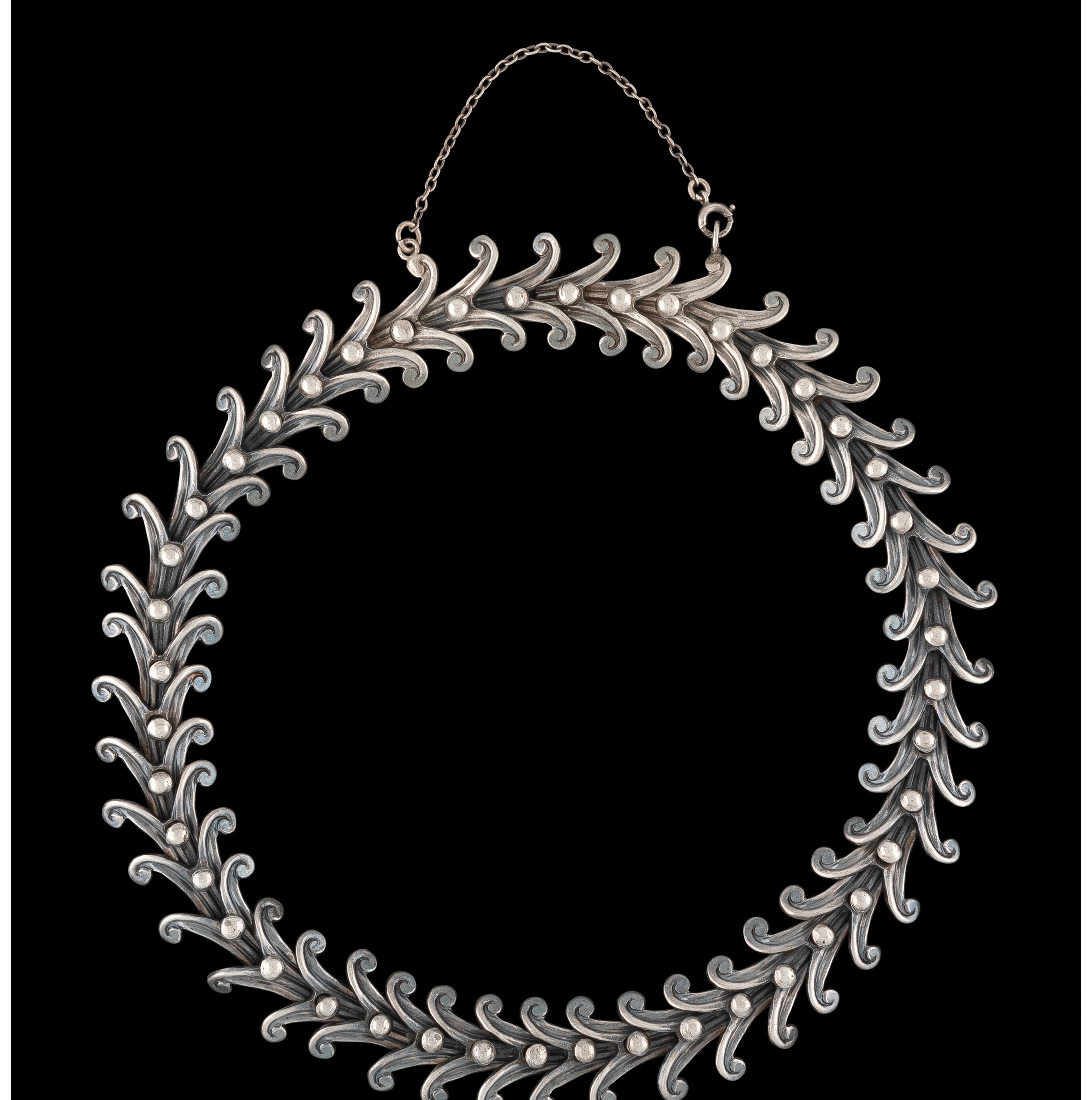
Frances Toor described the range of Los Castillo's work as running from chaste simplicity to the nearly overwhelming, and this necklace occupies a considered middle position on that scale. It is ornamental without being heavy. The scrolls are modeled in relief but kept shallow, the beading is confined to the lower arc of each link, and the recurring unit is small enough that the necklace lies as a continuous band rather than a series of medallions. Worn, the alternation of bright polished scroll, matte beadwork, and glowing glass would produce a steady rhythm around the neck, with the flexibility of the linked construction letting each unit tilt slightly and catch light independently. The floral character named in the workshop's designation is abstracted rather than literal: the scroll and bead cluster suggest a blossom and its stamens without describing either.
Museum of Mexican Silver. “Floral Necklace with Green Glass Beads.” Catalog no. MoMS-001873. https://museumofmexicansilver.com/pieces/los-castillo-necklace-floral
See something wrong with this record? Suggest a correction and the piece details fill in automatically.
Within the Museum's holdings the necklace documents an important and sometimes overlooked side of the Los Castillo enterprise. The firm's reputation rests substantially on its married metals work and on ambitious sculptural silver, but its sustained production of wearable, stone-set and glass-set jewelry was what carried the workshop's design ideas to the widest audience, sustaining a business that by the 1970s supported three retail shops in Mexico City. A necklace like this one shows how the taller translated the early Taxco ornamental vocabulary, the beadwork, the scrolls, the confident use of glass, into jewelry made for regular wear, and it preserves that vocabulary in a particularly legible and well-balanced form.
Los Castillo
Stone Inlay Necklace
Unidentified stone