Saves instantly, no account needed. Already a member? Sign in.
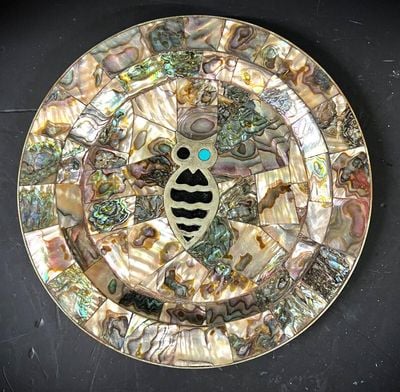
A single insect anchors this plate, its body drawn in metal and dark stone at the center of a field of shifting iridescence. Los Castillo built the design as a mosaic: shaped segments of abalone shell cover the entire face of the plate, organized into a broad outer band, a narrower inner ring, and a central medallion of larger, radiating pieces. Against that continuous shimmer of pink, green, and gold, the insect reads with almost heraldic clarity. Its abdomen is banded with inlaid black onyx, the stripes alternating with textured metal, and a small turquoise cabochon sits at the head beside a dot of onyx. The plate demonstrates one of the workshop's central convictions, that a functional silverplate form could carry the same lapidary ambition as its jewelry.
The design depends on controlled contrast. Abalone is an unstable, watery material to the eye, changing color as the plate turns, and no two tesserae repeat. The insect is its opposite: fixed, symmetrical, and dark. By setting matte black onyx and a single point of opaque turquoise inside the mosaic field, the designers gave the composition a still center that the surrounding iridescence cannot dissolve. The joinery does quiet work as well. The shell pieces are cut and fitted so that their seams form their own geometry, a network of lines that steps down in scale from the wide border to the smaller central segments, guiding the eye inward toward the figure.
Mixed-material surfaces of this kind were a signature of Los Castillo, the Taxco firm founded by Antonio Castillo and his brothers. The workshop developed and stamped named technical lines for its stone and shell work, including Onix Negro for black onyx inlay and Mosaico Azteca for its mosaic surfaces, and it marked its silverplate production Plateado, all documented in Hougart's hallmark reference. Those named lines matter here because they show that inlay and mosaic were not occasional experiments at Los Castillo but sustained programs with their own identities, refined across decades of production. This plate belongs to that tradition: shell mosaic as a total surface treatment, punctuated by contrasting stones, applied to a domestic object rather than a body ornament. The insect motif extends the firm's long engagement with the natural world, here rendered with the frontal symmetry of an emblem rather than the naturalism of an illustration.
The plate also illustrates why Los Castillo occupies an unusual position in the history of the Taxco workshops. As Contreras Osio observes, most of the designers celebrated during the silver renaissance had no continuity among their descendants, while Los Castillo continued reproducing Antonio Castillo's original designs, and the firm's works still circulate internationally and rest largely in private collections abroad. An object like this one, in which lapidary skill rather than silver weight carries the artistic content, helps explain that endurance. It shows a workshop treating mosaic as a medium in its own right, capable of holding a wall of color steady around a single, precisely composed figure.
Museum of Mexican Silver. “Insect-Motif Plate with Abalone Mosaic.” Catalog no. MoMS-001320. https://museumofmexicansilver.com/pieces/los-castillo-plate-owl-turquoise-silverplate
See something wrong with this record? Suggest a correction and the piece details fill in automatically.
Los Castillo
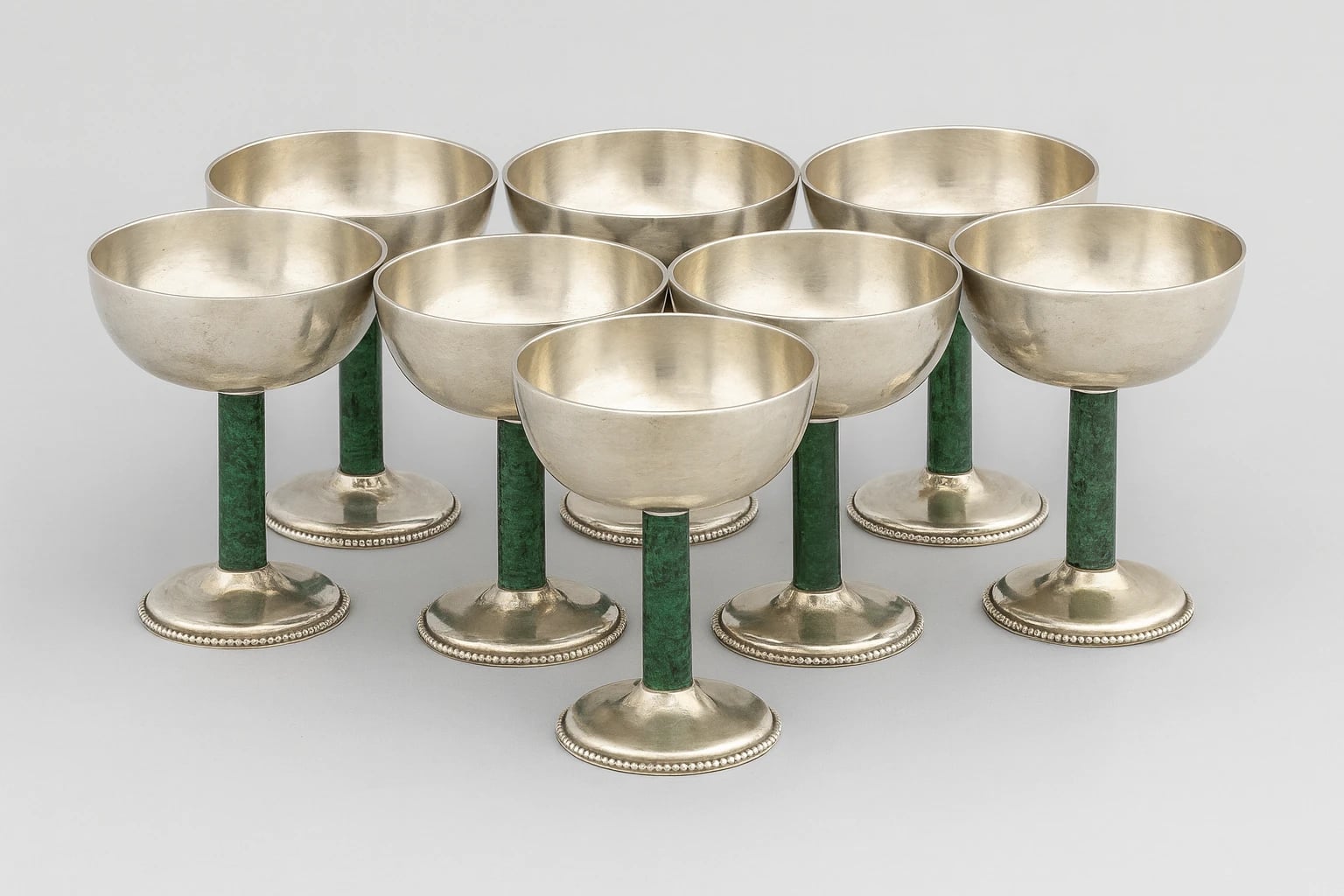
Set of Eight Malachite-Stem Goblets
Malachite