Saves instantly, no account needed. Already a member? Sign in.
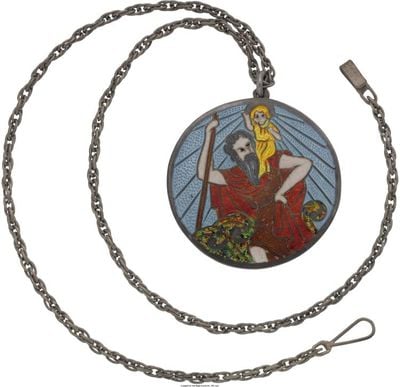
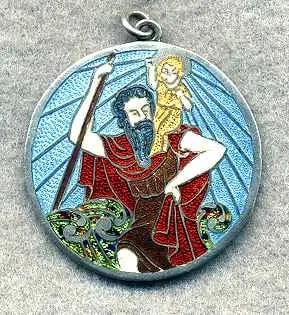
This small pendant compresses a full narrative scene into a circular field only 1 3/4 inches across. Saint Christopher fills the lower half of the medallion, his bearded head turned beneath the child who stands on his shoulder, while a staff, red cloak, pale blue ground, and clustered details at the base give the image its direction and setting. The design, numbered 5587 and signed Margot de Taxco, belongs to the enamel line for which Margot van Voorhies is now best known. Its rarity lies not simply in the subject, but in the density of pictorial work required by a devotional image treated through the disciplined color system of the Taxco workshop.
The pendant is organized by firm silver boundaries that separate figure, garment, water, staff, and ground into small fields of color. The blue background is not a flat backdrop. Its diagonal divisions move behind the saint like water or radiating light, giving the round format a quiet internal motion. Against it, the red of Christopher’s cloak becomes the strongest chromatic mass, folded around the body in angular passages that keep the figure legible at pendant scale. The child is held higher and brighter, modeled in yellow tones with small accents that distinguish face, body, and garment. At the bottom edge, greens, dark blues, yellows, and white details enrich the surface without crowding the central image. The result depends on a careful balance between illustration and ornament: the saint can be read immediately, but the pleasure of the object comes from how much the eye discovers within the enamel compartments.
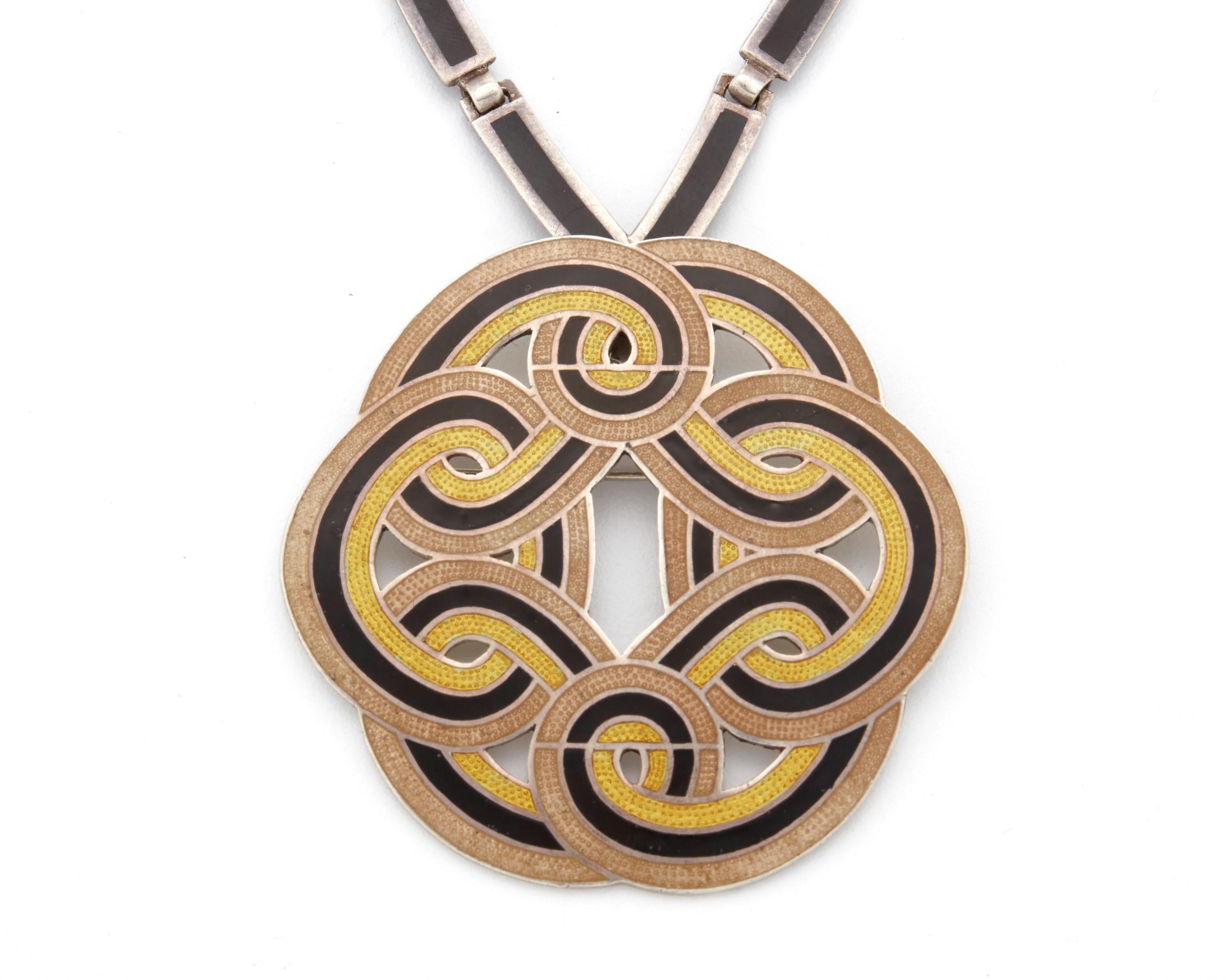
Margot de Taxco’s champlevé enamel was not an applied decorative afterthought to silver design. It was a workshop system in which drawing, metal preparation, color placement, firing, finishing, and assembly had to be coordinated from the beginning. Margot’s enamel production began in 1955, after her shop had already established a distinct position within Taxco silver. The design number 5587 falls within the enamel numbering range associated with her workshop, and its elaborate palette is consistent with the technical ambition of that line. In champlevé, the enamel settles into recessed areas of the metal, so the silver does more than frame the colors. It determines the drawing, fixes the internal structure, and catches light along every raised edge.
The choice of Saint Christopher gives the pendant a different tone from Margot’s better known animals, shells, zodiac figures, and motifs drawn from Japanese, Art Deco, or ancient Mexican sources. Here the subject belongs to a long Christian tradition of protective jewelry, especially suitable for a pendant worn close to the body. Margot translates that devotional type into the language of mid twentieth century Taxco modernism: compact geometry, controlled contour, brilliant enamel, and a surface in which silver and color carry equal weight. The piece shows how the Mexican silver renaissance could absorb inherited religious imagery without retreating into pastiche. In this object, a familiar saint becomes a study in color discipline, miniature composition, and the collaborative precision of one of Taxco’s most inventive enamel workshops.
Museum of Mexican Silver. “Design 5587 St. Christopher Enamel Pendant.” Catalog no. MoMS-002344. https://museumofmexicansilver.com/pieces/margot-de-taxco-pendant-st
See something wrong with this record? Suggest a correction and the piece details fill in automatically.
Margot de Taxco
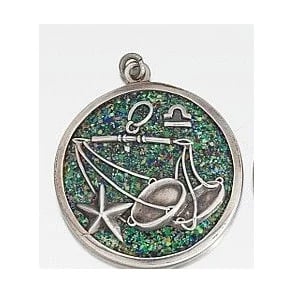
Libra Zodiac Pendant with Green Enamel, Design No. 5226
Sterling silver