Saves instantly, no account needed. Already a member? Sign in.
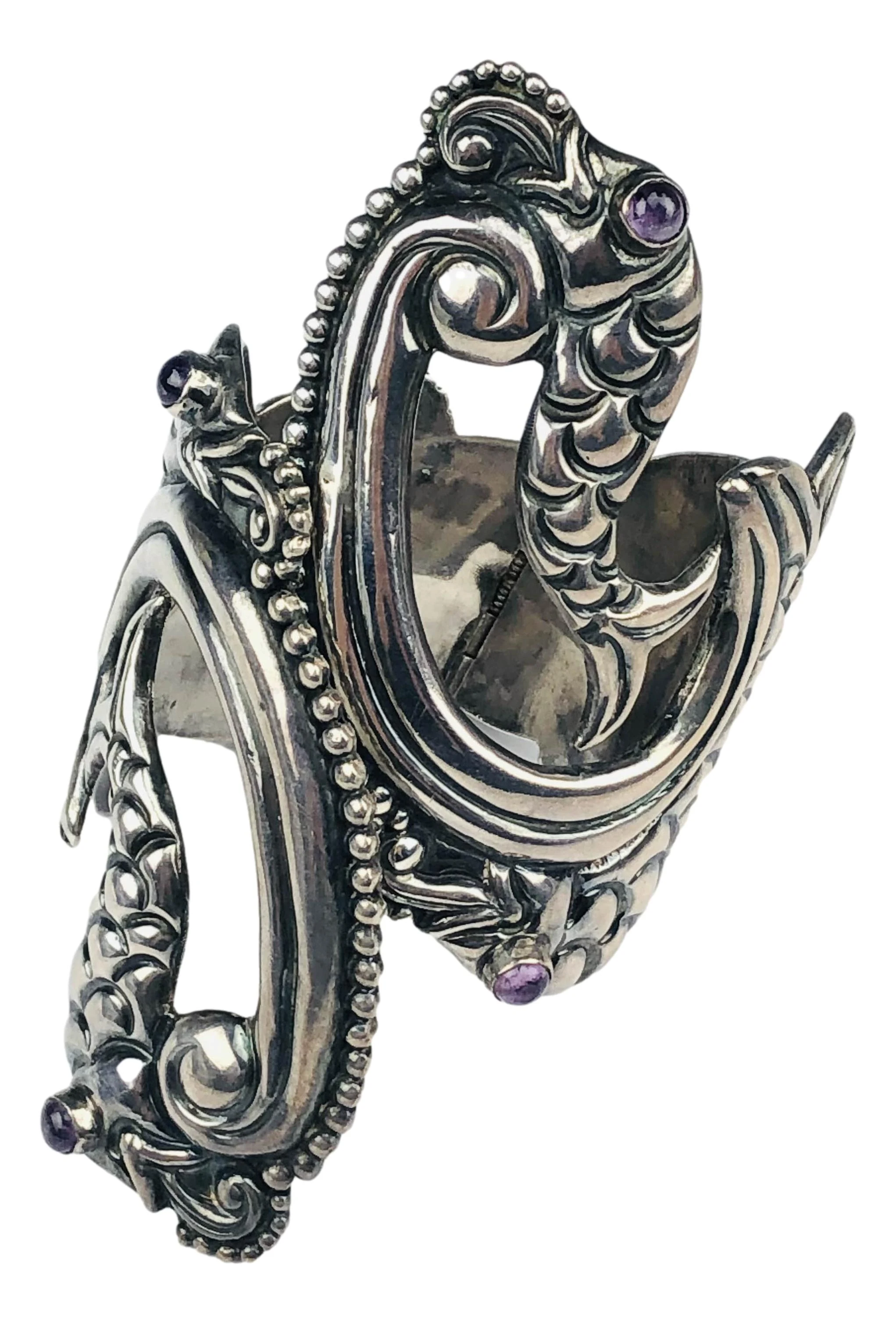
A stylized fish, rendered as a single continuous body along the wrist, gives the Margot de Taxco cuff its structure. The form is broad and slightly convex, curving to follow the arm, with the fish reading as one flowing silhouette rather than a set of applied ornaments. Amethyst cabochons punctuate the silver, and the design uses these violet accents sparingly, allowing the metal to carry the shape. The result is a bracelet organized around a single figurative motif treated with the discipline of pattern, a characteristic Margot approach in which a recognizable image is flattened and abstracted into wearable geometry.
The cuff depends on the interplay between the reflective silver ground and the rounded amethyst stops. Cabochons, cut smooth rather than faceted, read as pooled color against the polished metal, their opacity and warmth setting off the coolness of the silver surface. Where the fish's body curves, the metal catches and releases light along its length, so the ornament shifts as the wrist moves. The amethysts are positioned as points of emphasis, likely marking the eye and the articulation of the form, giving the composition a rhythm that keeps the single motif from becoming static. A cuff of this kind holds its shape as a rigid band, and the design accommodates the body through the gentle convexity of the fish rather than through hinged links.
Margot van Voorhies Carr, working under the Margot de Taxco mark she established in 1948, is best known for enamel work in which color fields are laid across silver in luminous, closely controlled patterns. This fish cuff belongs to her sterling production, where the same instinct for pattern and stylization appears without the enamel palette. Her marriage to Antonio Castillo and her years within the Los Castillo circle placed her at the center of Taxco's mid-century design culture, and her independent workshop developed a distinct formal language built on repetition, flattened figuration, and motifs drawn from marine life, serpents, and other natural forms. The fish here shows how she translated a figurative subject into a single, legible silhouette, an approach that connects her enamel and non-enamel work through a shared interest in the stylized outline.
Margot de Taxco marks documented in the museum's hallmark reference span sterling and enamel production from 1948 onward, and the workshop assigned design numbers to its models, a system that helps place individual pieces within her output. This cuff extends the record of her sterling jewelry and its use of colored cabochons alongside the enamels for which she is more widely known. Within a collection it clarifies the range of a designer often reduced to her enamel achievements, showing that her feeling for stylized natural form carried equally into worked silver and stone.
Museum of Mexican Silver. “Fish Cuff Bracelet.” Catalog no. MoMS-002163. https://museumofmexicansilver.com/pieces/margot-fish-cuff-bracelet-li129156248
See something wrong with this record? Suggest a correction and the piece details fill in automatically.
Margot de Taxco
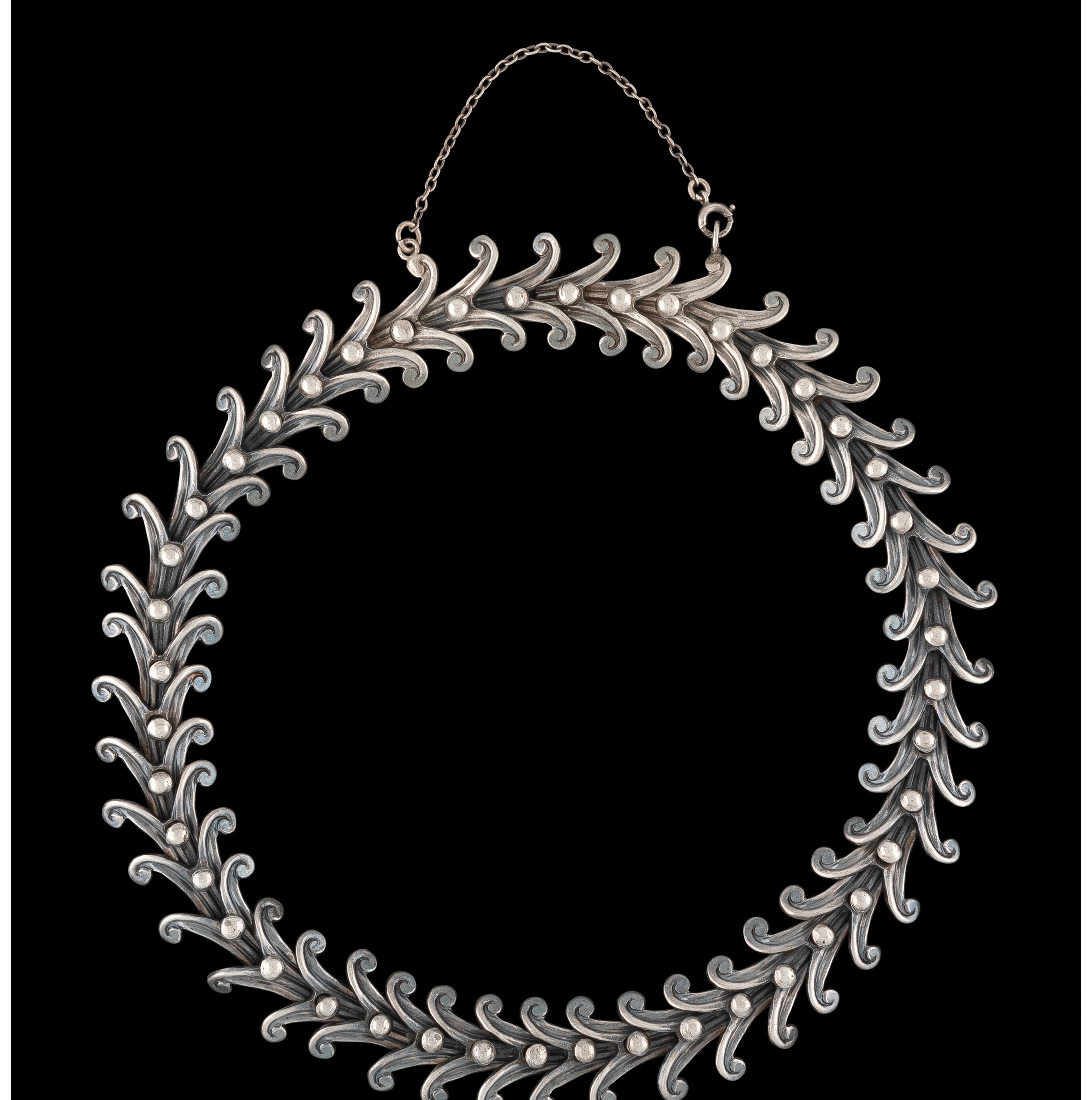
Design 5102 Necklace
Sterling silver