Saves instantly, no account needed. Already a member? Sign in.
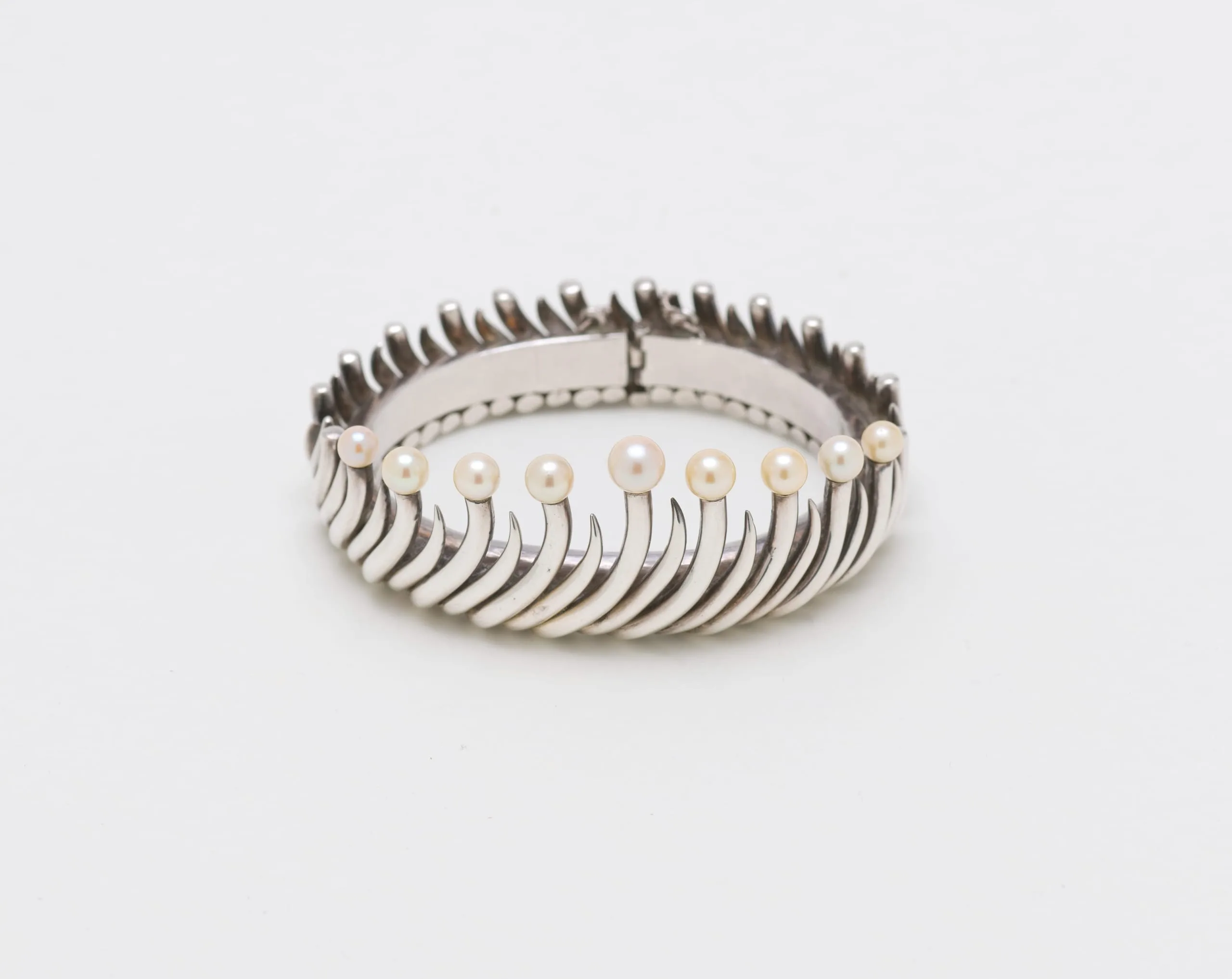
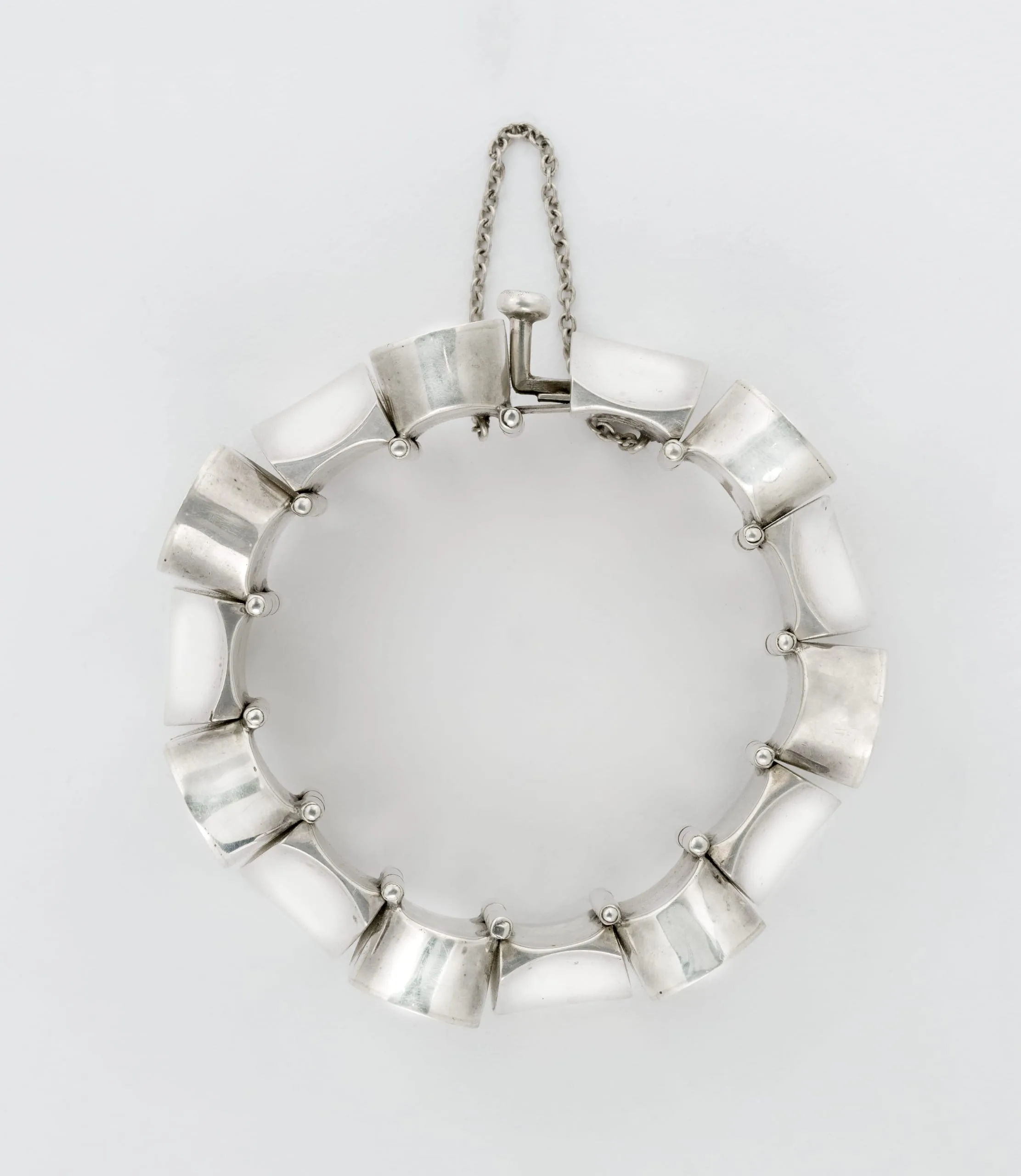
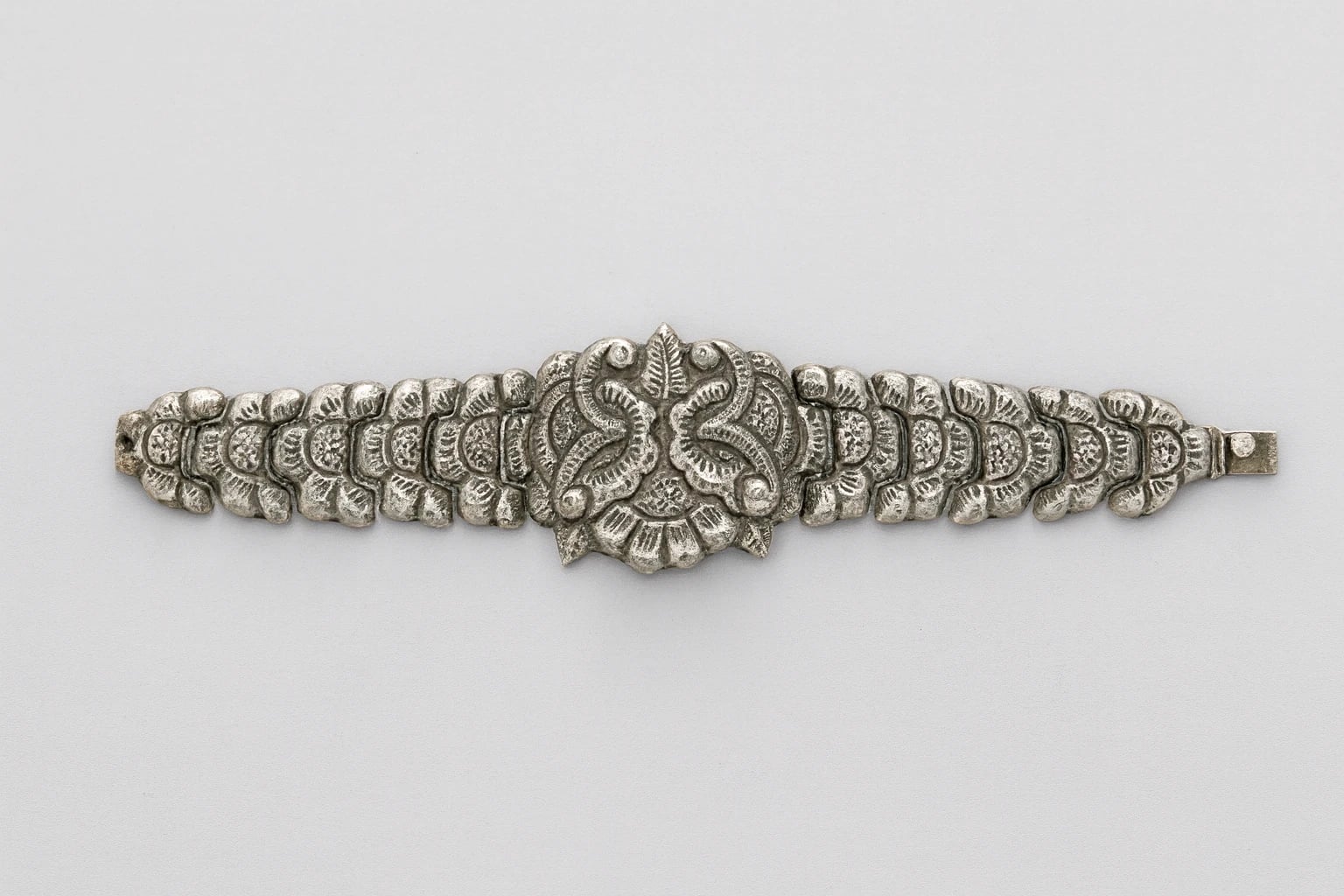
This MATL bracelet organizes a small number of forms with unusual clarity: elongated hollow links, rounded like narrow tubes, are joined by exposed silver loops and finish in tight curled terminals. The bracelet measures 7 1/2 inches by 1 3/8 inches, broad enough to read as a cuff but built as a fully articulated chain. Its old pin closure belongs to an earlier mode of Mexican silver construction, practical and direct, with the mechanism allowed to participate in the visual rhythm rather than disappear entirely. The museum record identifies the mark as MATL in old heavy script and dates the design to the pre Eagle period, before the national eagle assay system became the dominant dating framework for Mexican silver.
The design depends on repetition, but the repetition is not mechanical. Each link rises as a vertical silver panel and then softens at the ends into a pair of inward curls. The small connectors set between the links create intervals of shadow, so the bracelet never becomes a single immobile band. Around the wrist, those gaps would have given the silver both movement and relief. The front surface has retained the smooth, rounded presence of the original design, while the small indentations recorded on the back belong to the object’s later life as worn silver. They do not disturb the main reading of the bracelet, which is controlled by the alternation of polished swelling forms and tight volutes.
Matilde Eugenia Poulat’s MATL work is often remembered for dense ornament, applied wire, carved stones, religious imagery, doves, bells, and color. This bracelet shows another part of the same intelligence. It is all structure and line, without the coral, turquoise, amethyst quartz, ivory, or pictorial iconography that appear in many better known MATL pieces. Morrill and Berk place Poulat’s designs within the postrevolutionary search for a Mexican aesthetic and note her attention to Mixtec gold jewelry from Monte Albán as well as to the subjects of Mexican popular art. Here that broad cultural vocabulary is reduced to a compact system of curled silver forms. The bracelet does not need to quote a specific ancient motif in order to belong to that world. Its strength lies in the way a curled line, familiar within MATL’s ornamental language, becomes the organizing unit of a modern bracelet.
The mark is important to the object’s chronology and place within the MATL workshop. Hougart records that Poulat, a painter and designer who studied at the San Carlos Academy of Art, opened her shop in 1934, and that MATL was a registered trademark, number 142093. He also records early script MATL marks used from 1934 to 1948, before the later registered trademark forms of the 1950s and the later Salas continuation marks. Morrill and Berk further note that Ricardo Salas worked closely with Poulat from childhood and continued the MATL designs after her death in 1960. This bracelet, marked in the old heavy script and identified in the museum record as pre Eagle, belongs to the earlier phase of the workshop’s production rather than to the later family continuation.
Museum of Mexican Silver. “Tube Link Bracelet with Scroll Ends.” Catalog no. MoMS-002352. https://museumofmexicansilver.com/pieces/matl-bracelet-4
See something wrong with this record? Suggest a correction and the piece details fill in automatically.
Its publication in C. Jeanenne Bell’s Old Jewelry, sixth edition, page 448, confirms that the design has circulated in the collector and reference literature, but its importance is not only bibliographic. The bracelet clarifies why the Mexican silver renaissance cannot be understood only through Taxco’s major workshops or through the most pictorial examples of MATL jewelry. Made in Mexico City under one of the period’s distinctive women designer directors, it shows how the renaissance also advanced through modular construction, bodily movement, and a disciplined handling of silver alone. The result is a bracelet that carries MATL’s ornamental sensibility into a spare, wearable architecture.
MATL (Matilde Poulat)
Floral Bracelet
1934 or later
Silver