Part of the design family Birdcage
Saves instantly, no account needed. Already a member? Sign in.
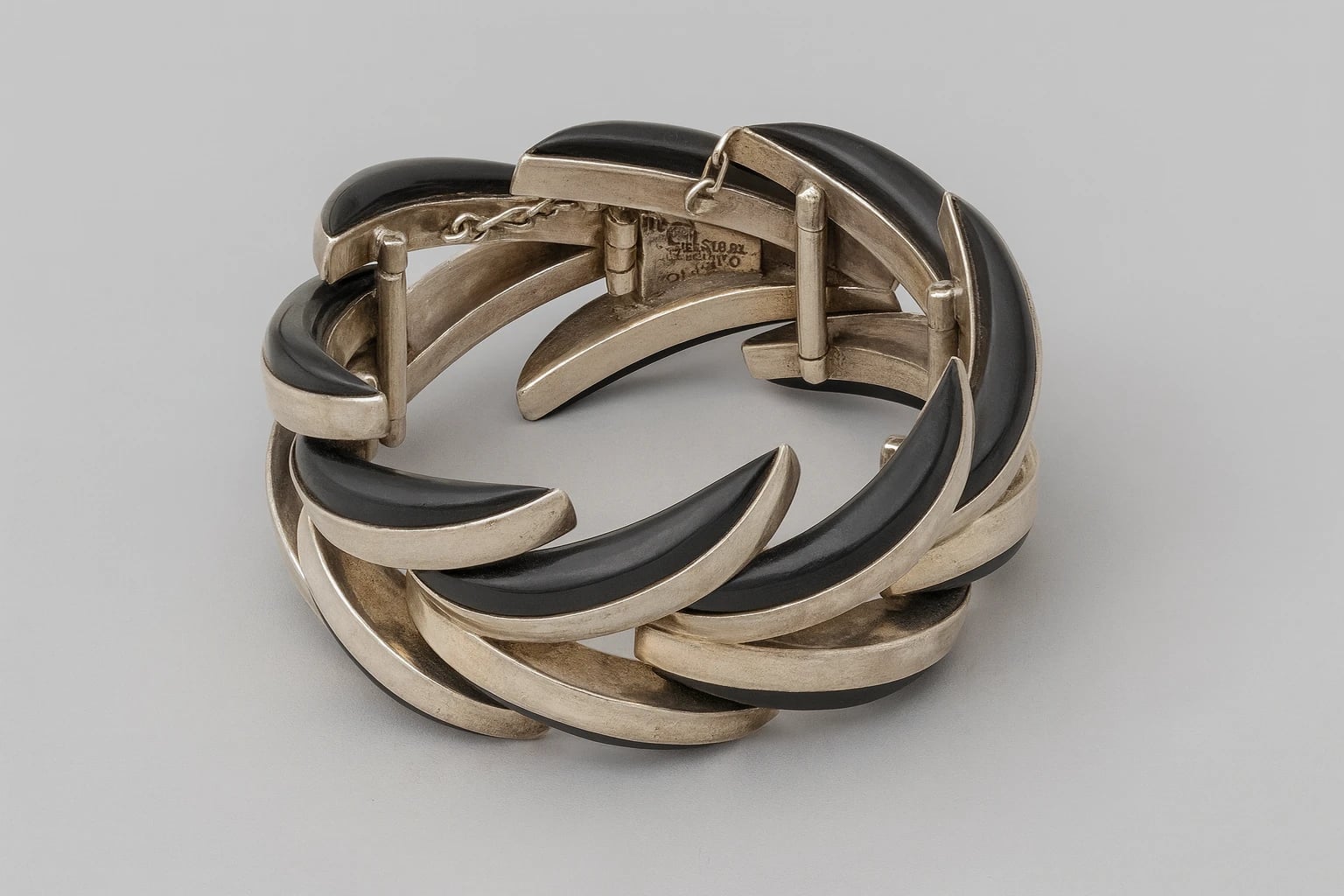
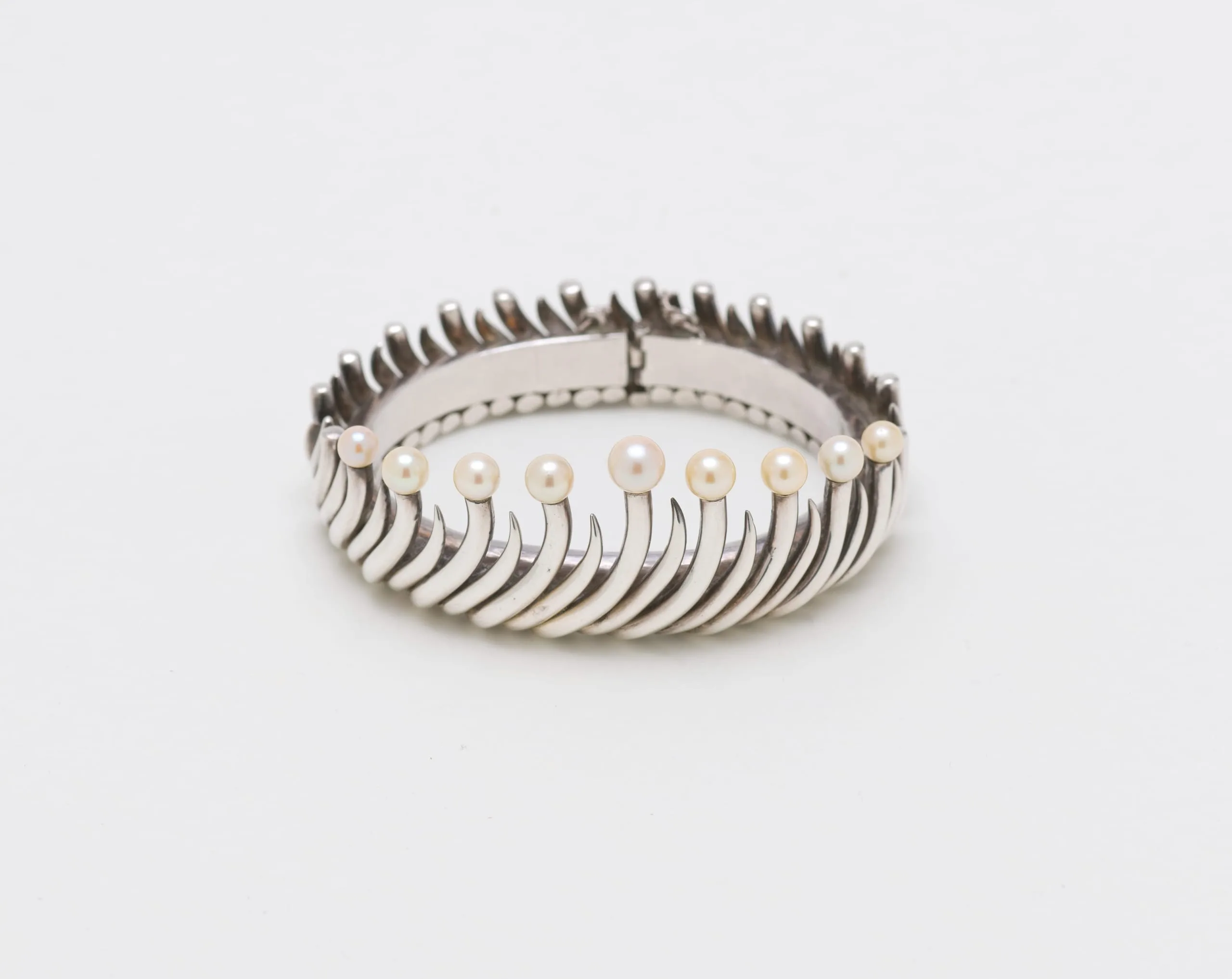
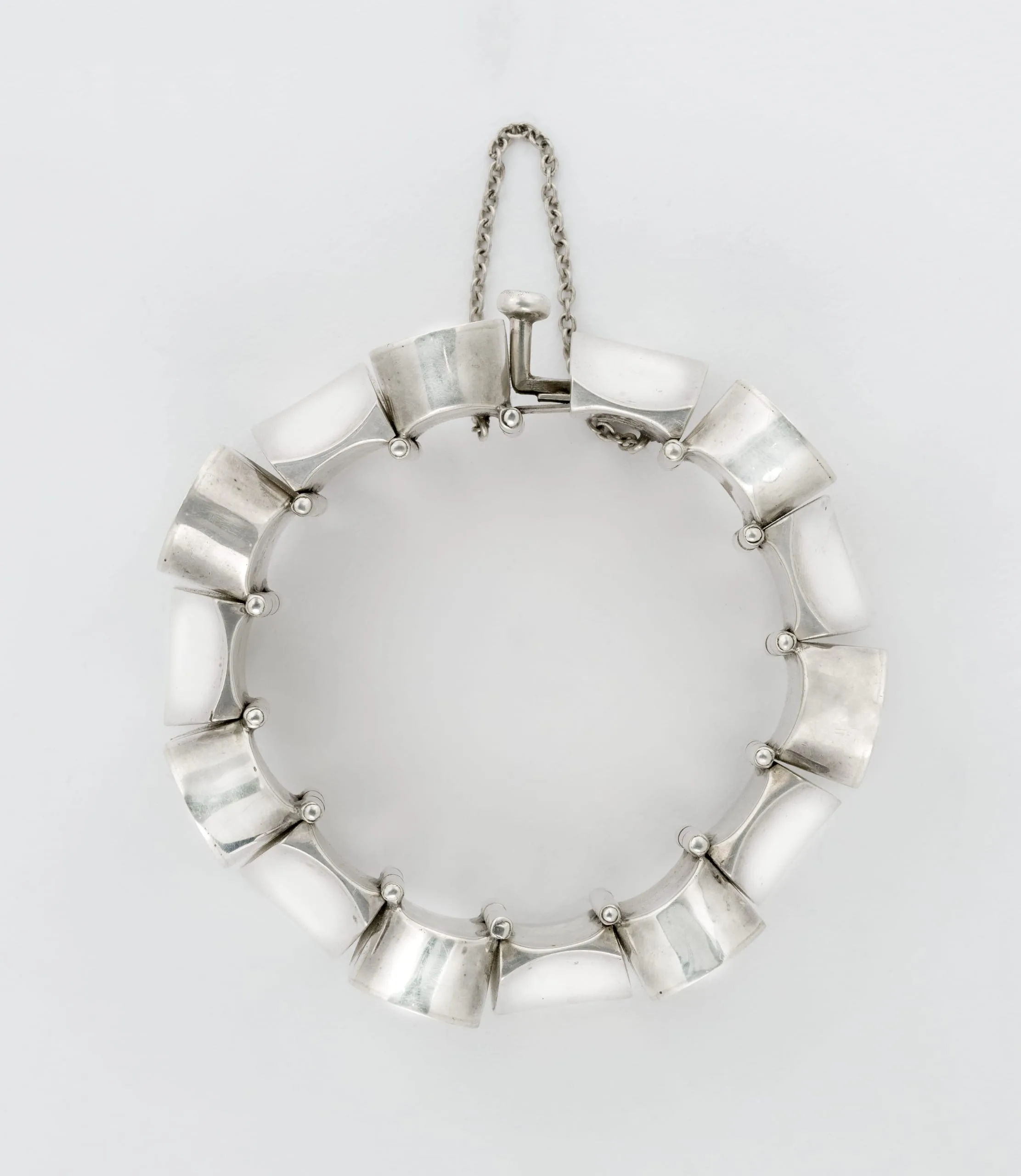
Cylindrical and rigid, this bracelet carries an openwork structure of parallel curved segments arranged around its full circumference, so that the wrist is enclosed within an architecture rather than banded by a solid form. The design belongs to Antonio Pineda's birdcage vocabulary, and the term is exact: hand-cut vertical elements curve outward and return, framing the empty interior the way the ribs of a cage frame air. The bracelet treats negative space as its principal material. Silver defines the volume, but the volume itself is mostly light.
The curves control how the bracelet reads from every angle. Each segment rises from the lower edge, bows outward at the midpoint, and closes again toward the top rim, so the profile swells and narrows as the eye travels around the cylinder. Because the elements repeat at regular intervals, the surface becomes a rhythm of solid and void that shifts continuously with movement and with the play of reflected light across the polished silver. Fabrication here depends on precise hand-cutting and joining rather than casting a single mass; the openwork demands that each curved rib be shaped and set to align with its neighbors and to hold the cylindrical geometry rigid. The result carries visible weight in its structure while enclosing almost nothing, a balance between architectural firmness and near-transparency. The bracelet was conceived as a companion to a necklace built on the same birdcage principle, and the two share a governing logic of curved cage-work that scales from the neck to the wrist.
Pineda directed his own taller in Taxco from the early 1940s, and by the 1950s his work had moved decisively toward this kind of sculptural abstraction, in which a piece of jewelry is organized as a small structure rather than a surface for ornament. The Antonio crown mark with eagle 17, in use from 1953 forward, places this bracelet within that mature period, and Stromberg's study reproduces the design among the works that define it. Pineda's shop operated through specialization and subcontracting, with named smiths such as Fortino Mota, Hilda, and María Pineda executing pieces under the crown mark in later years, so the design authority remained Pineda's while fabrication passed through skilled hands he supervised. The birdcage bracelets show that authority at its most spatial, where the interest lies not in stone or figuration but in how cut metal can describe and hold a hollow volume.
Within the Mexican silver renaissance, Pineda represents the current that pushed jewelry furthest toward independent sculptural form, and this bracelet documents that pursuit at the scale of the body. It records a specific problem the workshop set for itself: how to make a rigid cylinder that reads as a cage of curves rather than a decorated band, and how to keep that cage both structurally sound and visually open. Reproduced in Stromberg's monograph as part of a companion set, it preserves the birdcage idea in its bracelet form and clarifies how Pineda carried a single spatial concept across a suite of objects.
Museum of Mexican Silver. “Birdcage Bracelet.” Catalog no. MoMS-001746. https://museumofmexicansilver.com/pieces/pineda-bracelet-birdcage
See something wrong with this record? Suggest a correction and the piece details fill in automatically.
Record data: Stromberg, Silver Seduction: The Art of Mexican Modernist Antonio Pineda, p. 125, fig. 147b, documents this model. The design number 22679 and the 970 silver standard are taken from that entry and are now entered as structured fields, and the reference is listed under References. The Date field previously read "1953-present," a workshop span; it now reads 1953 or later, which is what the 970 standard supports.
Antonio Pineda
Thumbnail Bracelet
c. 1953
Sterling silver