Saves instantly, no account needed. Already a member? Sign in.
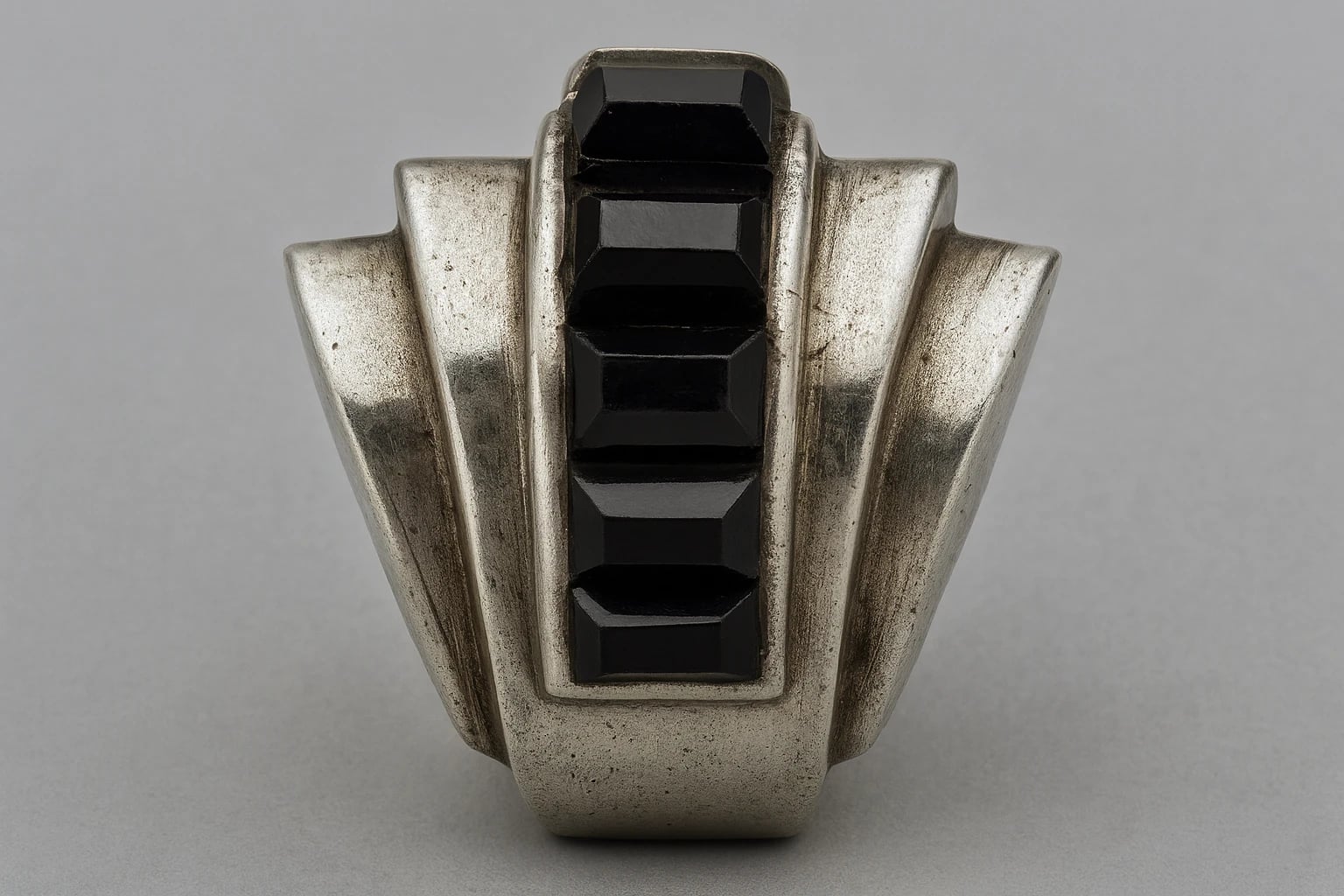
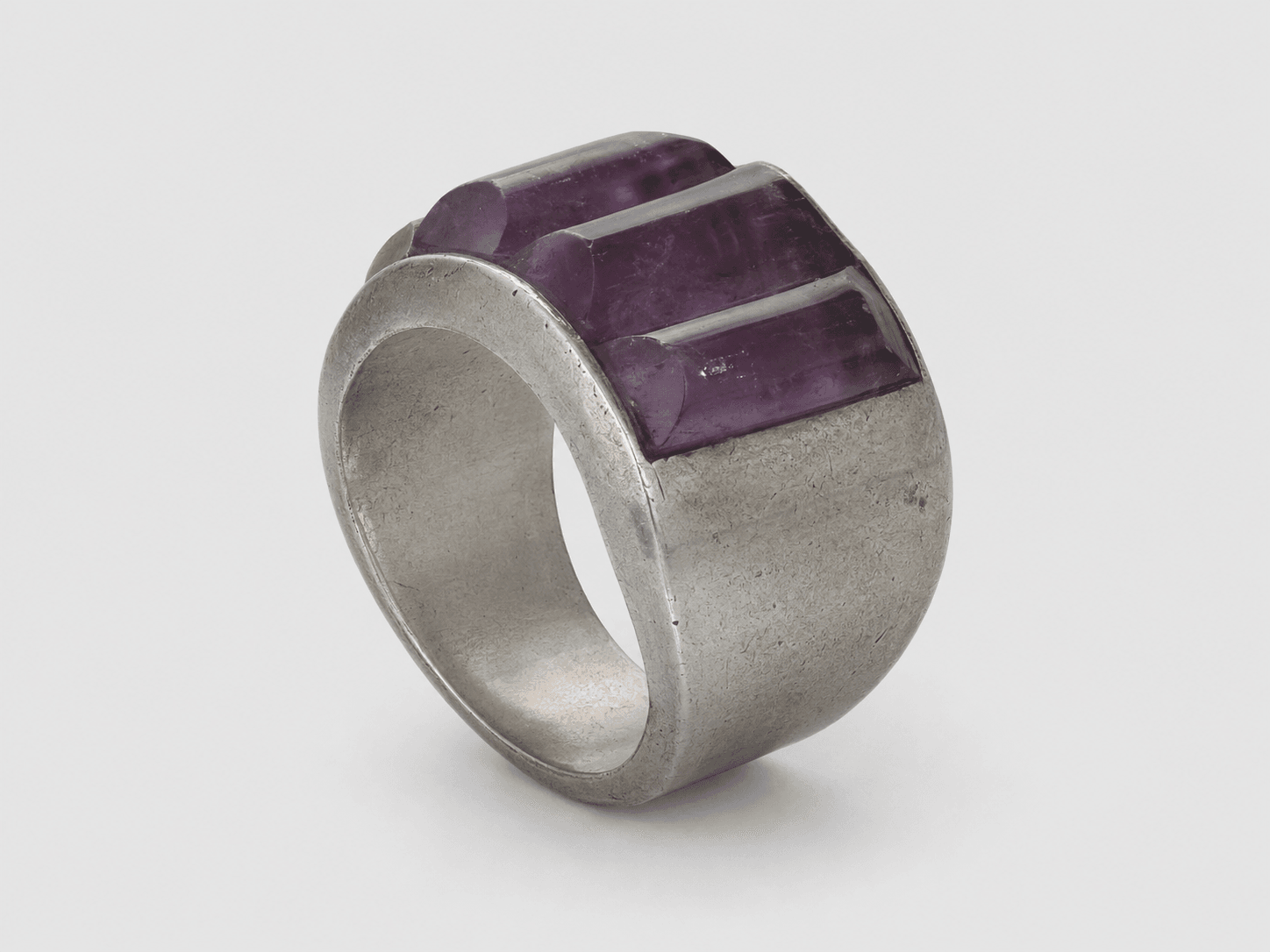
The band of this ring is built almost entirely of stone. Rectangular panels of amethyst, cut with softly curved faces, are set edge to edge around the full circumference, so that the gem does not sit on the ring as an ornament but constitutes its outer wall. Two polished silver rims frame the panels above and below, holding them in a continuous channel and supplying the only visible metal on the exterior. The result reverses the conventional hierarchy of ring design, in which silver forms the body and a single stone provides the accent. Here the silver recedes to a structural frame and the amethyst carries the architecture.
The design depends on disciplined lapidary work as much as on silversmithing. Each panel must be cut to a consistent height and curvature so that the sequence reads as one unbroken cylinder of violet stone, its color shifting from deep plum to a paler translucency as light moves across the rounded faces. The breaks between panels become a quiet vertical rhythm rather than an interruption, and the channel setting conceals every bezel and prong. That concealment is characteristic of Antonio Pineda's mature work, in which settings are engineered into the structure of a piece so that stones appear to float or, as here, to form the surface itself. The interior of the band is smooth silver, so the wearer feels metal while the world sees stone.
The ring carries the Antonio crown hallmark with the 970 fineness stamp and Hecho en Mexico. Hougart records the crown mark as in use from about 1953 onward, and the 970 standard, higher in silver content than sterling, became one of the signatures of Pineda's Taxco workshop, a deliberate statement of quality that distinguished his production. The hallmark establishes the period of manufacture from 1953 forward; the design itself belongs to the body of work Pineda developed as he moved from the retail success of his early years toward the sculptural, stone-integrated jewelry documented in Gobi Stromberg's Silver Seduction, where this ring appears. Pineda ran a substantial taller with skilled maestros and lapidaries, and a piece of this precision reflects that collaborative structure: a design conception executed through specialized hands working to the standard the crown mark guaranteed.
Within the Mexican silver renaissance, the ring illustrates a particular direction Pineda took that few of his Taxco contemporaries pursued as far: treating the gemstone not as a colorful addition to a silver form but as a building material with its own structural role. Amethyst, long mined in Mexico and a recurring stone in Taxco work, is here given an almost architectural treatment, closer in spirit to modernist design principles of unified surface and suppressed ornament than to traditional gem setting. For the Museum's collection the ring documents that side of Pineda's practice concisely, in an object small enough to circle a finger and complete enough to show how his workshop thought about the relationship between metal, stone, and structure.
Museum of Mexican Silver. “Amethyst Panel Ring.” Catalog no. MoMS-001803. https://museumofmexicansilver.com/pieces/pineda-ring-moonstone-silver-swirl
See something wrong with this record? Suggest a correction and the piece details fill in automatically.
Antonio Pineda
Emerald and Gold Ring
18k yellow gold (tested)