Saves instantly, no account needed. Already a member? Sign in.
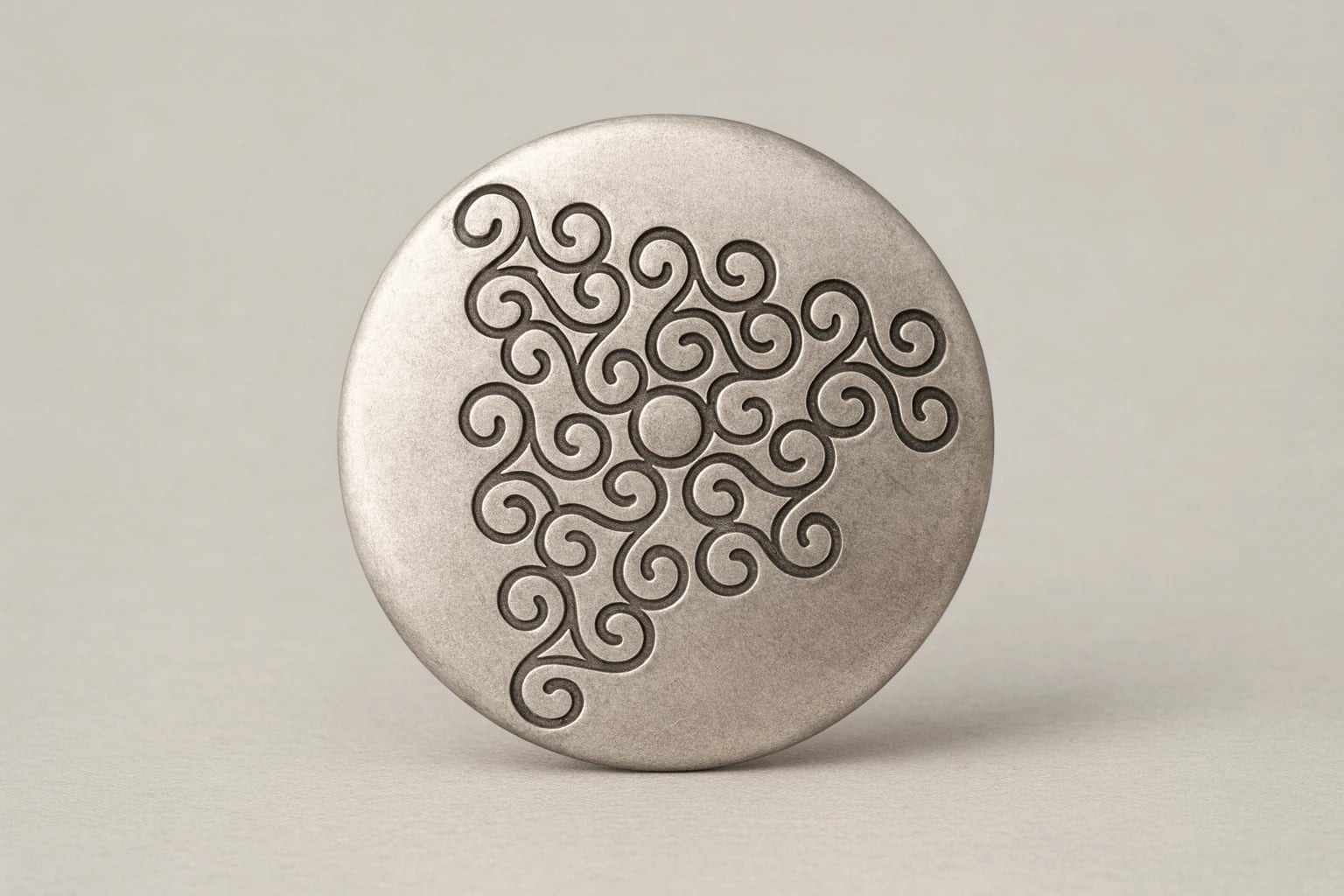
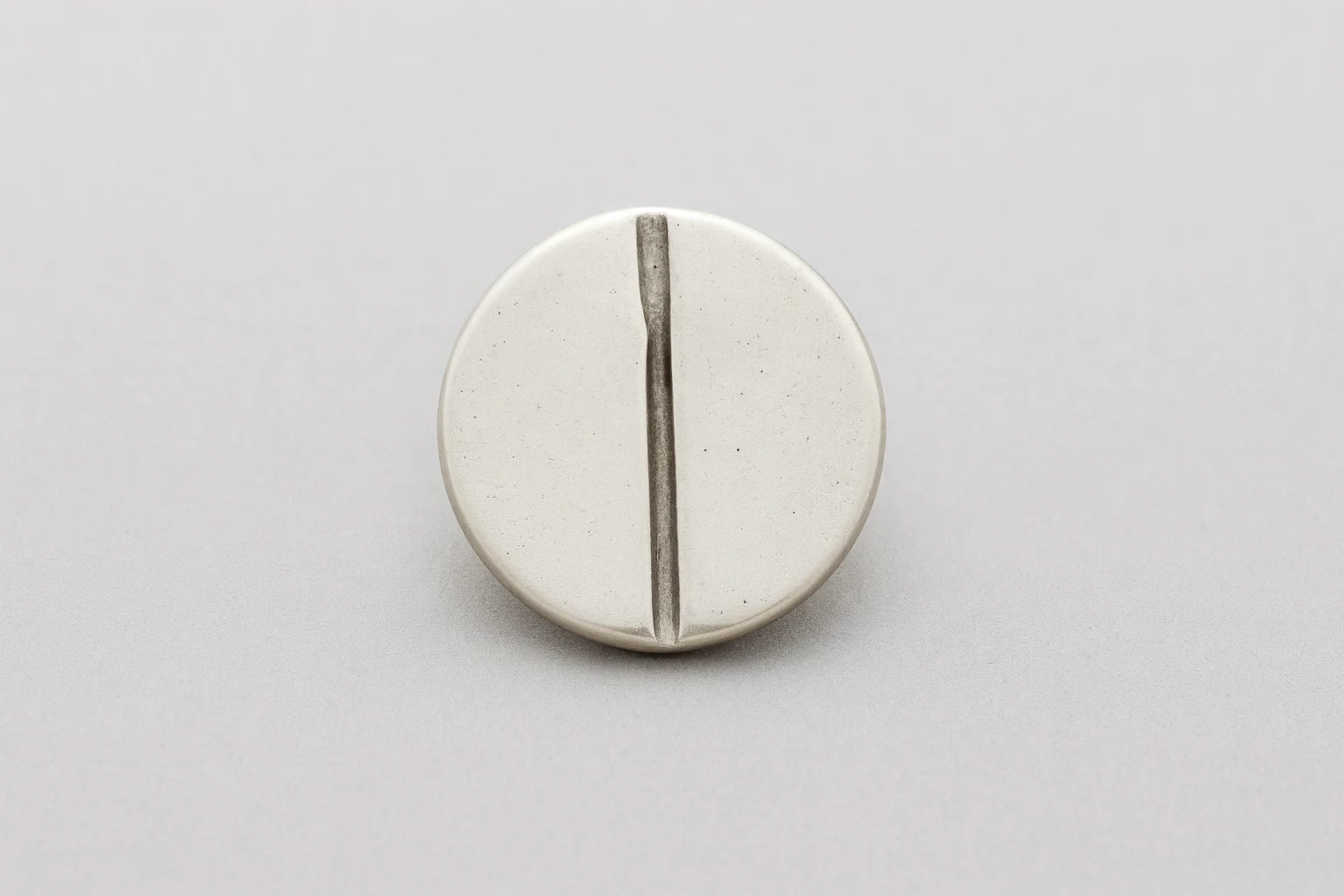
A round silver button divided by a single incised line makes a virtue of restriction. The whole design lives in that central seam, which halves the disc and sets up a quiet play of light: each half catches and returns illumination at a slightly different angle as the wearer moves, so a form with almost no ornament refuses to stay flat. This is Spratling working at the smallest scale in his repertoire, where there is no room for stone, applique, or figural motif, only the geometry of the circle and the discipline of one line.
The button reads as a controlled exercise in mass and division. A circle bisected is among the oldest gestures in ornament, and the interest here comes from how the line is handled rather than from the shape itself. A groove pressed into a convex surface reads as shadow, gathering darkness along the axis while the two flanking fields stay bright, so the eye registers weight and lift at once from a single cut. Buttons demand this economy. They are worked in multiples, sized to a garment, and judged by how they behave under handling and daylight rather than in a display case. The design succeeds because it survives that reduction and still organizes light with intent. The museum record establishes the silver and the maker; the photograph supports the geometry and the surface, though it cannot on its own confirm fineness, gauge, or how the piece was formed.
Buttons occupied a real place in the Taxco workshops, not a marginal one. The silversmith Rafael Dominguez, trained by Spratling from the time he could lift a hammer, was singled out in a 1950 Taxco guidebook specifically for his buttons, and Morrill records his taste for strong linear pattern set against dark ground, the same fascination with line that a bisected disc distills to its minimum. Spratling's own production carried buttons alongside his more ambitious hollowware and jewelry, and the Aguilar reference documents Spratling buttons under a range of marks spanning roughly 1935 to 1955 in both 925 and 980 silver. That span matters for reading this object. Spratling's early Taxco sterling and 980 marks belong to the 1930s, his Spratling Silver and Made in Mexico marks to the 1940s, and his eagle marks to the years after 1948, so a button of this design could have been fabricated across two decades without the design itself shifting. A later fabrication of a simple early idea is no contradiction in a workshop that produced staples for years.
For a collection, the button corrects a habit of judging the Taxco renaissance only by its largest and most theatrical pieces. The workshops sustained themselves on objects like this, small, repeatable, sold to visitors, worn on clothing, and made to a standard that did not relax because the object was minor. A disc and a line, resolved so that light does the work, shows the same design intelligence that governs a Spratling necklace, operating within the tightest possible constraint. It is a useful witness to how the movement actually functioned, and to the fact that its formal seriousness reached all the way down to a button.
Museum of Mexican Silver. “Lined Round Silver Button.” Catalog no. MoMS-000078. https://museumofmexicansilver.com/pieces/spratling-3032
See something wrong with this record? Suggest a correction and the piece details fill in automatically.
William Spratling
Rimmed Button with Ball in Center
Silver