Saves instantly, no account needed. Already a member? Sign in.
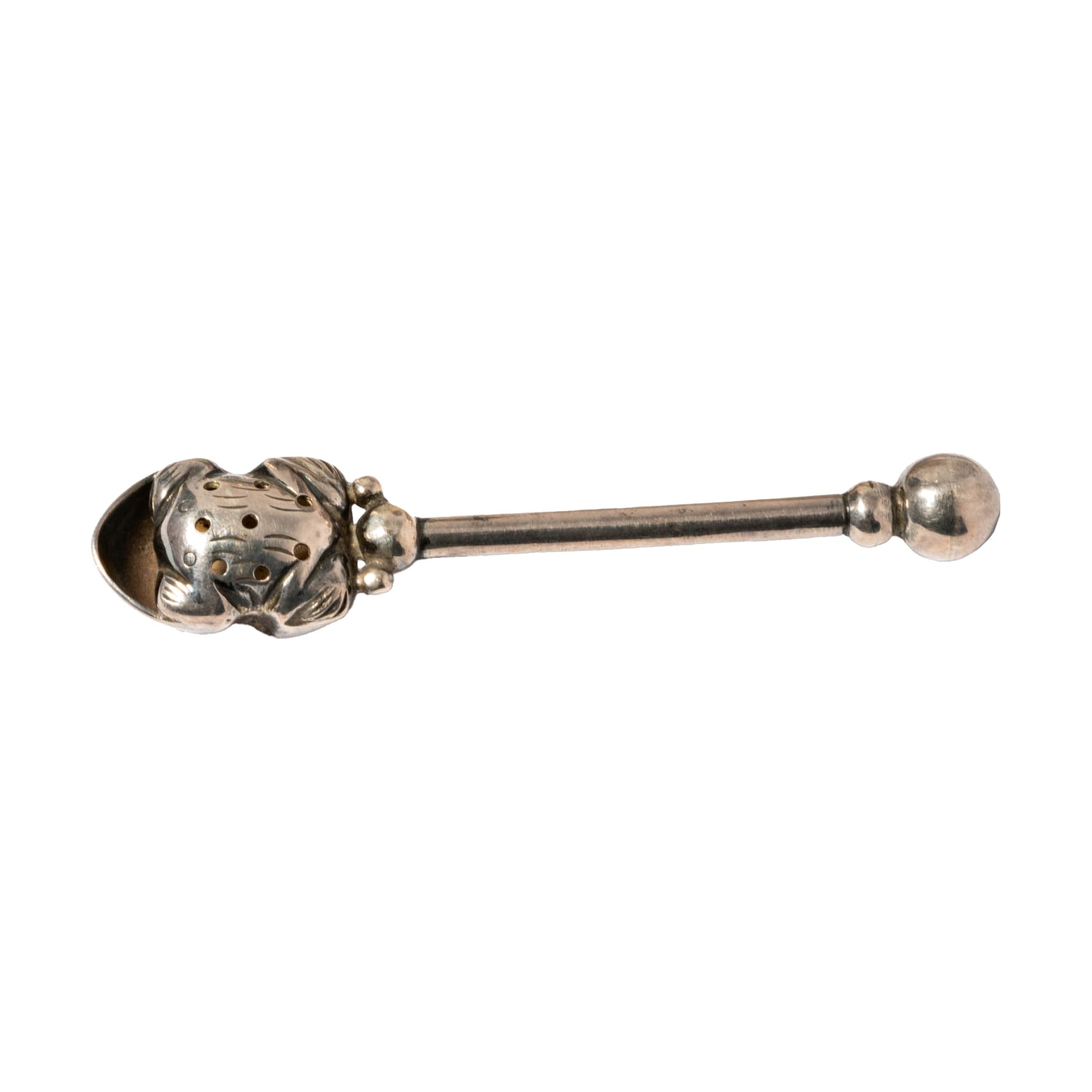
Few objects from the first years of the Taxco renaissance compress as much personality into as little silver as this salt spoon, on which a small chased frog has climbed onto the bowl and settled in as if it owned the table. The design comes from William Spratling's First Design Period, 1931 to 1946, the founding years of the Taller de Las Delicias, and it has become one of the most recognized and best loved of his miniature table pieces. Its fame rests on a simple, durable joke: the frog, a creature of ponds and rain, perches exactly where the salt goes, so that every pinch of seasoning requires a brief negotiation with an amphibian. Serious collectors know the piece on sight, and it has entered the published record repeatedly, appearing in Cederwall and Riney's Spratling Silver, in Morrill's William Spratling and the Mexican Silver Renaissance, and in Goddard's field guide to Spratling's work.
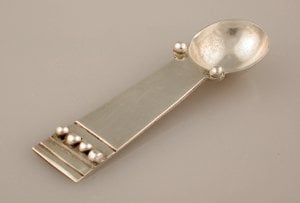
At three and three quarter inches, the spoon organizes itself around a clear contrast. The handle is pure geometry: a slender rod terminating in a sphere and a smaller bead, with paired beads marking the junction at the bowl. Against this restraint, the frog is all incident. Its rounded body is chased with short strokes suggesting skin and musculature, its legs grip the rim of the bowl, and its back is pierced with a scatter of small round openings. That piercing is the technique Taxco silversmiths call calar, cutting through the metal to open a design, one of the fundamental hand processes Morrill records in the vocabulary of the workshops. Here the openings lighten the little sculpture, let shadow move through it, and give the frog's back the mottled quality of the living animal. The composition works because neither half concedes to the other: the plain rod makes the frog funnier, and the frog makes the rod elegant rather than austere.
The frog itself belongs to Spratling's early habit of drawing his animal vocabulary from Mexico rather than from European table silver, where a salt spoon would ordinarily carry a shell, a scroll, or nothing at all. Amphibians, birds, and fish recur across his First Design Period work, part of the broader turn toward Mexico's indigenous and natural imagery that, as Stromberg's account of the period describes, made the recovery of Pre-Columbian and popular sources central to Taxco's Silver Age. Placing such a creature on a functional implement, and doing it with wit rather than solemnity, was characteristic of how Las Delicias translated that program into objects people actually used. The conjoined WS mark on this example is the early stamp of the workshop, tying the spoon directly to those founding years.
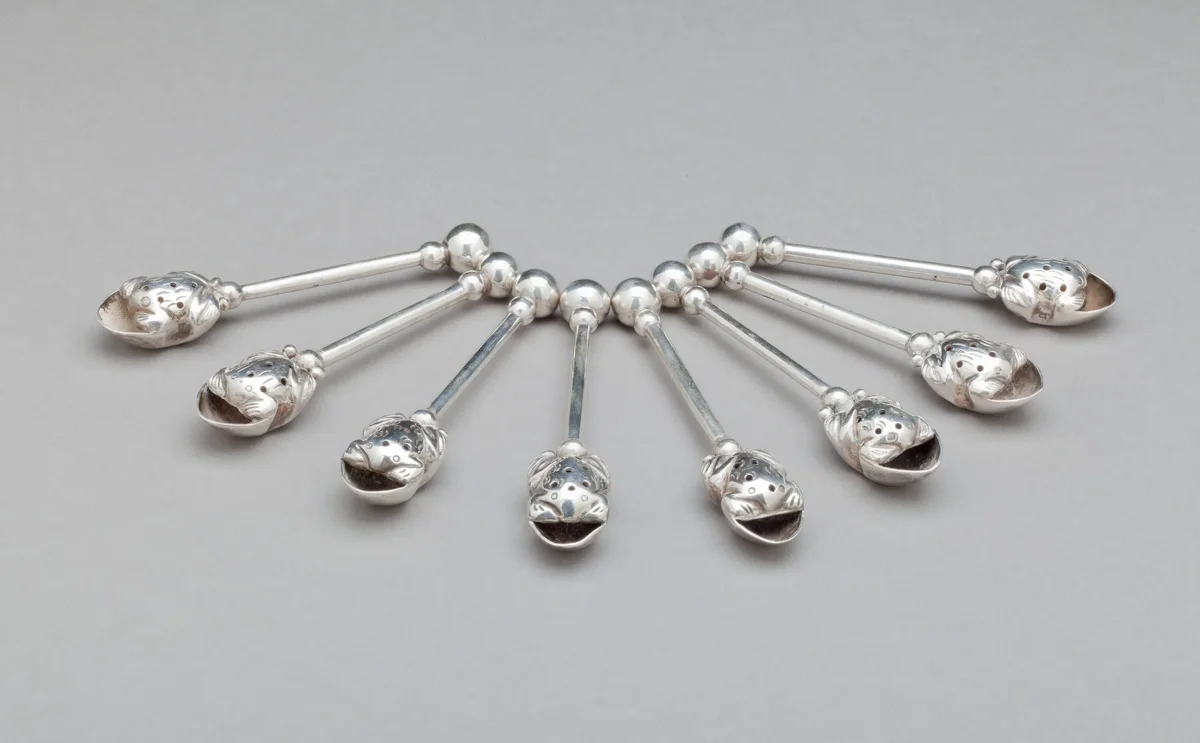
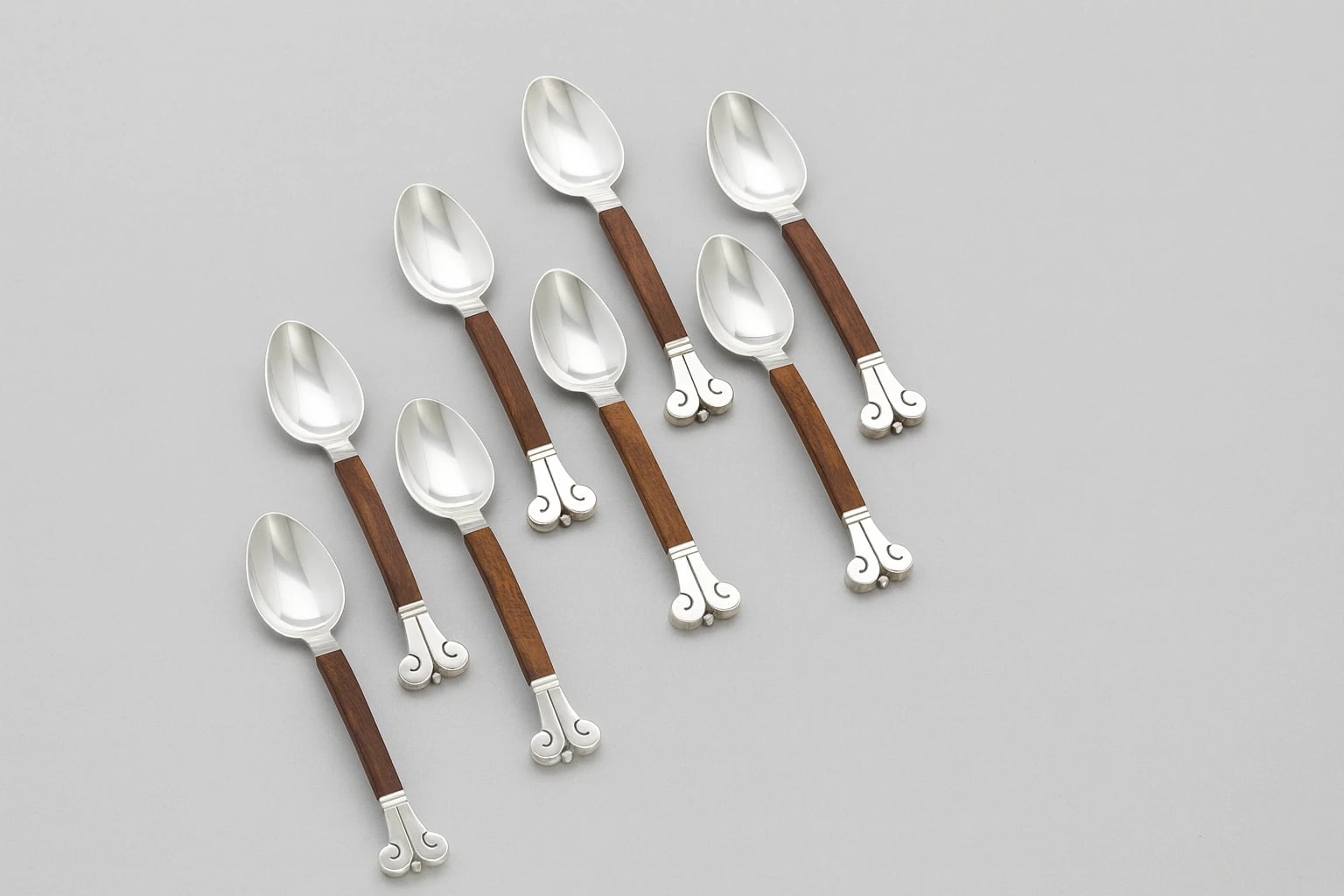
Set of Frog Spoons, circa 1940
Accession M.2013.211.1a-h. Official museum record Photo: Los Angeles County Museum of Art.
Verified against each institution's own collection records. All museum collections
Museum of Mexican Silver. “Frog Salt Spoon.” Catalog no. MoMS-000349. https://museumofmexicansilver.com/pieces/spratling-427
See something wrong with this record? Suggest a correction and the piece details fill in automatically.
Small table wares like this one carried the renaissance into daily life more effectively than any exhibition piece. A salt spoon is handled, passed, noticed, and remembered, and this design was clearly made to be remembered. For the Museum, the piece documents the lighter register of Spratling's early output: the same hand skills of chasing and calar that built his monumental hollowware, deployed at thumbnail scale in service of a joke that has now lasted the better part of a century. It is a reminder that the Taxco School's ambition included charm, and that charm, executed this precisely, is its own kind of design achievement.
William Spratling
Four Ball Salt Spoon
First Design Period: 1931 - 1946
Silver