Saves instantly, no account needed. Already a member? Sign in.
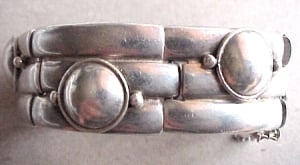
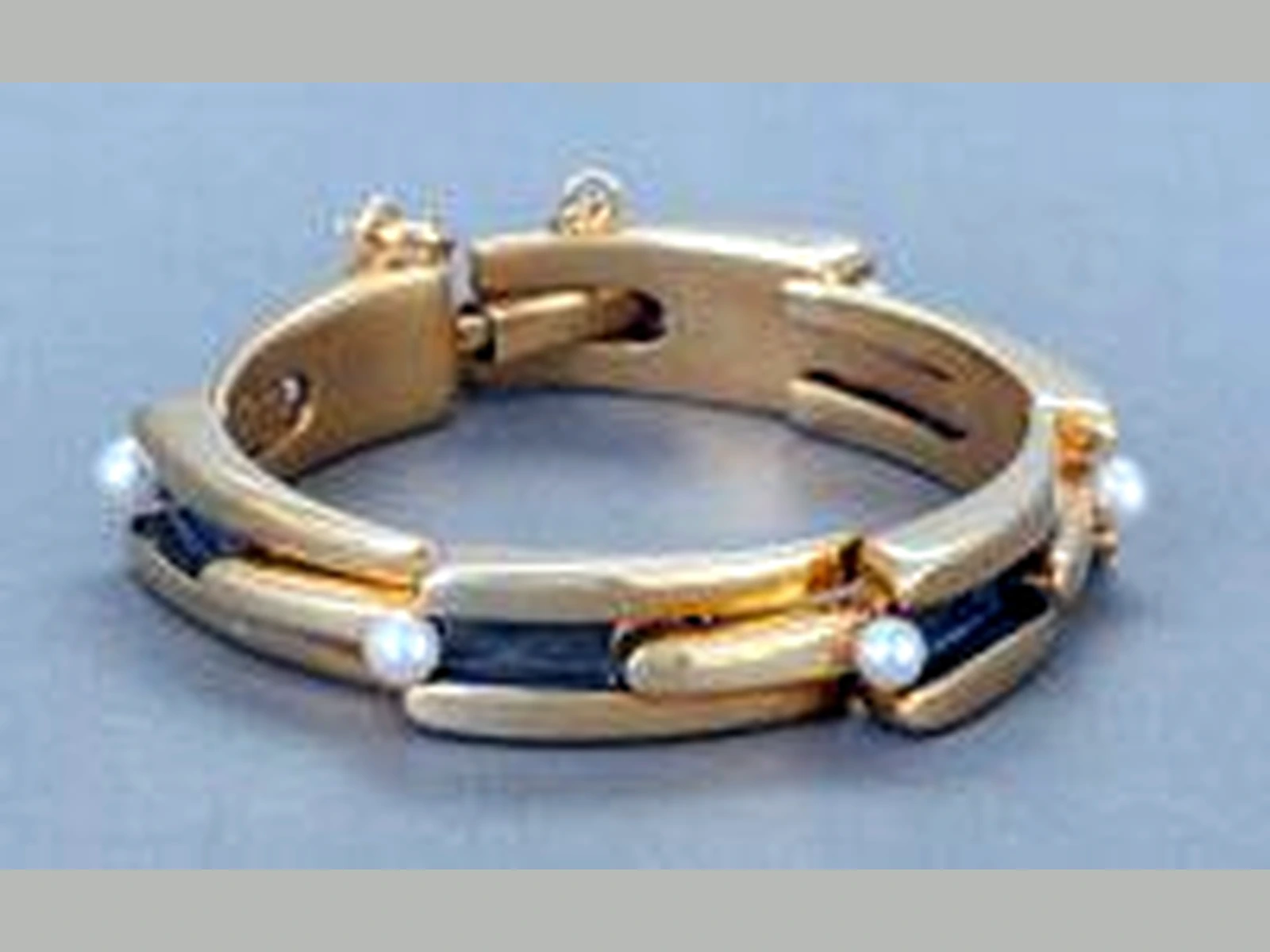
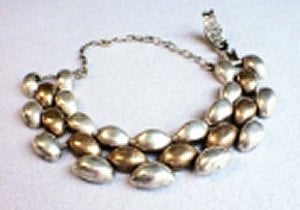
Silver and bronze alternate here in a band of elongated beads, each one tapering to a point so that the row reads as a sequence of suspended teardrops. The pairing of two metals is the governing idea. Silver holds a cool, reflective surface while bronze warms and darkens beside it, and the alternation turns a simple strand of beads into a study of color and light along the wrist. Spratling rarely let material serve only as material. In this bracelet the contrast between the two metals carries the design, and the beads become a rhythm rather than a mere accumulation of parts.
The beads themselves are shaped rather than round, drawn out at both ends until each resembles a drop of liquid caught mid-fall. Strung in series, they produce a repeating point-to-point cadence that runs the length of the band. Because the forms taper, the eye moves quickly from one to the next, and the negative space between the tips becomes part of the pattern. The bracelet is recorded in silver with bronze as the secondary metal, and the two materials would present slightly different weights and temperatures against the skin, giving the piece a tactile variation to match its visual one. The result is restrained. There is no applied ornament, no stone, no engraved surface. The design rests entirely on shape, sequence, and the meeting of two metals.
The work belongs to Spratling's First Design Period, the years between 1931 and 1946 that followed his founding of the Taller de Las Delicias in 1931 and the reorganization of design and production that helped set the course of the Taxco renaissance. His use of bronze alongside silver reflects the experimental production culture that Stromberg and others have described in the Taxco workshops, where innovation in materials and form was treated as central rather than incidental. The bracelet is documented in Phyllis Goddard's field guide to Spratling silver, which situates it within the body of work by which his designs are recognized. Spratling worked at the head of a taller in which master smiths translated his designs into finished objects, and this bracelet, with its clean geometry and its reliance on repeated modular units, shows the kind of production intelligence that structure made possible.
What this bracelet preserves is Spratling's habit of building ornament from the honest behavior of metal. The teardrop beads are a modest vocabulary, but the alternation of silver and bronze gives the band its character and demonstrates how early Taxco design found sophistication in material contrast rather than in decoration. For a collection tracing the Mexican silver renaissance, it records an early moment when a designer treated two metals as a deliberate palette and let their difference do the work.
Museum of Mexican Silver. “Bronze and Silver Bead Bracelet.” Catalog no. MoMS-000281. https://museumofmexicansilver.com/pieces/spratling-73
See something wrong with this record? Suggest a correction and the piece details fill in automatically.
William Spratling
Cuff Bracelet Overlaid with Tortoise Shell
Second Design Period: 1949 - 1951
Silver