Saves instantly, no account needed. Already a member? Sign in.
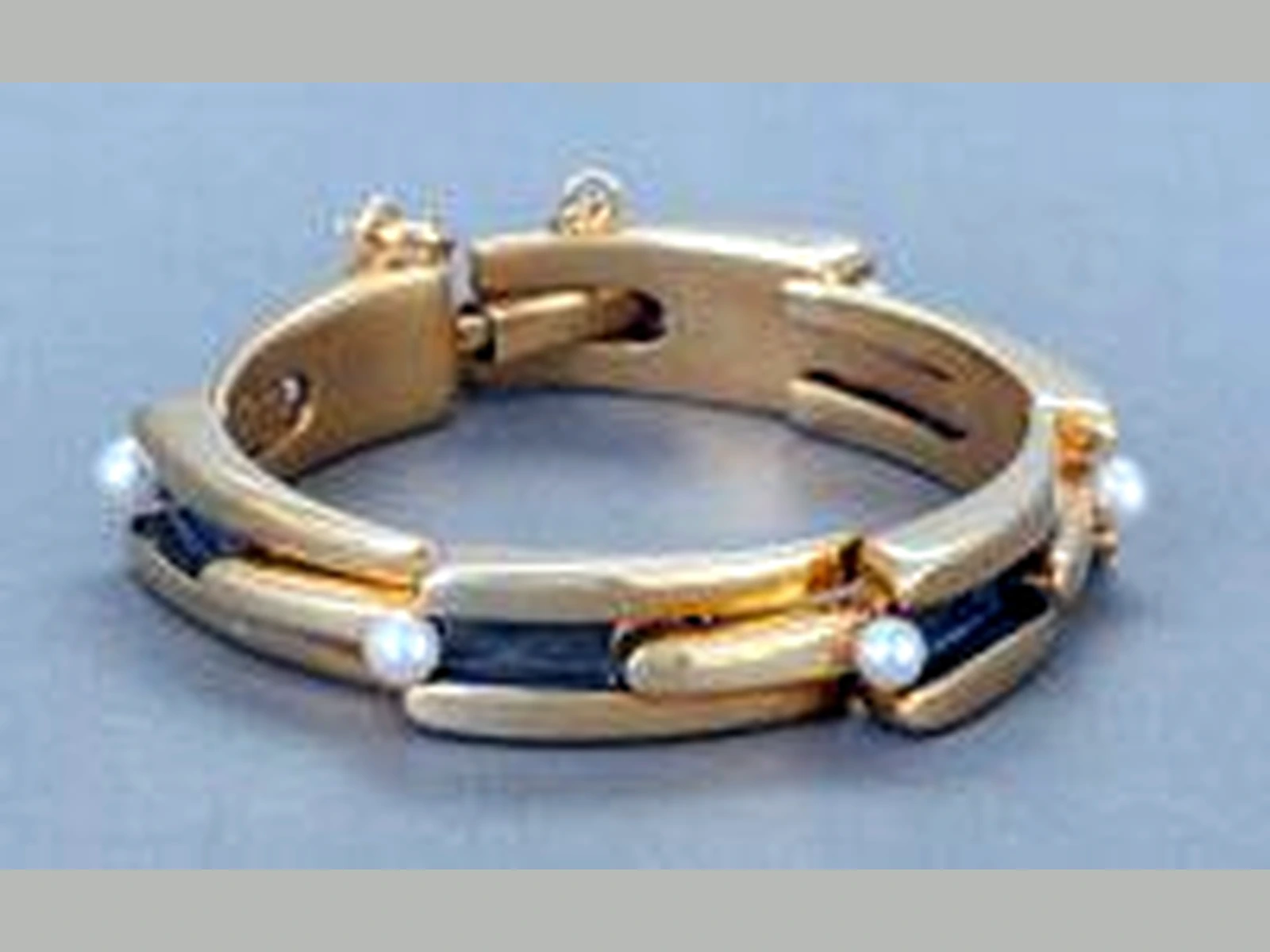
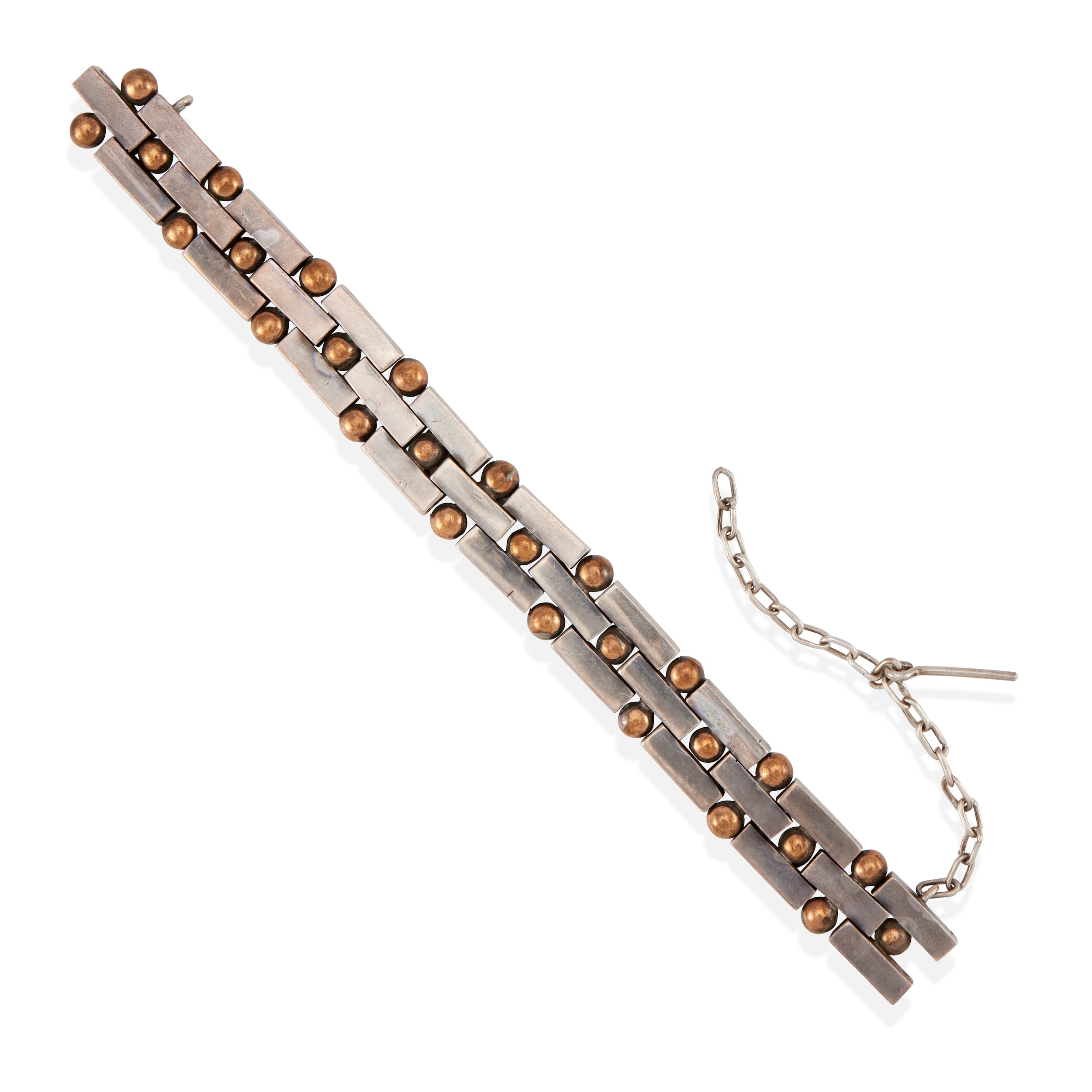
The bracelet organizes silver into three stacked tiers of rectangles, holding them apart with small bronze balls that sit at the joints like structural bearings. The result is a design that treats a bracelet as an exercise in interval. Space, not surface, carries the effect. The bronze spheres do double duty, functioning as spacers that establish rhythm and as the second metal whose warmer color plays against the cool sheen of the silver. Where much period jewelry filled the wrist with ornament, this design withholds, letting the gaps between rectangles do the work that engraving or repoussé would do elsewhere.
That restraint reflects a specific decision about how metal moves and reads on the body. The tiered rectangles must articulate for the band to curve around the wrist, and the bronze balls provide the pivots that let one row shift against the next. The eye reads three continuous horizontal registers, but the construction is modular, built from discrete units that flex at each junction. Silver here is handled as an architectural material, cut and set into a grid rather than hammered into flowing organic form. The bronze balls keep the geometry honest: they mark every seam instead of hiding it, so the mechanism of the bracelet becomes its ornament. The two metals are not blended but set in deliberate contrast, each color assigned to a role, silver to the planes and bronze to the joints.
The bracelet belongs to Spratling's First Design Period, the years following his 1931 founding of the Taller de Las Delicias, when the workshop was building the vocabulary that would define the early Taxco School. Combining silver with bronze was one strand of that experimental program, a way of thinking about color and contrast in metal that set Spratling's output apart from conventional silver jewelry. The taller system Spratling helped organize made exactly this kind of controlled, repeatable geometry possible, since designers could work with master smiths who translated a drawing into production units. The design carried well beyond Taxco: it appeared in the 1943 Montgomery Ward Christmas Book priced at $22.95, which placed a Spratling design in one of the largest mail-order catalogues in the United States. Spratling's cultivation of North American markets, documented across the literature on Taxco's silver age, is visible in that single catalogue listing, evidence of how a Taxco workshop reached ordinary American buyers rather than only expatriate collectors and Hollywood visitors.
The design's window was narrow. It ran in the Spratling wholesale catalogues only in 1944 and 1945, a short commercial life that bracketed the Montgomery Ward appearance. It is recorded in the standard Spratling references, including Cederwall and Riney's Spratling Silver and Goddard's field guide, which anchor it firmly within the documented First Period repertoire. For a collection tracing the early Taxco School, the bracelet is useful precisely because it shows Spratling working in a spare geometric mode with a two-metal palette, and because its catalogue history ties a surviving object to a specific moment when Taxco design entered the American mass market.
Museum of Mexican Silver. “Geometric Bracelet with Inset Bronze Balls.” Catalog no. MoMS-000428. https://museumofmexicansilver.com/pieces/spratling-946
See something wrong with this record? Suggest a correction and the piece details fill in automatically.
William Spratling
Carved Silson Link Bracelet
First Design Period: 1931 - 1946
Silver Plate