Saves instantly, no account needed. Already a member? Sign in.
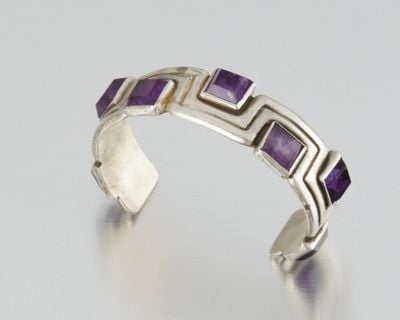
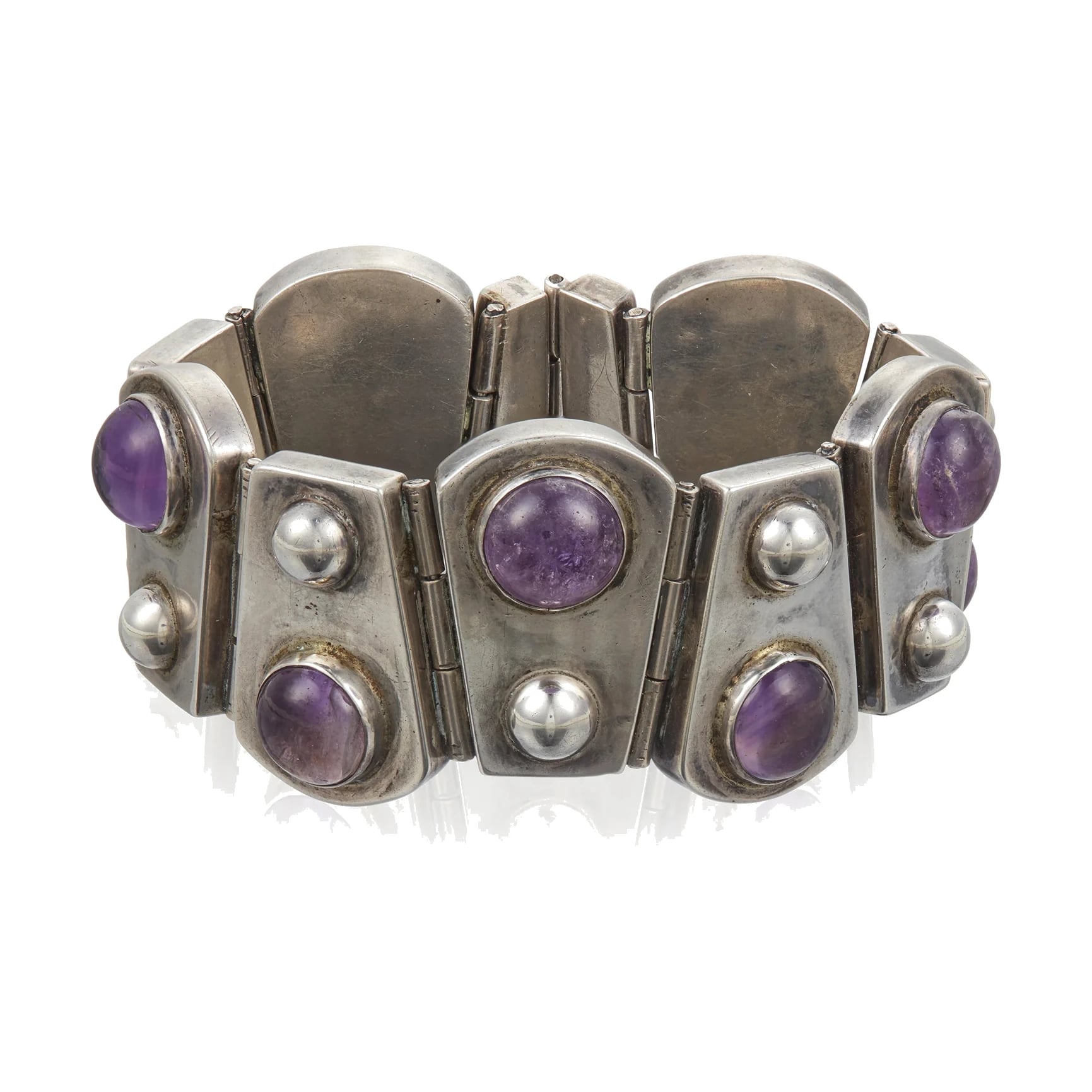
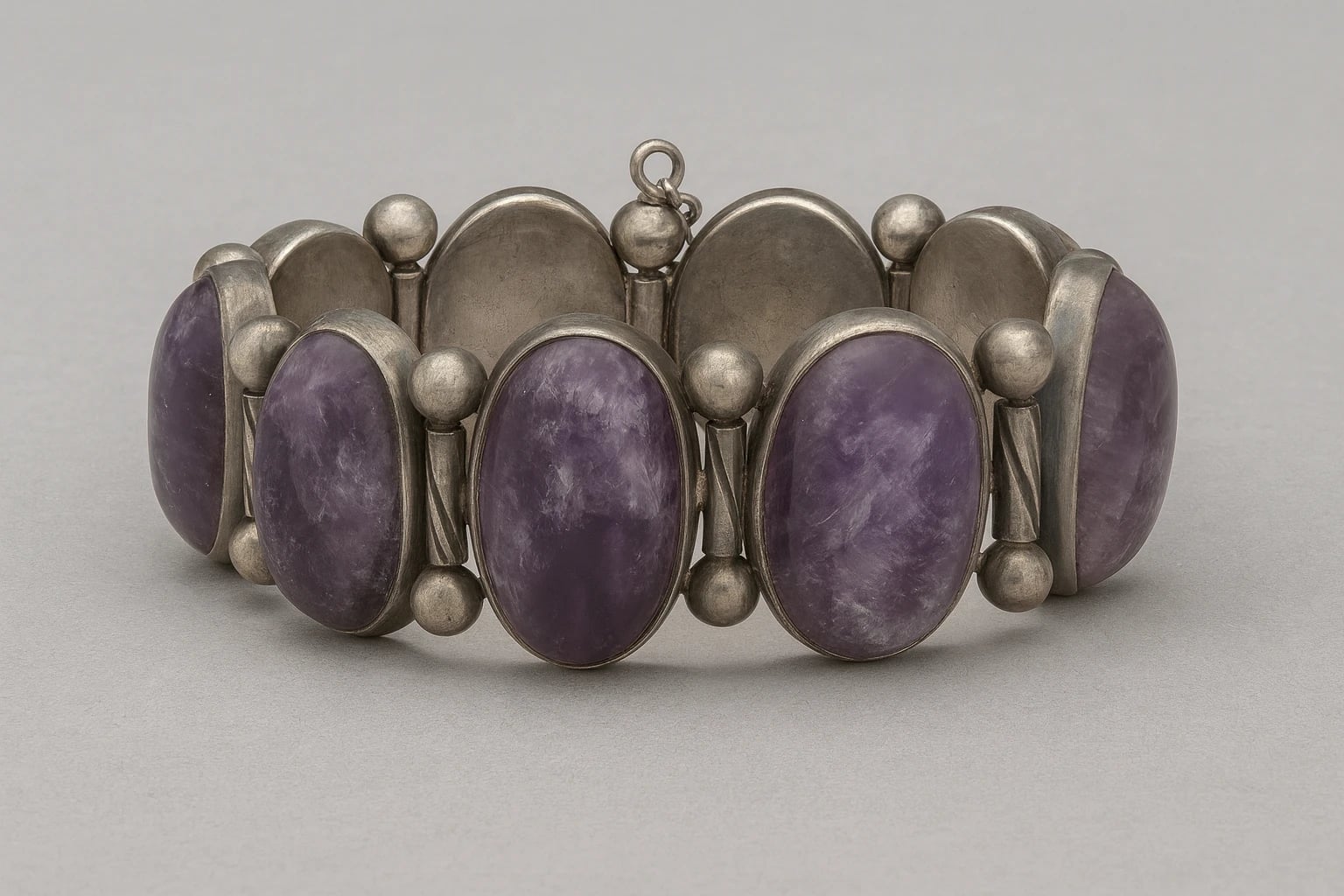
The bracelet builds its rhythm from three distinct silver events: roped links whose twist catches and breaks the light, smooth beads that gather it into rounded points, and amethyst cabochons that stop the metallic reflection with pooled violet. Aguilar sets these against one another so the eye moves along the band in a measured cadence, hard shine to soft shine to translucent color, then repeats. The purple stones are cabochon cut rather than faceted, which keeps them domed and quiet, reading as weight and depth instead of glitter. That restraint is the point. Where a jeweler chasing luxury would multiply facets, Aguilar lets the amethyst behave like a considered accent within a structure governed by silver.
The roped links are the design's engine. Twisting the wire into a braided or corded surface gives Aguilar a texture that reflects light in many small directions at once, so the metal never goes flat or dead between the stones. The same braided idea recurs across his amethyst bracelets, where Morrill describes boldly braided hinges echoing the beading that surrounds the stones, a strategy of rhyming one ornamental element against another so the whole band feels internally consistent. Here the silver beads perform that echo, their rounded volumes answering the domed cabochons. Articulation matters too. A bracelet must curve around the wrist, and Aguilar's linked construction lets the band flex while holding its cadence, turning the mechanical necessity of movement into part of the ornament rather than something to conceal.
Héctor Aguilar founded his Taller Borda in Taxco in 1939 after years managing William Spratling's Taller de Las Delicias, and he brought to his own workshop a taste for substantial silver, strong architectural forms, and the disciplined use of Mexican amethyst quartz. His workshop produced a sustained family of amethyst bracelets through the 1940s and beyond, documented by Morrill in variants that pair the stones with braided hinges, flanged settings, domes, and beading. This bracelet belongs to that family without simply repeating any one recorded example. The Taller Borda operated as a collaborative shop, and Morrill credits designers within it, among them Dámaso Gallegos, whose amethyst bracelet with braided hinges and beaded surrounds shows how deeply the roped-and-beaded vocabulary ran through the workshop. Attribution to Aguilar names the design authority and the mark under which the piece was made, not necessarily the single hand that fabricated it.
What the bracelet contributes is a clear reading of how the Taxco renaissance treated color and metal as equal partners in a modern object. The amethyst is not there to signal wealth. Its opacity and cool violet exist to interrupt the silver's brilliance at fixed intervals, giving the band its structure of pause and continuation. That is a modernist proposition worked out in a wearable form: ornament derived from the honest behavior of materials, rhythm built from repetition and contrast rather than pictorial decoration. Within Aguilar's output, the roped links and beads place this bracelet squarely in his most recognizable idiom, and within the broader silver renaissance it demonstrates that a Taxco taller could carry design ideas as rigorous as those found in the period's furniture, architecture, and sculpture.
Museum of Mexican Silver. “Bracelet with Amethyst Cabochons, Roped Links, and Silver Beads.” Catalog no. MoMS-001344. https://museumofmexicansilver.com/pieces/aguilar-bracelet-amethyst
See something wrong with this record? Suggest a correction and the piece details fill in automatically.
Héctor Aguilar
Fertility Bracelet
1939-1962
Silver