Saves instantly, no account needed. Already a member? Sign in.
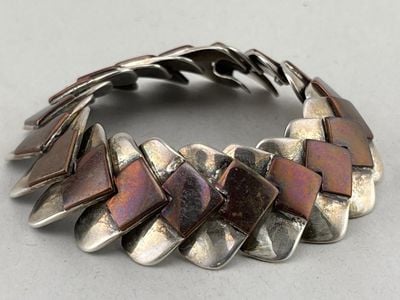
Copper links shaped into hearts turn a sentimental motif into a study of rhythm and repetition, and that is the quiet ambition of this bracelet. Héctor Aguilar worked copper with the same seriousness other Taxco makers reserved for silver, and the heart here is not a charm but a structural unit, repeated along the wrist so that the eye reads a chain of forms rather than a single emblem. The warm red of copper does the work that silver's reflectivity would do differently, absorbing light instead of throwing it back, and giving the bracelet a density and warmth against the skin that a comparable silver piece would not share.
The strength of the design lies in how the hearts are joined and how the bracelet moves. Aguilar favored articulated construction in which each element carries its own weight and hinges against its neighbors, so a bracelet drapes and flexes rather than sitting rigid on the wrist. Copper permits this without the expense of high-fineness silver, and Aguilar treated the metal as a legitimate material in its own right, not a substitute. Morrill's survey of his work records copper and silver bracelets across the 1940s and into the 1950s, including wire and combination pieces, which places a copper heart bracelet firmly within his working vocabulary rather than at its margin. The repetition of a single motif, disciplined and even, is characteristic of his approach: he tended to build ornament from controlled multiplication rather than from a single dramatic gesture.
Aguilar founded his own workshop, the Taller Borda, after leaving the commercial side of Spratling's operation, and he built a production that used copper, brass, and silver with equal confidence. Hougart's hallmark reference documents Aguilar marks struck specifically on copper and on brass, evidence that these were not incidental experiments but a recognized part of the taller's output. The design period assigned to this bracelet, 1939 to 1962, spans the life of that workshop, and the copper marks recorded in the literature fall on both sides of the 1948 introduction of the eagle assay number. Within the Mexican silver renaissance, Aguilar's willingness to make ambitious, well-constructed jewelry in copper distinguishes his taller from workshops that treated silver as the only material worthy of serious design.
For a collection, the bracelet documents the part of Aguilar's practice that copper made possible: strong form carried by an inexpensive metal, and a designer confident enough to let material warmth, rather than precious content, define the object. It records a workshop that took base metals seriously and a designer whose sense of rhythm held whether the medium was 940 silver or copper. The heart, so easily reduced to sentiment, becomes in his hands a repeating architectural element, and that transformation is what the bracelet preserves.
Museum of Mexican Silver. “Copper Heart Bracelet.” Catalog no. MoMS-001343. https://museumofmexicansilver.com/pieces/aguilar-bracelet-copper
See something wrong with this record? Suggest a correction and the piece details fill in automatically.
Héctor Aguilar
Maguey Bracelet
circa 1940
Silver