Saves instantly, no account needed. Already a member? Sign in.
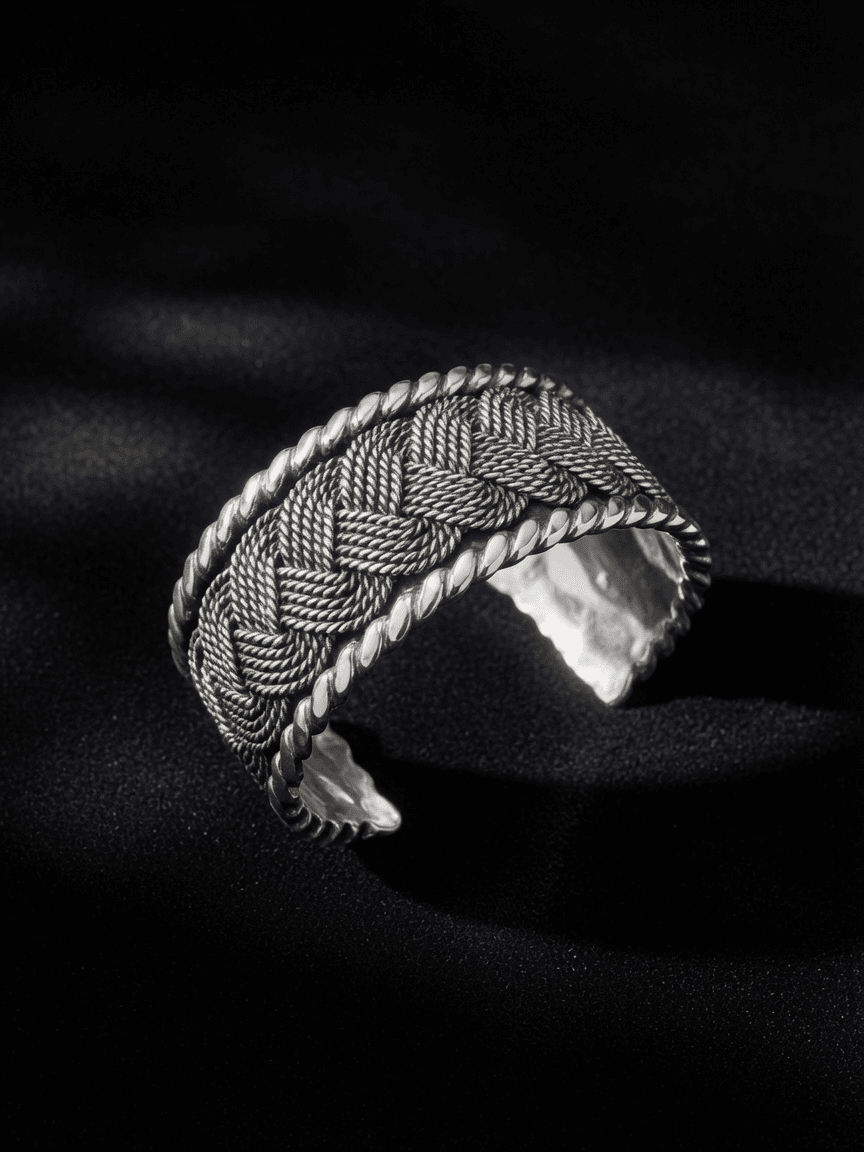
A cuff built from twisted rope-braid strands, closed at each end by smooth silver balls, states its intentions through mass and surface rather than applied ornament. The braid gathers the eye along the wrist, its diagonal ridges catching and breaking light as the arm turns, while the polished terminals arrest that motion with two calm, rounded stops. This is silver understood as a plastic material worked in the hand, where the design lives in the weight and torsion of the metal itself. Among Héctor Aguilar's bracelet forms, the rope-braid cuff is one of the clearest demonstrations of weight functioning as a design element.
The braid is the whole event. Individual strands are twisted and drawn together so that the surface reads as continuous rhythm, a series of oblique ridges that repeat around the band without a single flat passage to interrupt them. Against that busy, tactile field, the ball terminals supply contrast through pure geometry and reflection. The transition from twisted rope to smooth sphere is the bracelet's one moment of formal wit, handled with restraint rather than display. Because the cuff is open rather than hinged, it depends on the springiness and heft of the metal to hold its shape on the wrist, and the density of the braid gives it the substance to do so. Sterling silver here carries meaning through its physical presence: the coolness, the audible and tactile weight, the way a heavy handwrought band settles against the arm.
Aguilar founded the Taller Borda in Taxco in 1939, after years managing William Spratling's Taller de Las Delicias, and this cuff shows both what he took from that period and where he departed from it. The commitment to heavy, handwrought silver over engraved or repoussé surface decoration is continuous with Spratling's ethos, which valued the material worked directly and generously. Yet the Borda language is more compressed and forceful. Where Spratling often let a single motif breathe within open space, Aguilar fills the band edge to edge with dense, insistent structure, so that the design registers first as mass and rhythm. The rope-braid construction places the bracelet within a Mexican modernist current that found its formal ideas in the behavior of the metal rather than in imported ornamental vocabulary. Aguilar's documented range in bracelets was wide, from copper and silver combinations to amethyst-set bands and wire constructions, and the rope-braid cuff belongs among the forms in which he worked silver alone at its most tactile.
It should be noted that Aguilar's production also passed at times through outside manufacturers, since Conquistador S.A. produced items marked for both William Spratling and Héctor Aguilar. That fact bears on how such workshop objects reached the market and how the Borda mark circulated. As a museum object, the rope-braid cuff records a designer building a distinct identity out of the heavy-silver tradition he knew intimately, compressing it into something more forceful and immediate, and holds a characteristic and fully resolved example of Aguilar's thinking about weight as form.
Museum of Mexican Silver. “Rope-Braid Cuff Bracelet.” Catalog no. MoMS-001960. https://museumofmexicansilver.com/pieces/aguilar-heavy-rope-braid-cuff-bracelet-with-ball-termina-15
See something wrong with this record? Suggest a correction and the piece details fill in automatically.
Héctor Aguilar
Sterling Silver and Onyx Cuff Bracelet
Sterling silver