Saves instantly, no account needed. Already a member? Sign in.
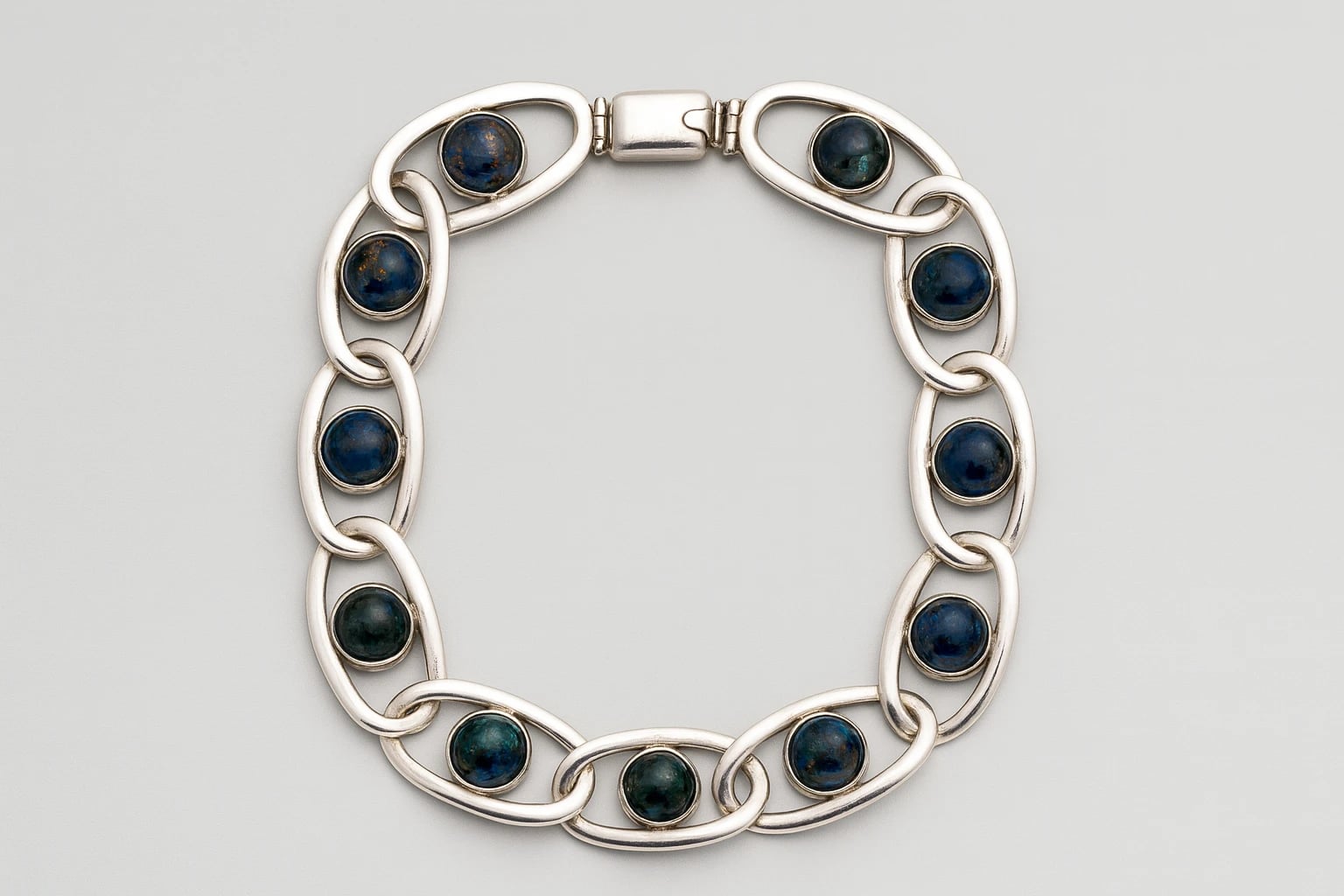
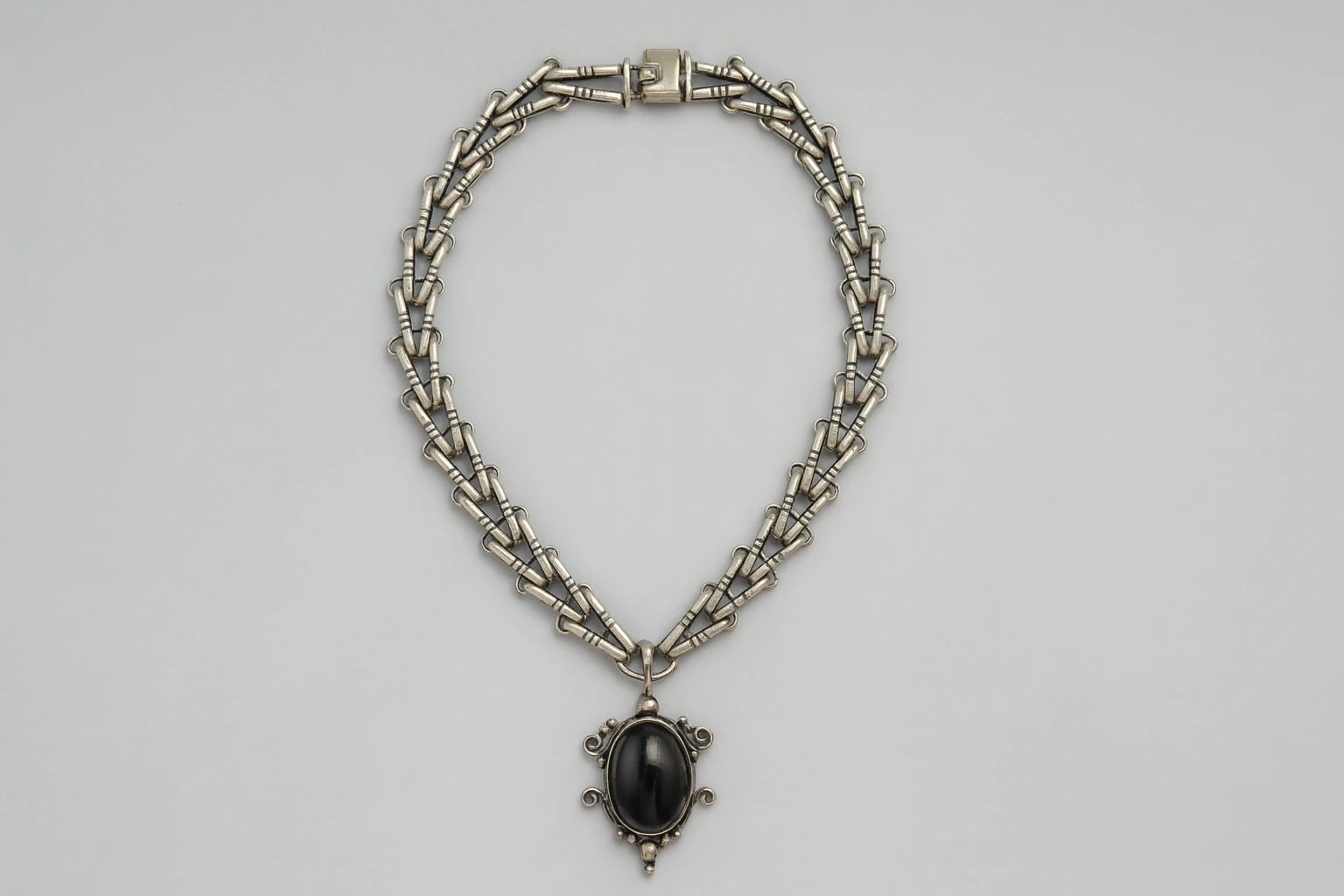
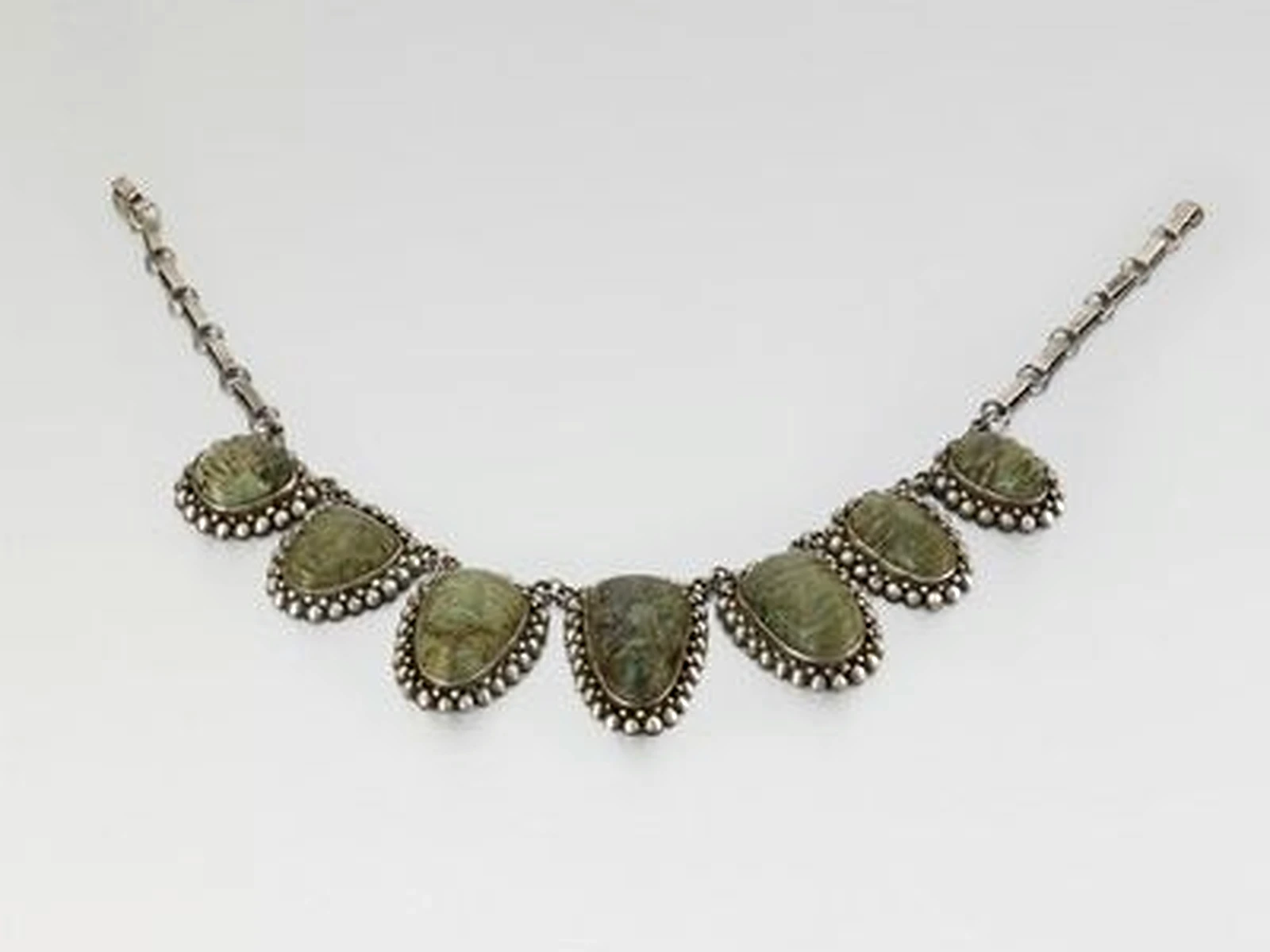
Carved malachite faces set into silver give this necklace its subject and its structure at once. The stone is not treated as a passive cabochon but worked into small human visages, each one framed by the metal and linked into a continuous band that rides the collarbone. The design belongs to a distinct current in Héctor Aguilar's early production, one in which figurative carving in a hardstone becomes the organizing motif rather than an accent. Marjorie Morrill records a carved malachite faces necklace by Aguilar from about 1939, executed in 980 silver and malachite, and the type this necklace represents sits at the beginning of Aguilar's independent career.
The interest of the piece lies in how the faces are repeated and joined. Malachite carries a deep banded green that shifts with the direction of its layering, so no two carved faces read exactly alike even when the forms are consistent. Silver surrounds each stone and connects one element to the next, allowing the necklace to curve and follow the neck while keeping the carved profiles upright and legible. The metal does the quieter work here, holding the malachite in position and supplying the articulation that lets a rigid material behave like a flexible ornament. Photographs establish the carved subject and the green of the stone; the specific alloy, the method of setting, and the weight are matters for the object record rather than for visual inference.
Aguilar left William Spratling's Taller de Las Delicias in 1939 to open his own shop, Taller Borda, in Taxco, and a carved malachite faces design from that same year marks the moment he began to define a language of his own. His mature work is often remembered for broad, architectural silver and for heavy strap forms, but this necklace shows a different and earlier concern: the integration of a carved colored stone with silver, with the figurative image carrying the design. The documented hallmark sequence for Aguilar spans an early Taxco/HA fineness mark of 1940 to 1945, the Made-in-Mexico export marks, and the eagle 9 assay marks used from 1948 to 1962, so an object within the 1939 to 1962 range could correspond to any of several fabrication periods. The date of a carved malachite design conceived around 1939 should not be collapsed into the date of a later mark that a given example might carry.
Two cautions belong to the record for this type. Aguilar is among the designers whose classic work has been reproduced with legitimately acquired hallmarks and, separately, whose marks have been outright counterfeited, and the museum's hallmark reference flags several false HA stamps by their crude carving and by fineness figures such as .925 and 980 that do not belong to authentic Aguilar production. For a figurative malachite necklace, then, the carving quality, the character of the silver, and genuine patina matter as much as any stamp. Within Aguilar's output, a carved malachite faces necklace documents the early, image-driven side of his work and the point at which he set out on his own, a useful counterweight to the later reputation built on plain silver mass.
Museum of Mexican Silver. “Hardstone Necklace.” Catalog no. MoMS-001356. https://museumofmexicansilver.com/pieces/aguilar-necklace-hardstone
See something wrong with this record? Suggest a correction and the piece details fill in automatically.
Héctor Aguilar
Malachite Necklace
1939-1962
Malachite