Saves instantly, no account needed. Already a member? Sign in.
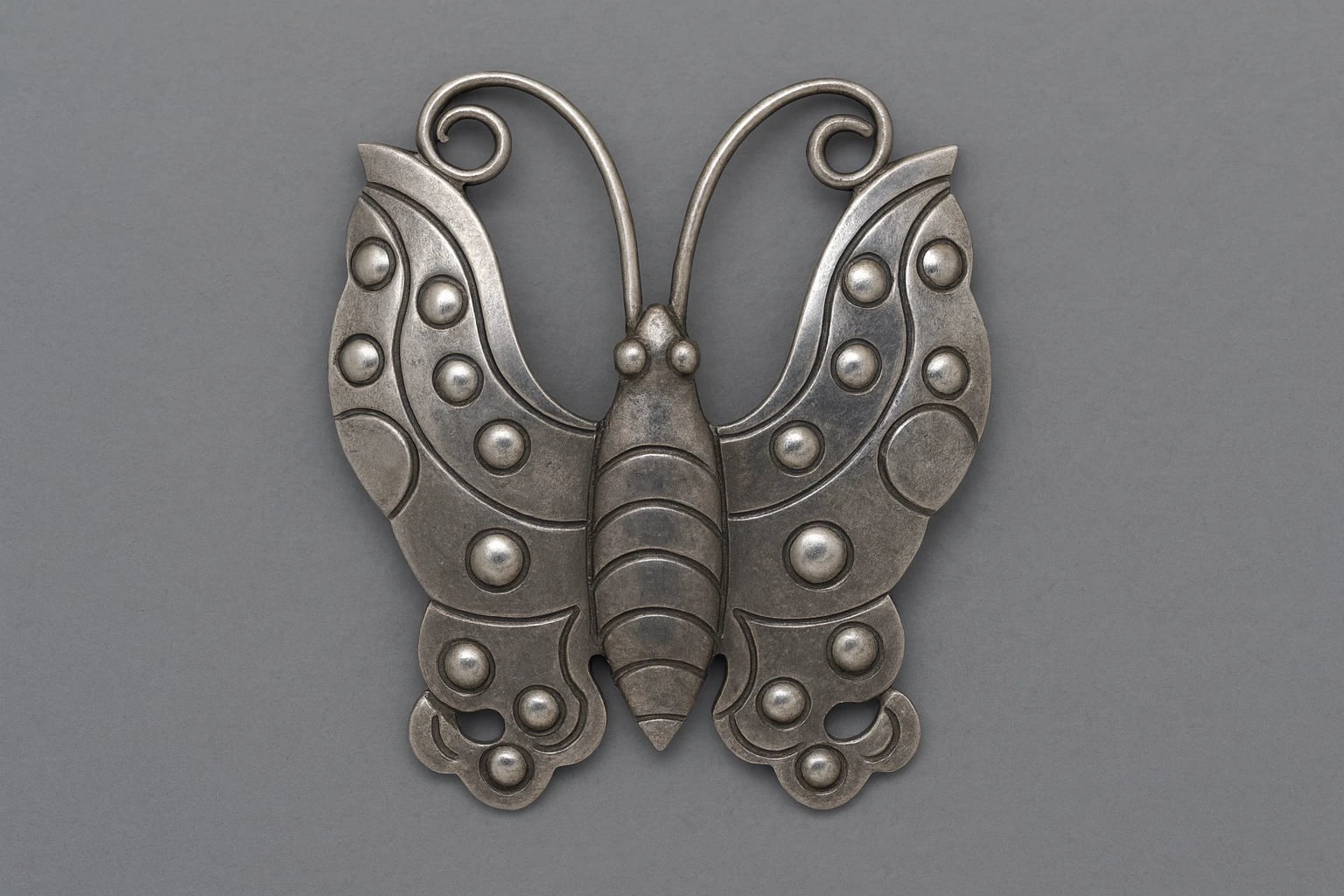
The butterfly brooch organizes a familiar natural form through a disciplined pattern of silver relief. Its wings open in a compact, nearly square span, measuring 2 1/2 by 2 1/8 inches, with the body set as a vertical axis and the antennae drawn into tight spirals above. Incised lines divide the wings and abdomen, while rounded domes punctuate the surface like controlled drops of metal. The design depends on a clear contrast: the outline is light and animated, but the ornament is weighty, tactile, and frontal. The result is not a delicate insect translated literally into silver. It is a small modern brooch that uses the butterfly as a structure for symmetry, rhythm, and surface.
Marked “FD Silver Mexico,” the brooch belongs to the Frederick Davis sphere of Mexico City silver, where design, selection, retail presentation, and workshop execution were closely intertwined. Hougart identifies one class of Davis marks as incised conjoined FD initials usually combined with “Silver Mexico,” and records Davis’s importance as a promoter of Mexican native arts, a manager at Sanborns, and later the first director of the Museo Nacional de Artes e Industrias Populares. Morrill and Berk likewise emphasize that Davis worked through master silversmiths and did not personally originate every object bearing the FD mark. That point matters here. The brooch should be understood not as evidence of a solitary studio practice, but as a product of the collaborative system through which Davis encouraged, selected, refined, and circulated modern Mexican silver.
The surface treatment places the brooch close to Davis’s larger interest in regional jewelry, popular art, and ancient Mexican design sources without requiring a single iconographic source. The domes recall the appeal of applied bosses and beadlike metalwork in vernacular ornament, while the incised divisions give the insect a graphic clarity suited to modern jewelry. Nothing is casual in the distribution of detail. The larger domes anchor the lower wings, smaller ones climb toward the upper lobes, and the darkened grooves make the body read as segmented armor. The brooch is modest in scale, but it has the frontal authority of a pendant or emblem. It was made to sit visibly on the body, where the polished high points would catch light and the recessed lines would keep the form legible.
Its publication history gives this particular design additional weight within the study of Mexican silver. The butterfly is recorded as illustrated on the dedication page of Morrill and Berk’s Mexican Silver and in C. Jeanenne Bell’s Old Jewelry, sixth edition. That does not make the brooch unique, and the evidence should not be stretched into a claim about production numbers. It does, however, show that the design entered the visual record of the field as a representative Davis object. For the Museum, the brooch is valuable because it clarifies an early and influential current of the Mexican silver renaissance outside the later Taxco workshop narrative. In this small butterfly, Davis’s world is visible: Mexico City networks, high standards for handwork, a respect for popular forms, and a modern silver vocabulary built from line, relief, and disciplined ornament.
Museum of Mexican Silver. “Butterfly Brooch with Round Domes.” Catalog no. MoMS-002313. https://museumofmexicansilver.com/pieces/frederick-davis-butterfly-brooch
See something wrong with this record? Suggest a correction and the piece details fill in automatically.
Fred Davis
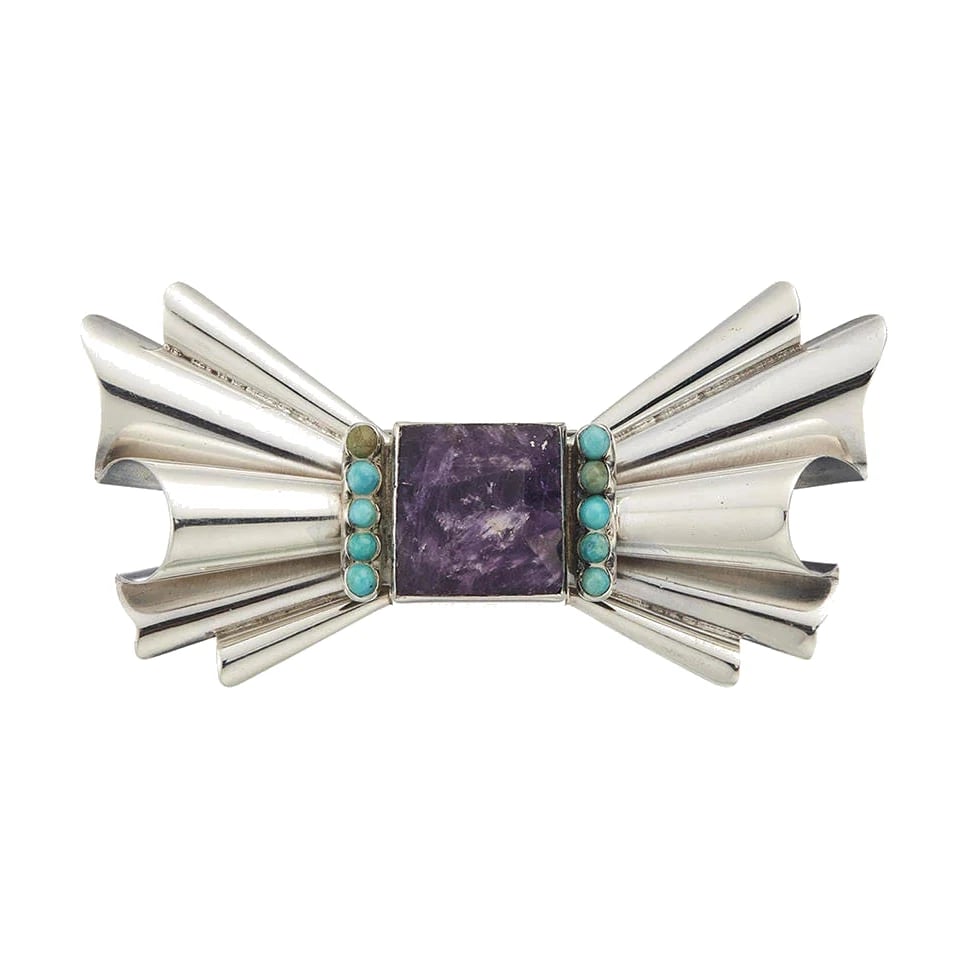
Amethyst and Turquoise Bow Brooch
Silver