Saves instantly, no account needed. Already a member? Sign in.
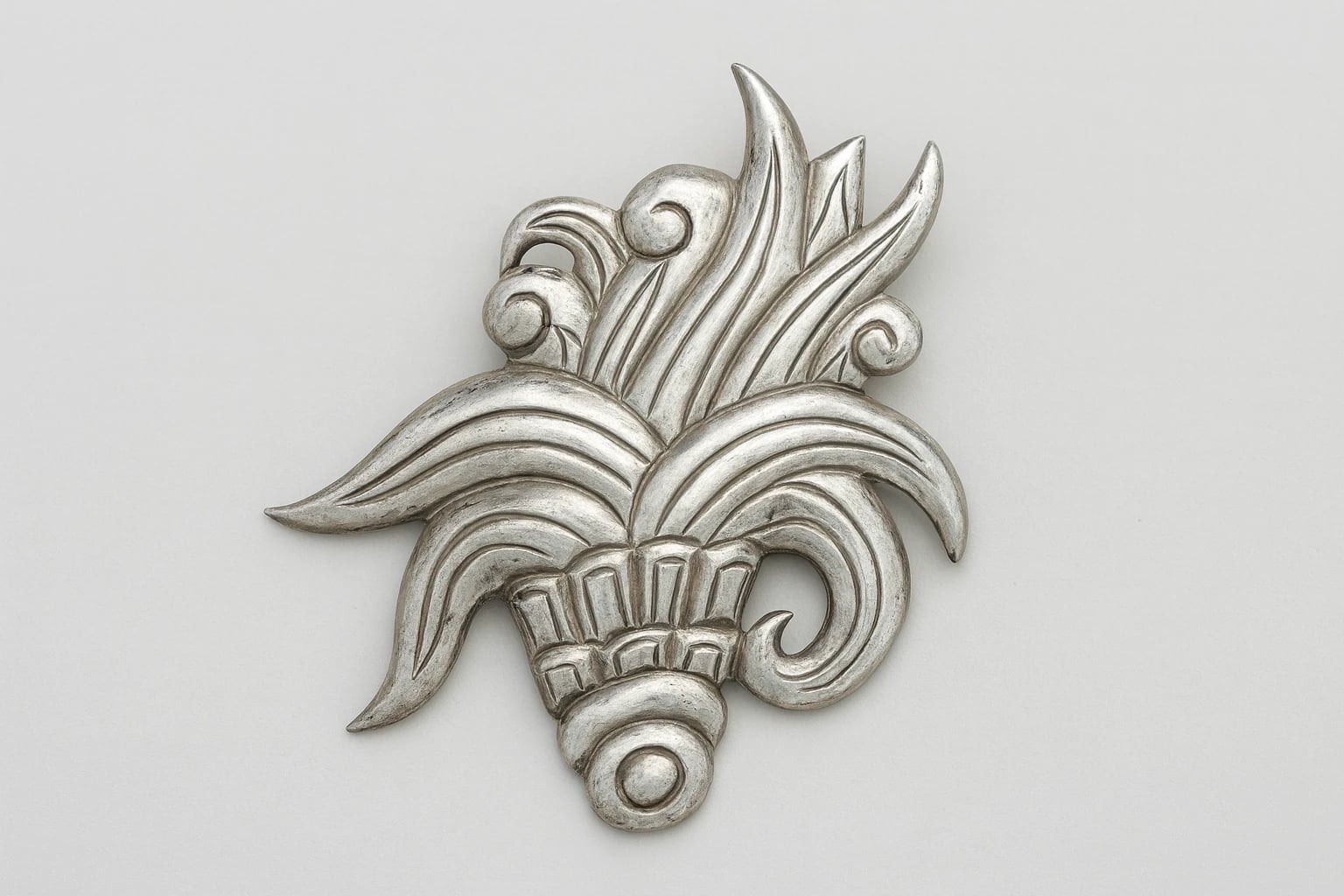
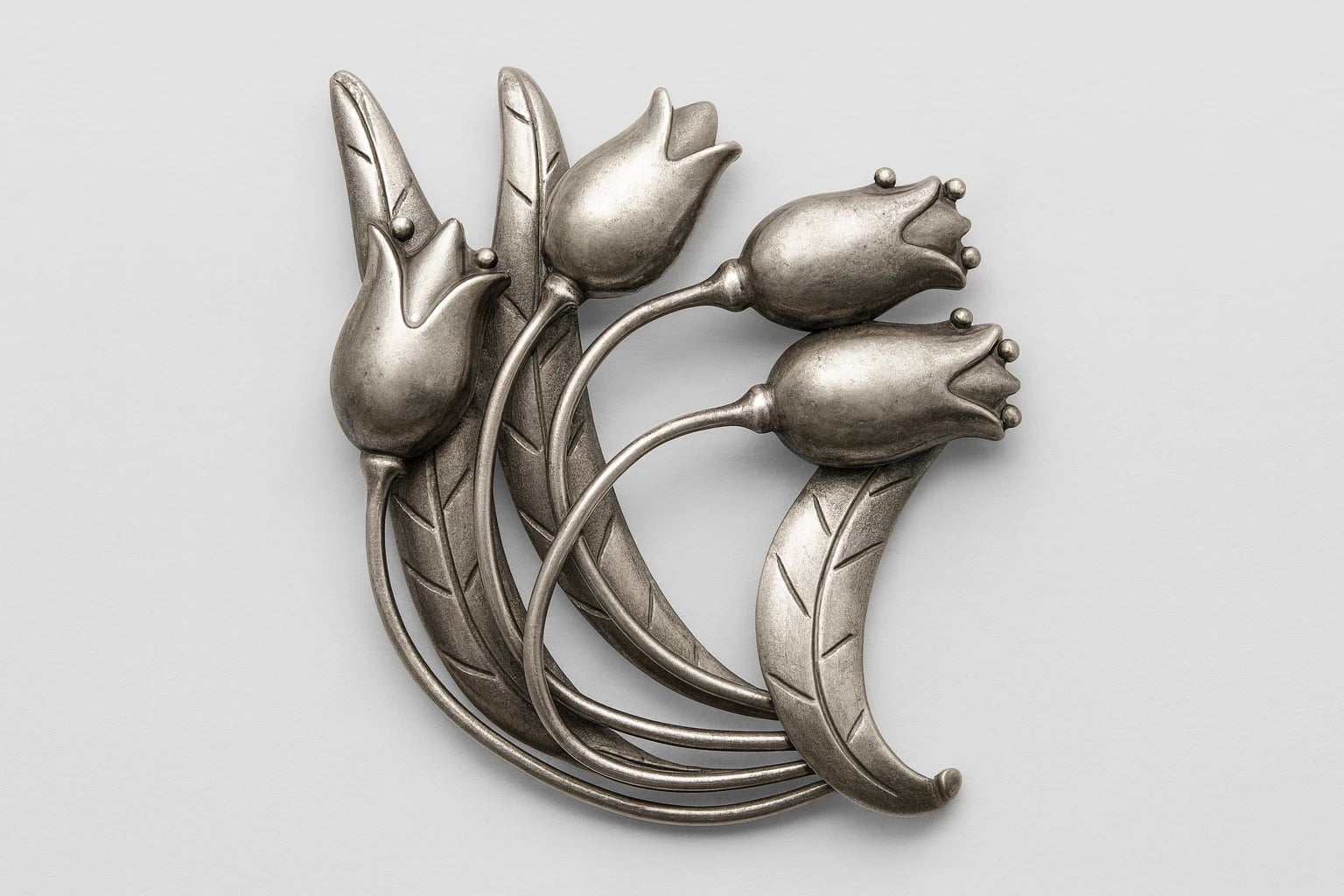
The brooch organizes a bouquet as a study in curvature. Five closed flower forms rise from a shared base, each carried on a separate arcing stem, while two broad leaves hold the outer edges of the composition. The design avoids a naturalistic spray. Instead, it compresses the plant into a compact, almost shieldlike form, with the stems bending in parallel lines and the buds gathered as rounded volumes against the smoother ground of the leaves. The result is floral, but also architectural: a small structure of ribs, bulbs, and enclosing contours.
Its strength depends on the difference between line and swelling mass. The stems are long, narrow, and elastic in appearance. They cross and return toward the base without losing clarity, creating open channels of shadow between them. The buds are treated differently, as taut, polished forms with small pointed tips and folded lips. The leaves are broader and flatter, their incised veins giving a measured counterpoint to the more fluid stems. Worn on the body, the brooch would read first as a bright cluster and then, at closer range, as a set of carefully separated parts. That alternation between immediate silhouette and close construction is characteristic of the strongest Taxco floral jewelry.
The brooch belongs to the floral current within Héctor Aguilar’s Taller Borda, a current that should not be treated as secondary to the better known geometric and ancient Mexican inspired designs. Penny Morrill notes that Aguilar was the principal designer for the work he signed, while Valentín Vidaurreta supplied many of the elaborate floral designs for which the workshop became known. She records that Vidaurreta arrived in Taxco in 1941 and collaborated with Aguilar until his death in 1955. Morrill also emphasizes that tropical flowers growing in Taxco provided important sources for both Aguilar and Vidaurreta, who translated those forms into silver rather than merely decorating silver with botanical motifs.
That workshop context matters because this brooch is not a generic flower pinned onto a modernist history. It shows how Taller Borda could convert observation of local plant life into a disciplined silver design. The bouquet is legible, but the emphasis falls on proportion, spacing, reflection, and the relation of convex and flat surfaces. In this sense the object sits comfortably within the broader Mexican silver renaissance, where jewelry carried modern design ideas through the scale of the hand and the body. It also recalls the collaborative character of Taxco production: Aguilar’s name marks a design world directed through Taller Borda, while the floral vocabulary points to the shared knowledge of designers, silversmiths, and artists who made the workshop one of the central laboratories of mid twentieth century Mexican silver.
Museum of Mexican Silver. “Tulip Bouquet Brooch.” Catalog no. MoMS-002297. https://museumofmexicansilver.com/pieces/hector-aguilar-brooch
See something wrong with this record? Suggest a correction and the piece details fill in automatically.
Héctor Aguilar
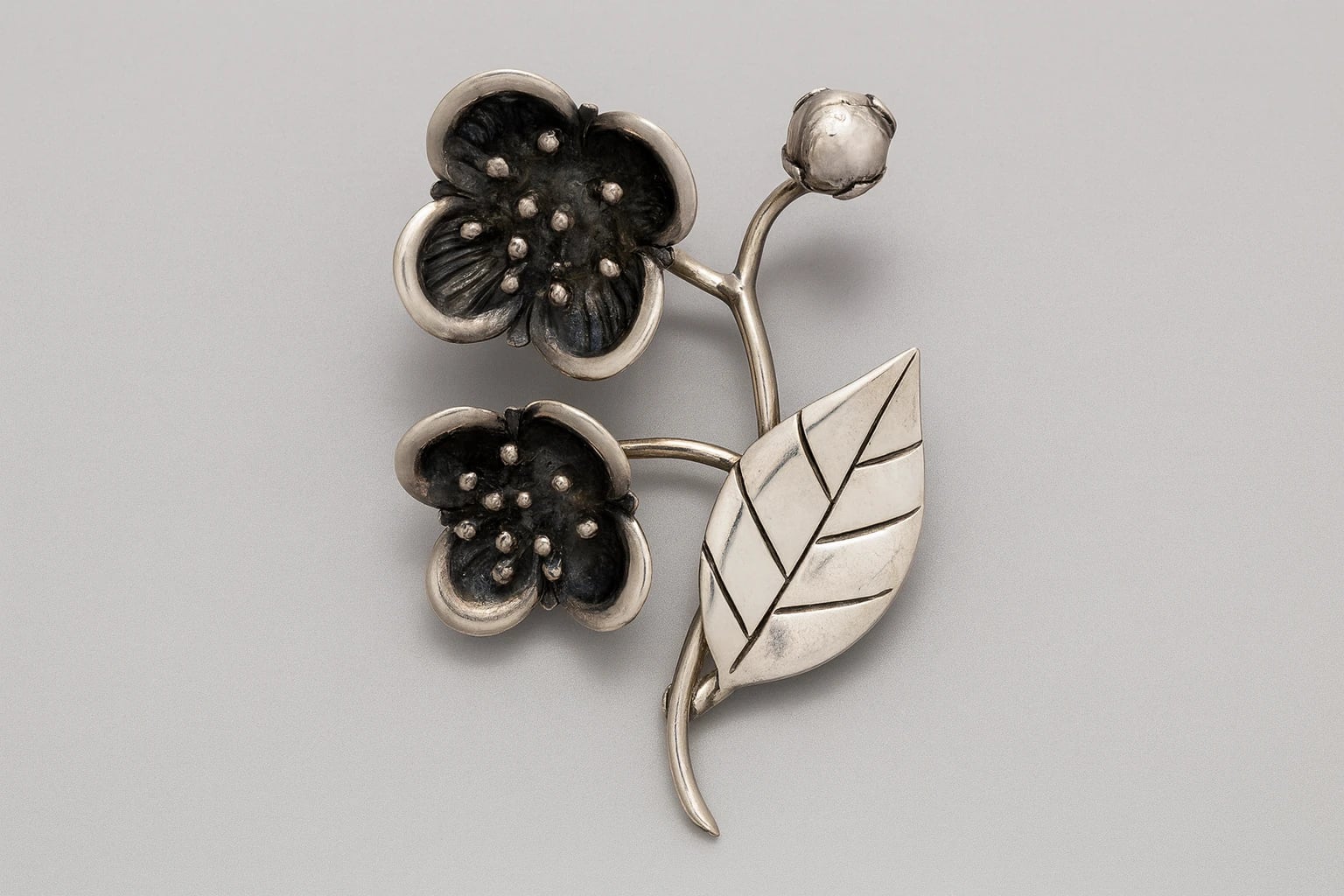
Flowers and Leaves Brooch