Saves instantly, no account needed. Already a member? Sign in.
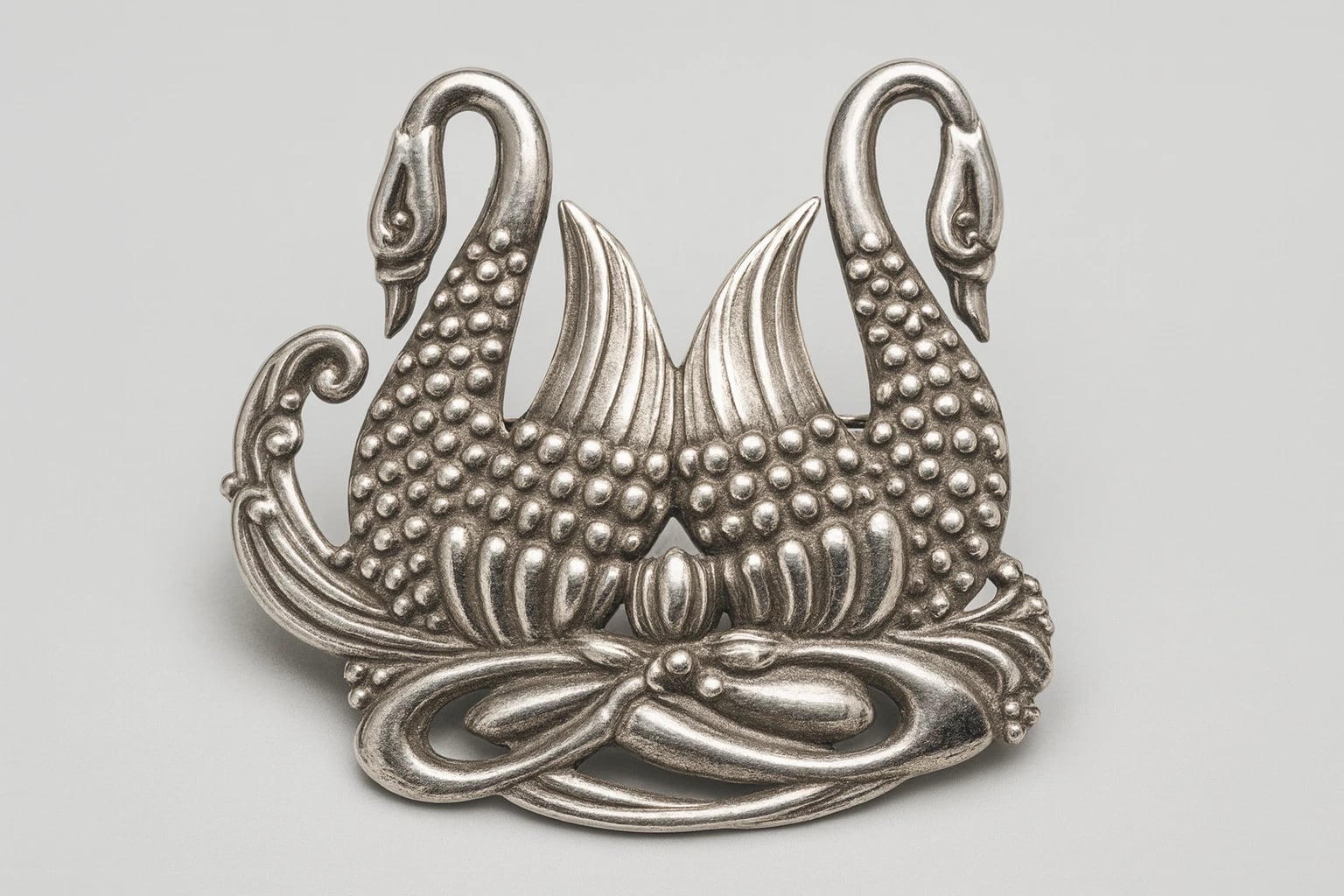
The brooch pendant organizes two swans into a compact circular scene, with the birds’ arched necks forming the upper rim and the pond closing the composition below. At 2 3/4 inches square, it is large enough to read almost as a small relief plaque, yet its function remains intimate: a jewel that could be pinned to clothing or suspended from a chain through the two loops placed behind the heads. The old linear Los Castillo mark and the Museum record place the work in the 1940s, before the eagle assay stamp became part of the workshop’s later marking practice. Hougart records several Los Castillo marks from 1940 to 1945 without eagle numbers, while later examples include eagle 15 and other eagle numbers assigned to or used by the firm.
The design depends on repetition without becoming static. The two swans mirror one another, but their bodies are not treated as flat silhouettes. Rounded granulation across the breasts gives the surface a beaded density, while the raised feather channels rise between them like a fan. Below, the water is not a background but an active structure. It curls into loops and elongated channels that hold the birds in place and provide the lower counterweight to the necks above. The brooch is ornamental in the precise sense: every detail, from the dotted plumage to the scroll of the pond, contributes to the object’s legibility at small scale and to the way light breaks across the raised silver.
Los Castillo was established in 1939 by Antonio Castillo with his brothers Justo and Jorge and their cousin Salvador Terán, and it quickly became one of the important Taxco workshops of the silver renaissance. Hougart describes the firm as an influential design and manufacturing enterprise known for jewelry and for work in varied techniques, including the later married metals and specialty lines that made the workshop unusually wide ranging. Stromberg also emphasizes the breadth of Los Castillo production, noting its use of different techniques and styles and identifying the early workshop as a collaboration among the Castillo family circle, Margot van Voorhies Carr, and Salvador Terán. This brooch pendant belongs to the earlier figural current within that history, before the workshop became especially identified with its more experimental color and inlay techniques.
The double swan design shows why Los Castillo animal jewelry has remained so closely watched by informed collectors. Its appeal is not only the charm of the subject, although the subject is handled with considerable grace. The importance lies in the workshop’s ability to translate a lively natural motif into a disciplined modern relief, one that can shift from garment ornament to pendant without losing its composure. Within a museum collection, the object helps define the 1940s Los Castillo language: generous scale, highly worked surface, strong contour, and a willingness to let figuration carry modern design rather than retreat into abstraction.
Museum of Mexican Silver. “Double Swans Pendant.” Catalog no. MoMS-002307. https://museumofmexicansilver.com/pieces/los-castillo-brooch-pendant-2
See something wrong with this record? Suggest a correction and the piece details fill in automatically.
Los Castillo
Bull-Motif Money Clip