Saves instantly, no account needed. Already a member? Sign in.
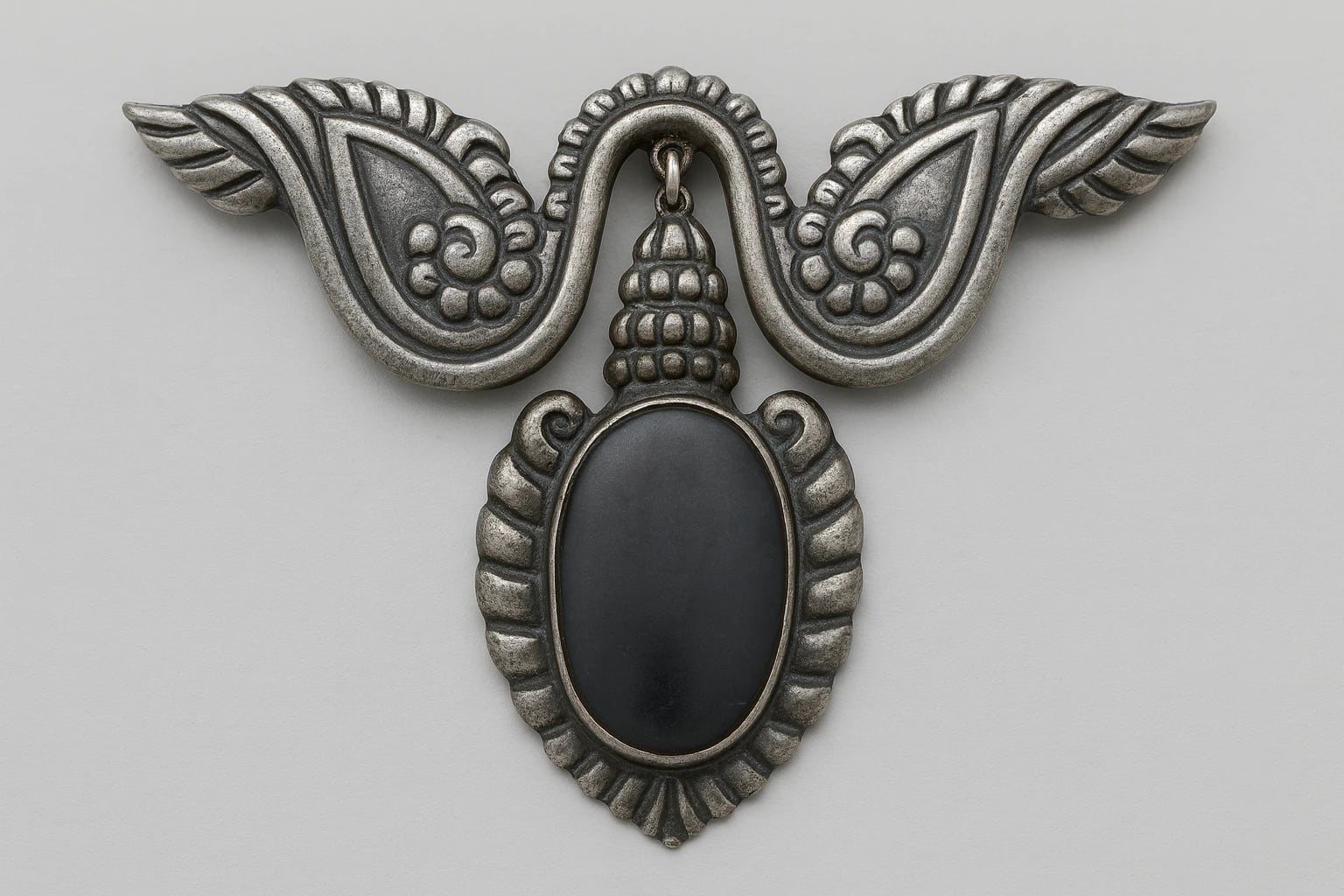
The most surprising thing about this brooch is that only half of it stands still. The upper element, a pair of outspread wings meeting at a central scroll, pins flat against the garment, while the oval locket below hangs from a small link and swings freely. Most brooches of the period are single rigid compositions. Here Los Castillo built a piece of jewelry in two registers, one fixed and one mobile, so that the ornament answers the wearer's movement with a slight, continuous animation of its own.
The wings themselves are dense with worked ornament. Each one gathers a row of teardrop panels filled with beaded ribs and tight spiral volutes, the forms swelling outward and tapering to a point, so that the eye reads them simultaneously as feathers and as the curling foliate scrollwork familiar from colonial silver and Mexican popular art. That double reading is characteristic of the Castillo workshop's early vocabulary, which drew freely on devotional and folk sources without copying any single one. Below, the locket reverses the strategy. Its dark oval stone is left broad, smooth, and unadorned, framed by a radiating fluted border and hung from a beaded cap shaped like a small finial. The contrast does the compositional work: intricate, silvery agitation above, a calm, deep-toned oval below, with the open space between them keeping the two halves legible as separate events joined by a single point of suspension.
The locket form matters as more than a structural conceit. A locket is jewelry that holds something, and suspending it beneath spread wings gives the piece an unmistakable echo of the winged hearts and guarded relics of Mexican devotional imagery, translated into a secular, wearable modern object. Whether or not any individual wearer used the compartment, the design presents concealment itself as ornament: the fluted frame and beaded crown announce that the plain dark oval is a protected thing. At roughly three inches across, the brooch has real presence on the body, yet the drop's articulation keeps that scale from becoming static or armorial.
Los Castillo, the taller founded in Taxco in 1939 by brothers who had trained in William Spratling's Las Delicias, grew into one of the most inventive and productive workshops of the silver renaissance, known both for ambitious material experiments and for designs rooted in Mexican popular sources. Hougart's hallmark survey documents the workshop's long sequence of marks, from the early 980-fine stamps of the first years through the sterling and specialty-line marks of later decades, evidence of a sustained enterprise rather than a brief studio. Contreras Osio notes that Los Castillo is among the very few Taxco houses whose designs continued in production across generations, the firm still reproducing Antonio Castillo's original models. This brooch shows why that repertoire endured: it takes a traditional sentimental form, the locket, and a traditional protective image, the wing, and resolves them into a composition whose logic is entirely its own, ornament above, reserve below, and motion built into the join between them.
Museum of Mexican Silver. “Winged Locket Brooch.” Catalog no. MoMS-002310. https://museumofmexicansilver.com/pieces/los-castillo-locket-pin
See something wrong with this record? Suggest a correction and the piece details fill in automatically.
Los Castillo
Lapis Brooch
Lapis