Saves instantly, no account needed. Already a member? Sign in.
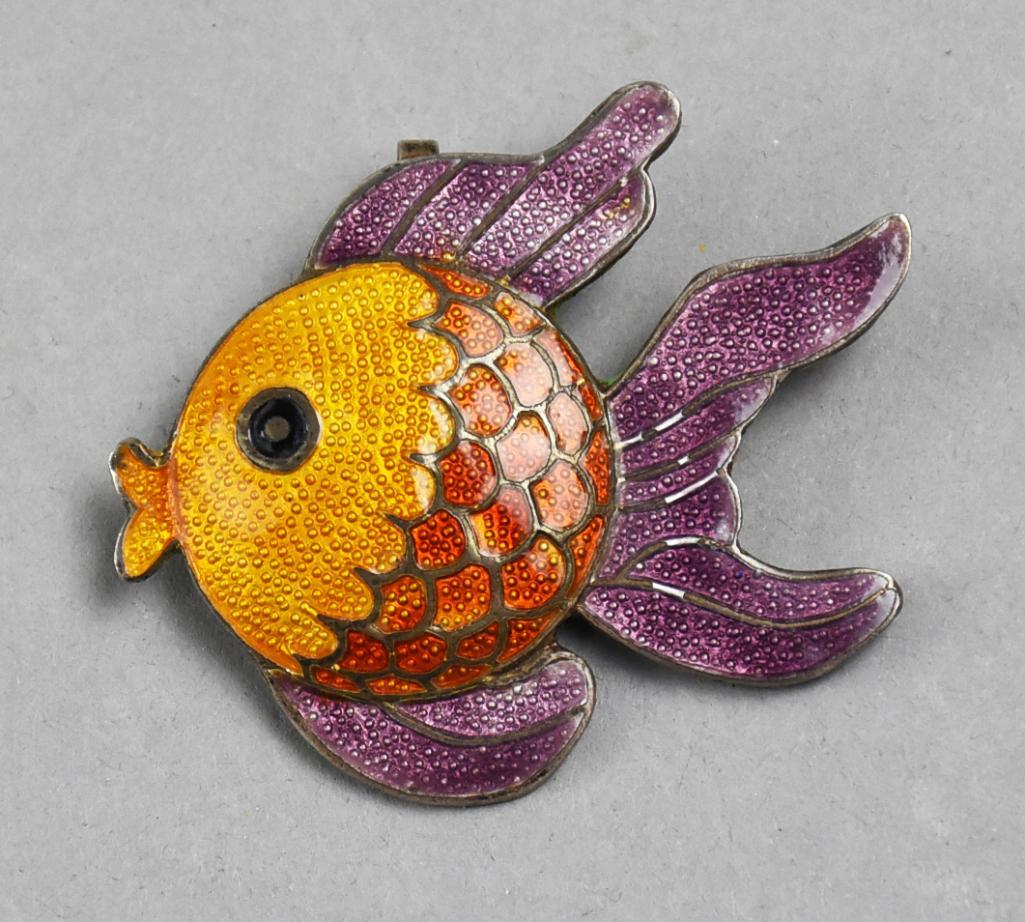
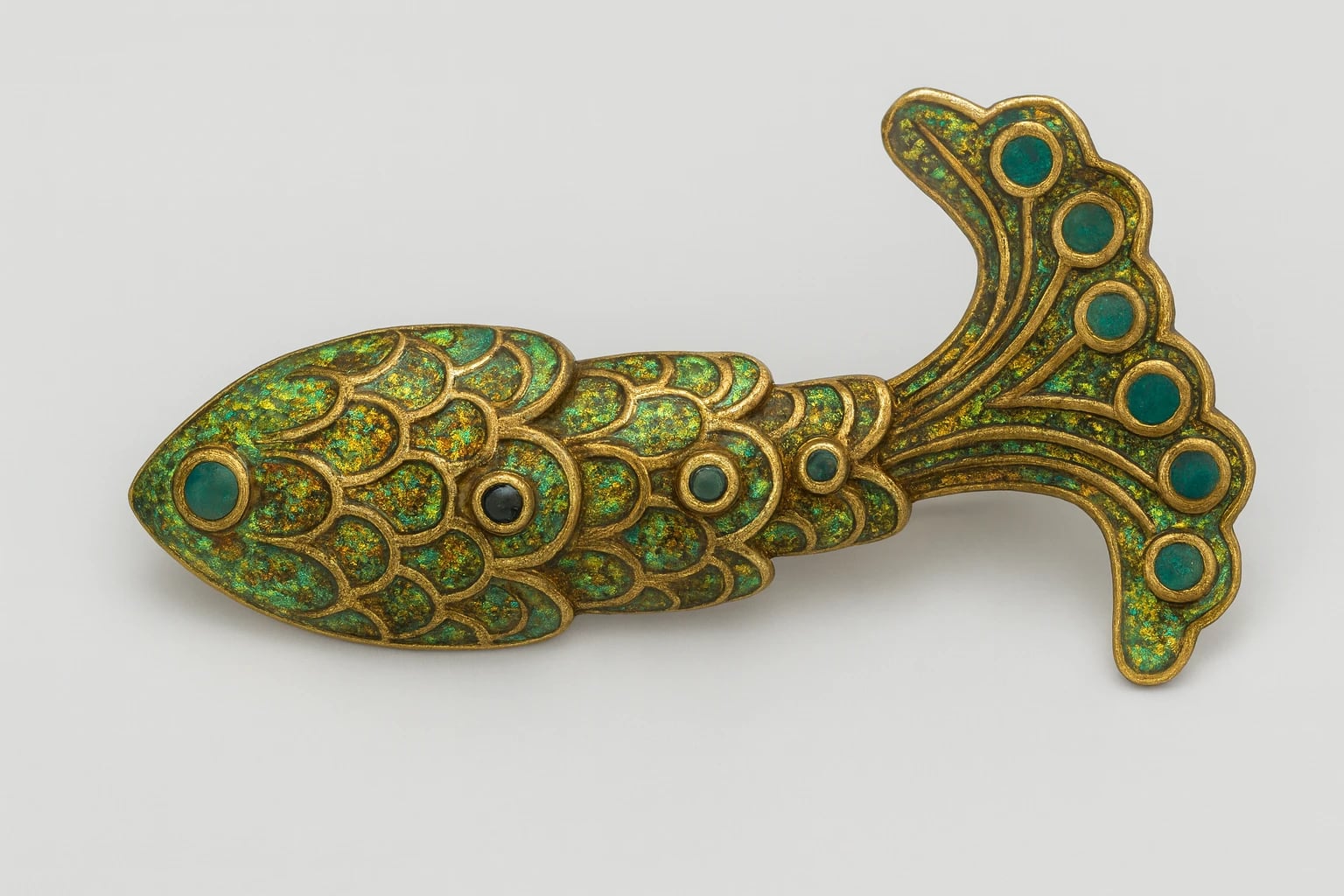
This small fish pin is organized around motion. At 1 3/4 by 1 1/8 inches, it compresses a lively animal form into a sequence of movable silver segments, each one carrying enamel as part of the structure rather than as a surface decoration added afterward. The head is broad and rounded, the body narrows through linked sections, and the tail opens into a fan with scalloped edges. Reticulation lightens the form and gives the green enamel a framework of silver ridges, so the fish reads as both creature and patterned object. The effect depends on the slight independence of the segments: even at this scale, the pin suggests the bend of a swimming body.
The green confetti enamel is central to the design. Its mottled field breaks into flashes of yellow, blue, and darker green, with small circular accents set into the body and tail like bubbles, scales, or stones caught in water. Margot de Taxco’s enamel work was never merely a way to color silver. In her workshop practice, champlevé enamel required the design to be planned as a metal relief, with recessed fields made to hold fused color. That technical discipline suited her painterly imagination. Here, the silver ribs control the enamel while also drawing the fish’s anatomy, so line, color, and construction remain inseparable.
The recorded mark, Margot de Taxco Sterling, together with design number 5693, places the pin within the numbered production of Margot van Voorhies’s Taxco workshop. Its 1950s date is especially meaningful, since Margot de Taxco opened in 1948 and added enamel on silver as a defining line in 1955. The pin belongs to that moment when the workshop was translating Margot’s drawings and color decisions into small, repeatable designs without losing the wit of the individual motif. Her workshop was collaborative, involving silversmiths, die makers, enamelists, and supervisors, but the surviving record consistently describes Margot as the directing designer whose gouache sketches and production instructions guided the finished jewelry.
Animal pins were a natural field for Margot’s enamel language because they allowed pattern to become behavior. This fish does not imitate natural coloration. It uses green as an imaginative environment, closer to pond weed, mineral, or mosaic than to the body of an actual fish. That freedom is part of the broader Mexican silver renaissance, in which Taxco workshops treated jewelry as a modern design medium with its own intelligence. The pin is modest in scale, but it preserves several of the qualities that made Margot’s enamel work distinct: disciplined metal planning, vivid color, articulated construction, and a figural subject transformed into rhythmic modern ornament.
Museum of Mexican Silver. “Design 5693 Green Confetti Enamel Fish Brooch.” Catalog no. MoMS-002315. https://museumofmexicansilver.com/pieces/margot-de-taxco-enamel-figural-pin-2
See something wrong with this record? Suggest a correction and the piece details fill in automatically.
Margot de Taxco
Design 5227 Brooch
Sterling silver