Saves instantly, no account needed. Already a member? Sign in.
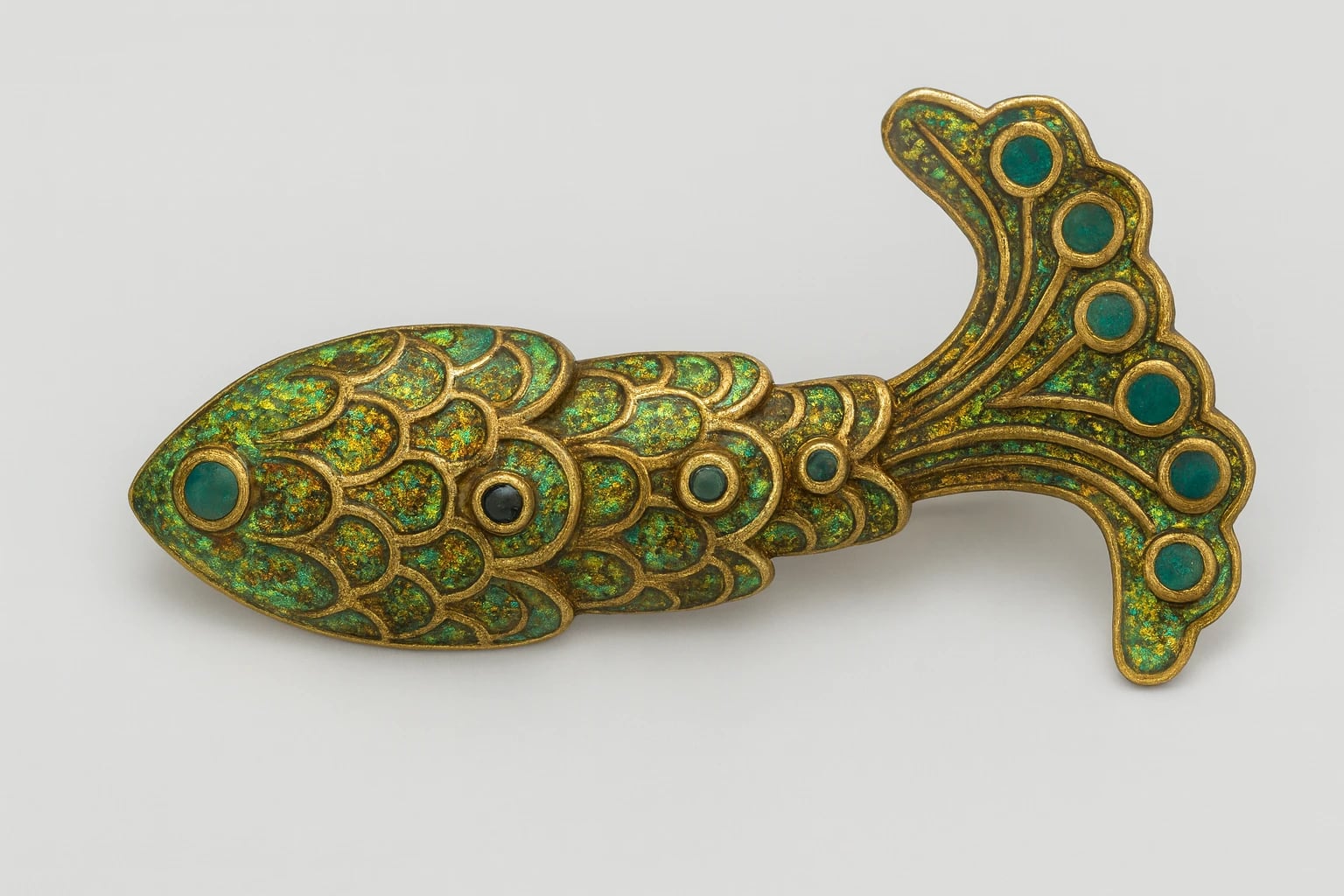
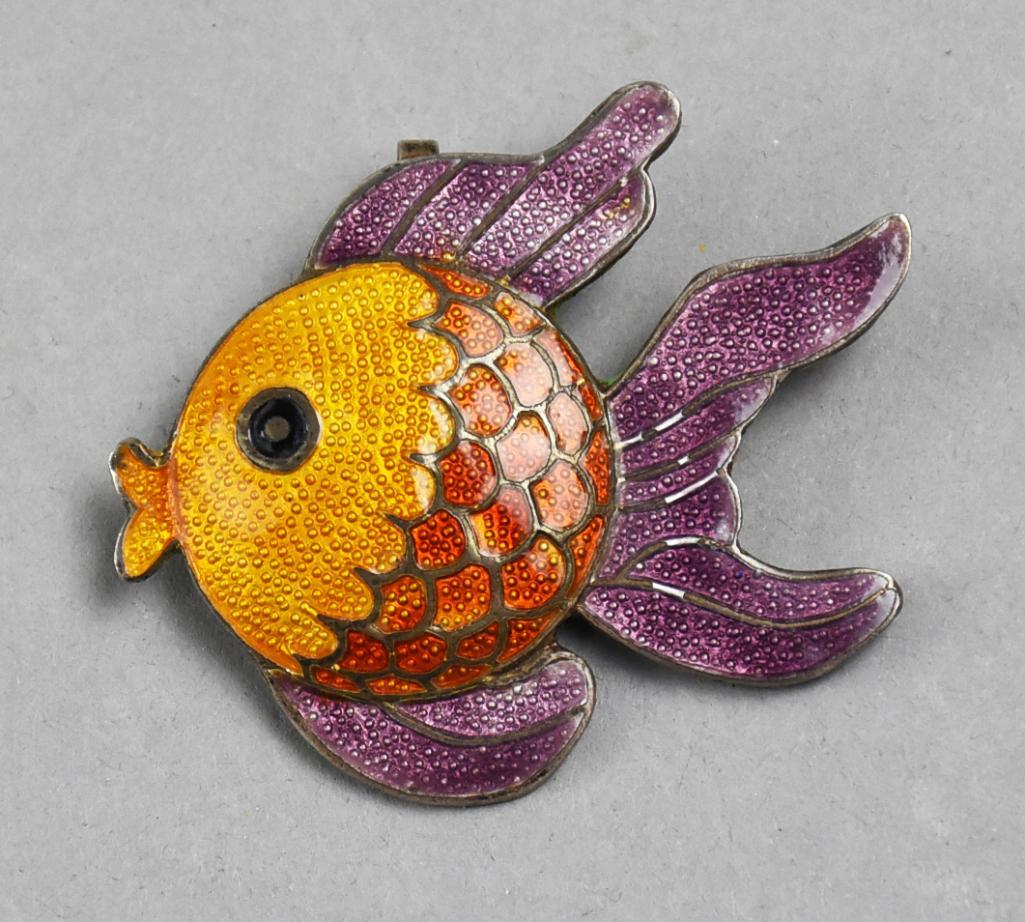
A fish becomes a study in controlled color when Margot de Taxco reduces it to a single silhouette carrying bands of enamel across its body. The design works because the outline is confident and the surface is disciplined: silver defines the fins, tail, and eye, while enamel fills the interior compartments with a graded run of color that reads as scales without imitating them. This is the logic of champlevé, in which recesses are cut or built into the metal and filled with vitreous enamel, then leveled so that thin walls of silver separate one color from the next. The fish is a natural subject for that technique, since a real fish already divides itself into segmented, iridescent zones, and Margot lets the metal armature do the drawing while the enamel does the singing.
The brooch belongs to the phase of her workshop that made enamel its signature. Margot van Voorhies opened Margot de Taxco in 1947, and according to Hougart the champlevé production for which she is best known began in 1955. On enamel pieces her marks carry design numbers in a distinct range, and the museum's hallmark reference records enamel stamps such as 5199, 5357, 5626, and 5404, several accompanied by the eagle 16 assay mark, with a use period running from 1955 into the late 1970s. The eagle number places the object within the national assay system rather than fixing an exact year, and the long span of the mark means the design could have been conceived earlier than a given example was fabricated. What the enamel range does confirm is category: this is a piece from her mature enamel program, not from the earlier sterling-only work.
Margot's command of enamel did not arrive from nowhere. Before her own shop she created many of the early designs for Los Castillo, the taller founded by Antonio Castillo and his brothers, and that grounding in a workshop known for combining metals and for inventive surface treatment shaped her later independence. Her enamel work became distinctive enough that imitation followed. Hougart notes that some Castelan pieces, sterling with enamel, are very reminiscent of Margot, and the reference flags at least one crude cast counterfeit mark bearing her name. That a small workshop's enamel identity attracted both emulation and forgery is a measure of how recognizable her color sense had become within the broader silver renaissance, where enamel offered Mexican designers a way to carry painterly color into wearable form.
The fish brooch distills what made her enamel jewelry cohere: a firm silver drawing holding a passage of color that would collapse into decoration in weaker hands. For a collection tracing the Mexican silver renaissance, it documents the specific contribution of a workshop that treated enamel not as embellishment but as the primary material event, with silver reduced to structure and edge. It also marks the moment when Taxco design moved decisively beyond the polished-metal vocabulary of its first decade and claimed color as a serious modern tool.
Museum of Mexican Silver. “Fish Brooch.” Catalog no. MoMS-001108. https://museumofmexicansilver.com/pieces/margot-pin-fish
See something wrong with this record? Suggest a correction and the piece details fill in automatically.
Margot de Taxco
Netsuke Brooch
circa 1940
Ivory