Saves instantly, no account needed. Already a member? Sign in.
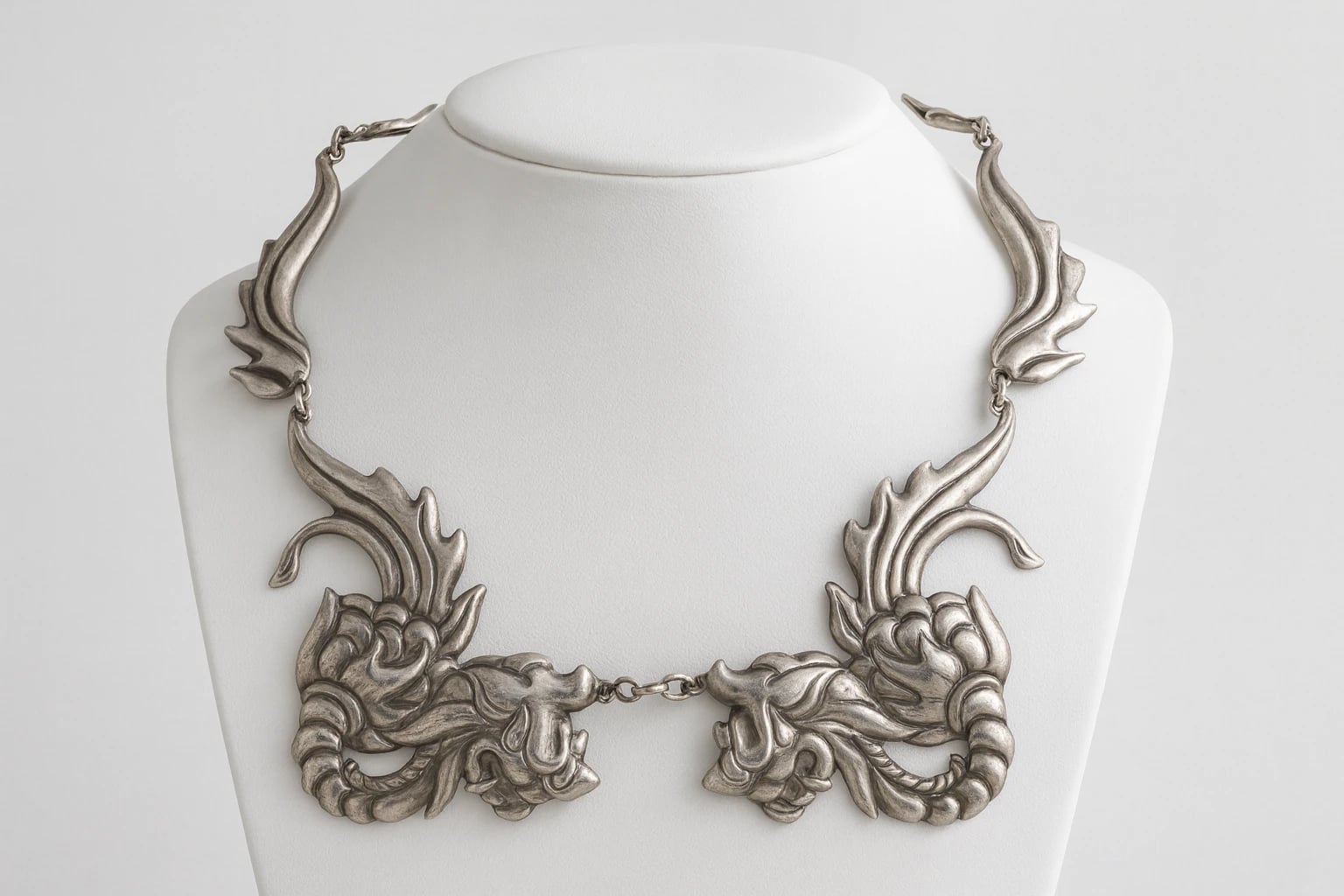
Two dragons meet head to head at the base of this necklace, jaws nearly touching, crests flung back into sprays of raised silver. Each creature fills a plaque of substantial size, and the whole composition spans six and a half inches across and drops two and a quarter inches at the center, dimensions that place it in the pectoral class of Taxco necklaces rather than among modest neckwear. Los Castillo produced such large repoussé collars in its early years: Penny Morrill's Silver Masters of Mexico records a large repoussé pectoral necklace from the workshop dating to about 1940, along with a second repoussé necklace of the same period, and this example belongs to that ambitious body of work.
The technique is what gives the dragons their life. Repoussé raises the design from behind, pushing the sheet outward so that the crests, coiled tails, and swelling bodies become genuinely three-dimensional volumes rather than engraved outlines. Here the silversmith exploited that dimensionality fully. The bodies of the two beasts curl inward toward the central closure while their crests sweep up and outward, so the eye travels in opposing spirals across the mirrored halves. Ropelike twists at the tails and deep hollows between the plumes catch and release light as the wearer moves. Above each dragon, an upswept plume of flame or foliage rises toward the shoulder, and the necklace then tapers through smaller winged links to the back, each element hinged to the next. That articulation is the practical intelligence of the design: it allows a composition of this sculptural mass to bend and settle along the collarbone instead of standing away from the body like armor.
The imagery sits comfortably within the vocabulary Los Castillo developed in this period. Morrill's documented examples from the workshop include a fish tail necklace and cuff, a large leaf pin, and later suites of swirling silver fish, evidence of a house repertoire in which animal and vegetal forms merge and everything moves. The dragons here are of the same family. Their bodies dissolve into leaves and flames, so that it is difficult to say where creature ends and foliage begins, and the fantastic subject becomes a pretext for the rhythmic play of curling, high-relief silver. This willingness to treat the necklace as a field for large-scale figurative modeling, rather than as a chain carrying a pendant, distinguishes the strongest Taxco repoussé work of the 1940s.
Los Castillo proved unusually durable among the great Taxco houses. As Contreras Osio observes, while most of the celebrated designers of the renaissance found no successors among their townsmen or descendants, Los Castillo continued, still reproducing the original designs of Antonio Castillo long after the movement's first generation had passed. A necklace like this one helps explain that endurance. It demonstrates the workshop's command of repoussé at pectoral scale, its instinct for symmetry animated by movement, and its ability to make heavy sculptural silver wearable. Within the history of the Taxco School, it stands as a strong example of the moment when the town's workshops were proving that a necklace could carry the ambitions of sculpture.
Museum of Mexican Silver. “Repoussé Facing Dragons Necklace.” Catalog no. MoMS-002322. https://museumofmexicansilver.com/pieces/los-castillo-necklace-2
See something wrong with this record? Suggest a correction and the piece details fill in automatically.
Los Castillo
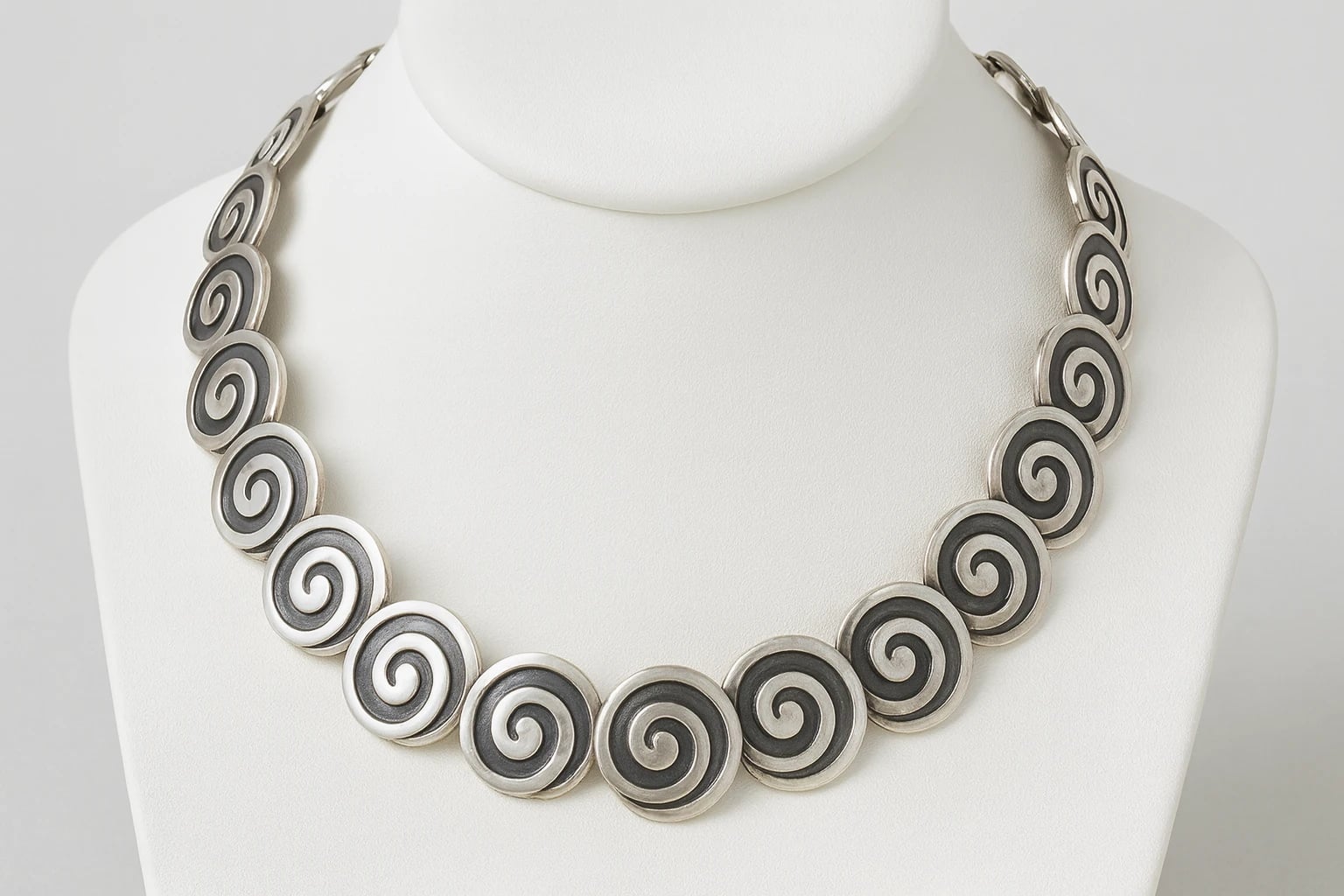
Spiral Disc Necklace