Saves instantly, no account needed. Already a member? Sign in.
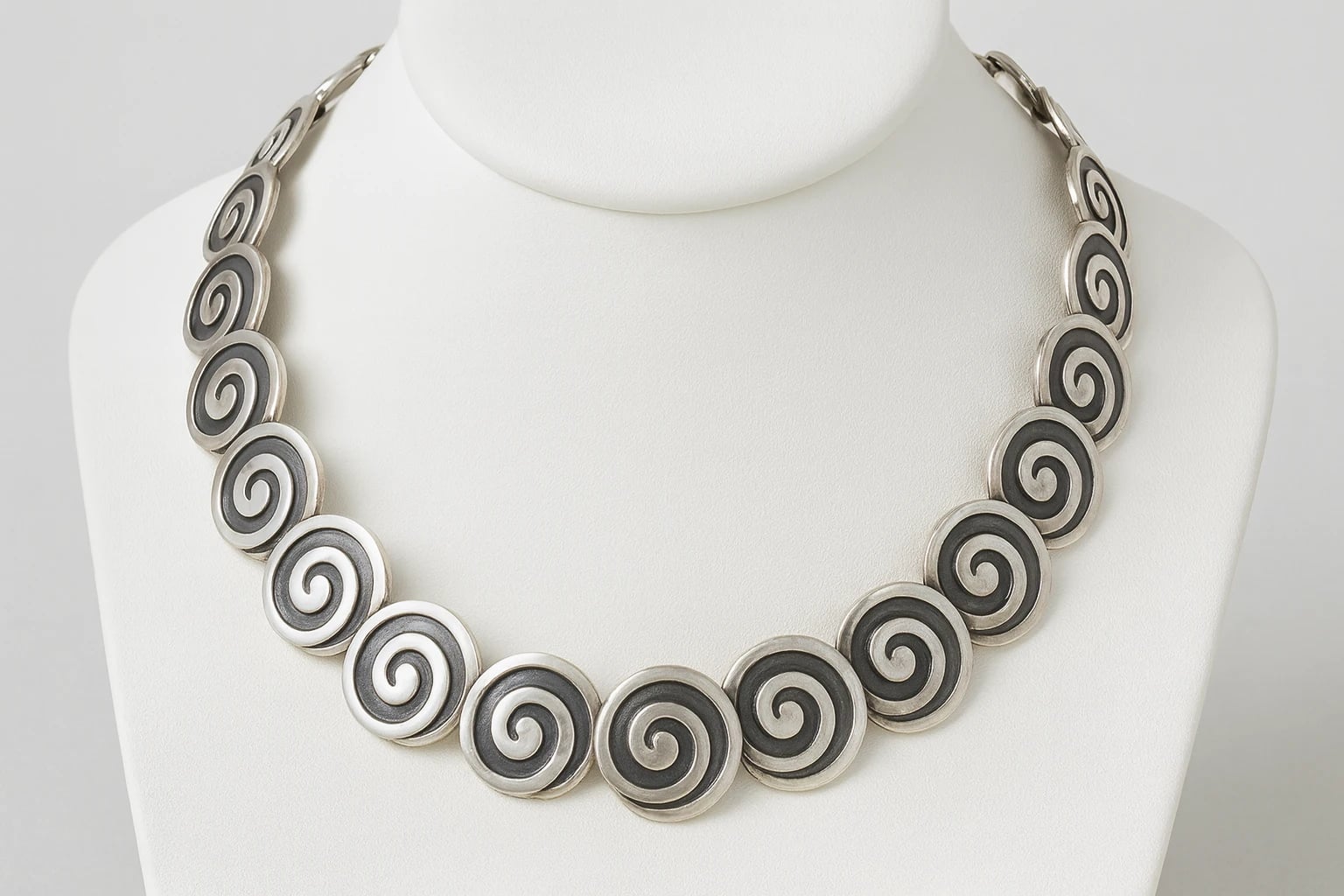
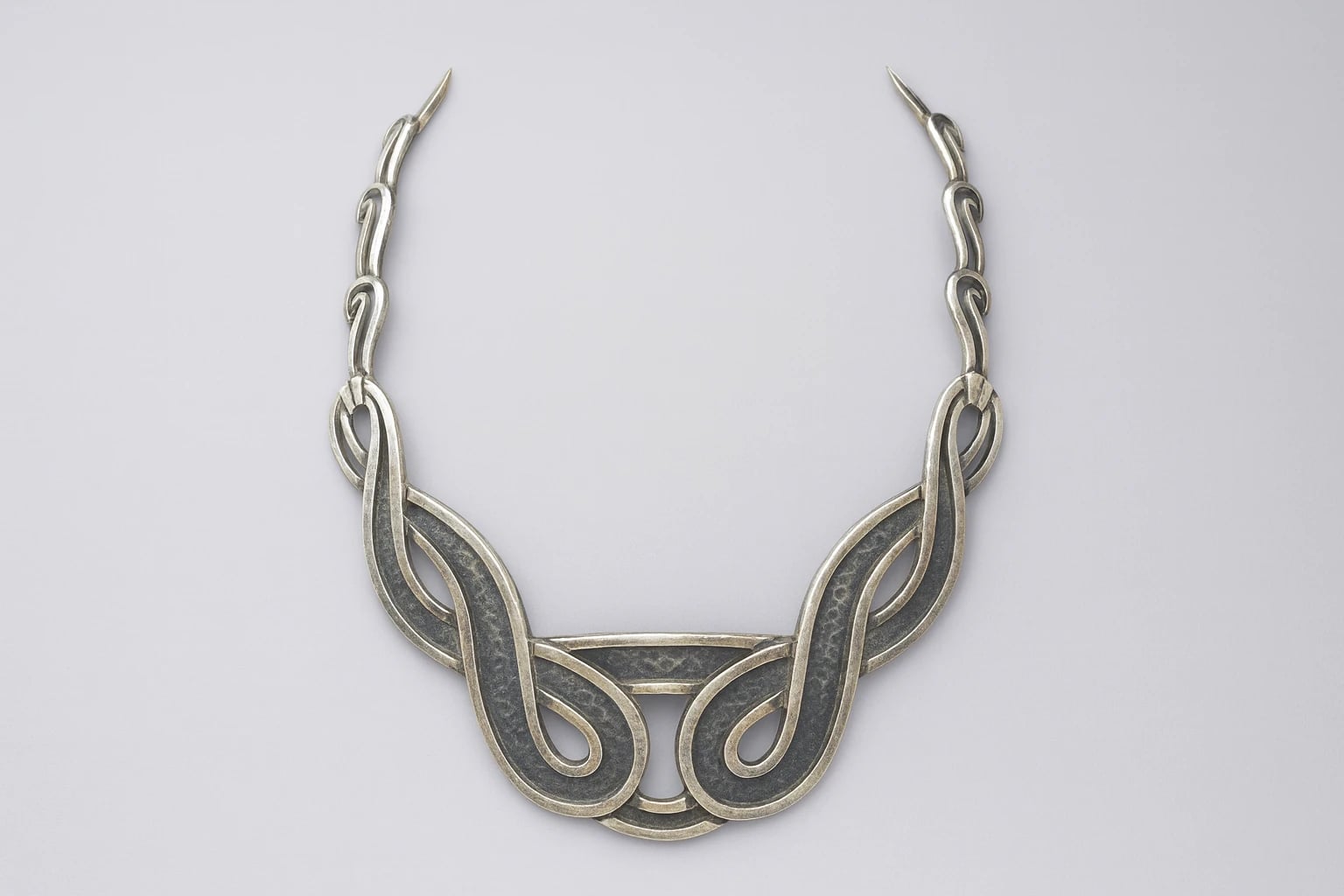
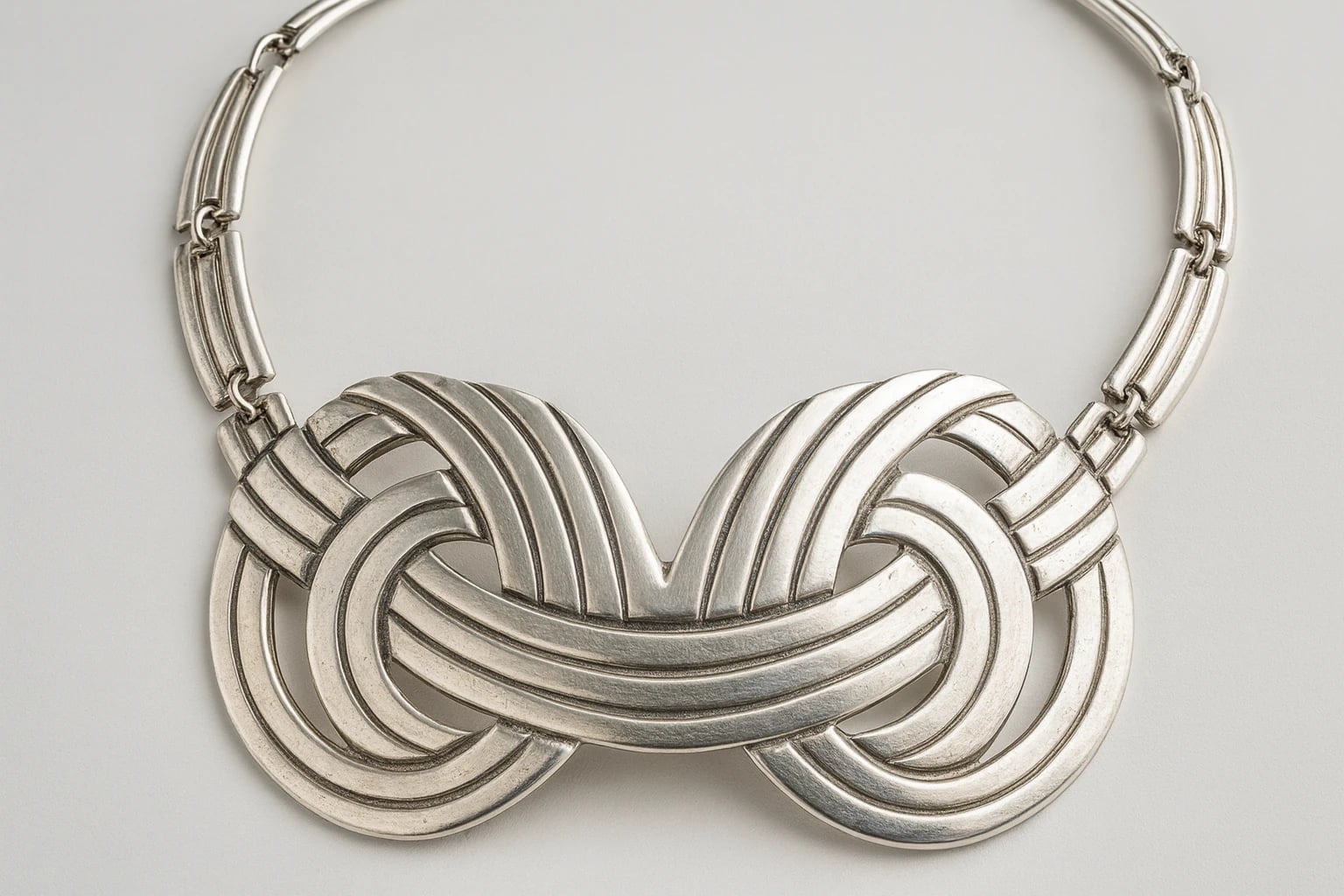
The necklace organizes its front around a clear, repeated problem: how to make circular geometry behave like a flexible collar. Two large opposing circle forms anchor the chest, each built from open arcs and parallel raised bands. Across the center, a nested bridge of curved bars binds the halves together, while the linked side sections reduce the same vocabulary into narrower, hinged passages that carry the design around the neck. At approximately 17 inches, it is neither a pendant suspended from a chain nor a rigid torque. It is a constructed sequence of silver elements in which the ornament and the structure are the same thing.
The principal motif is often described in the Los Castillo design family as circles within circles, and the phrase is useful because it identifies the necklace’s method as much as its imagery. The broad frontal units do not present closed medallions. They open, overlap, and interrupt one another, leaving dark spaces between the silver bands. Those voids keep the necklace from becoming visually heavy, even though the frontal section has considerable scale. Light collects on the convex ridges and then drops into the channels between them, so that the design is read in pulses: bright line, shadow, bright line. The side links repeat this alternation in a smaller register, changing a bold chest ornament into a rhythm that can turn with the body.
The mark recorded on the piece, LOS CASTILLO, TAXCO, STERLING MADE IN MEXICO, with design number 674, places the necklace within the workshop’s early numbered production before the eagle assay system became part of the normal marking language. The absence of an eagle in the object record accords with its catalogue dating to the 1940s and with Hougart’s documentation of Los Castillo’s early marks, which includes several 1940 to 1945 forms before later eagle numbered stamps became regular in the postwar period. The use of a design number is also characteristic of the taller’s organized production. It signals a workshop capable of repeating and varying successful forms, not as mechanical duplication, but as a disciplined design system in which motifs could be scaled, articulated, and recomposed.
Los Castillo was established in Taxco in 1939 by Antonio Castillo with members of the Castillo and Terán family circle, after their formative experience in William Spratling’s Taller de Las Delicias. By the mid 1940s the workshop had already developed a distinct identity, especially in designs that converted ancient Mexican visual sources into crisp modern line. Morrill and Berk illustrate a related variation on page 87 of Mexican Silver, and the present necklace belongs to that same broad current of pre Conquest inspired abstraction rather than to a literal archaeological revival. Its circular forms do not ask to be read as a single named symbol. Their importance lies in the transformation of a motif into modular modern jewelry: symmetrical, architectural, and carefully jointed, but still responsive to the body.
Museum of Mexican Silver. “Circles Within Circles Necklace.” Catalog no. MoMS-002351. https://museumofmexicansilver.com/pieces/los-castillo-necklace-4
See something wrong with this record? Suggest a correction and the piece details fill in automatically.
Within the Museum’s collection, this necklace is valuable for the way it clarifies Los Castillo’s early modernist language before the workshop became widely identified with later technical innovations such as married metals, mosaico azteca, pluma azteca, and other specialized lines. It shows the taller working in sterling alone, relying on proportion, repetition, openwork, and the reflective behavior of silver to produce depth. The result is a necklace that gives a large frontal design the mobility of linked jewelry, and it preserves an early moment when Taxco designers were defining how a Mexican modern ornament could be both historically grounded and formally exact.
Los Castillo
Eagle Turquoise Necklace
Turquoise