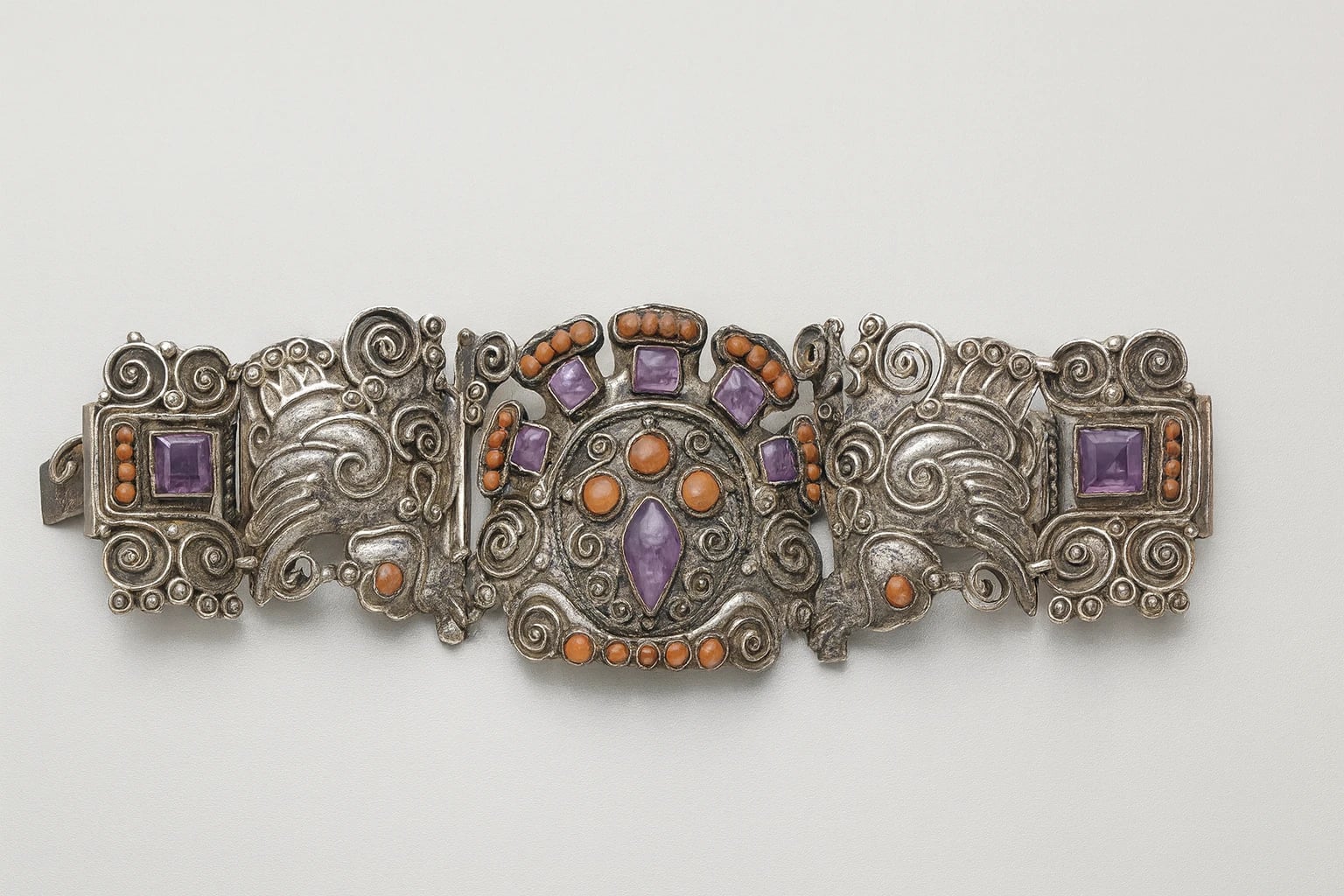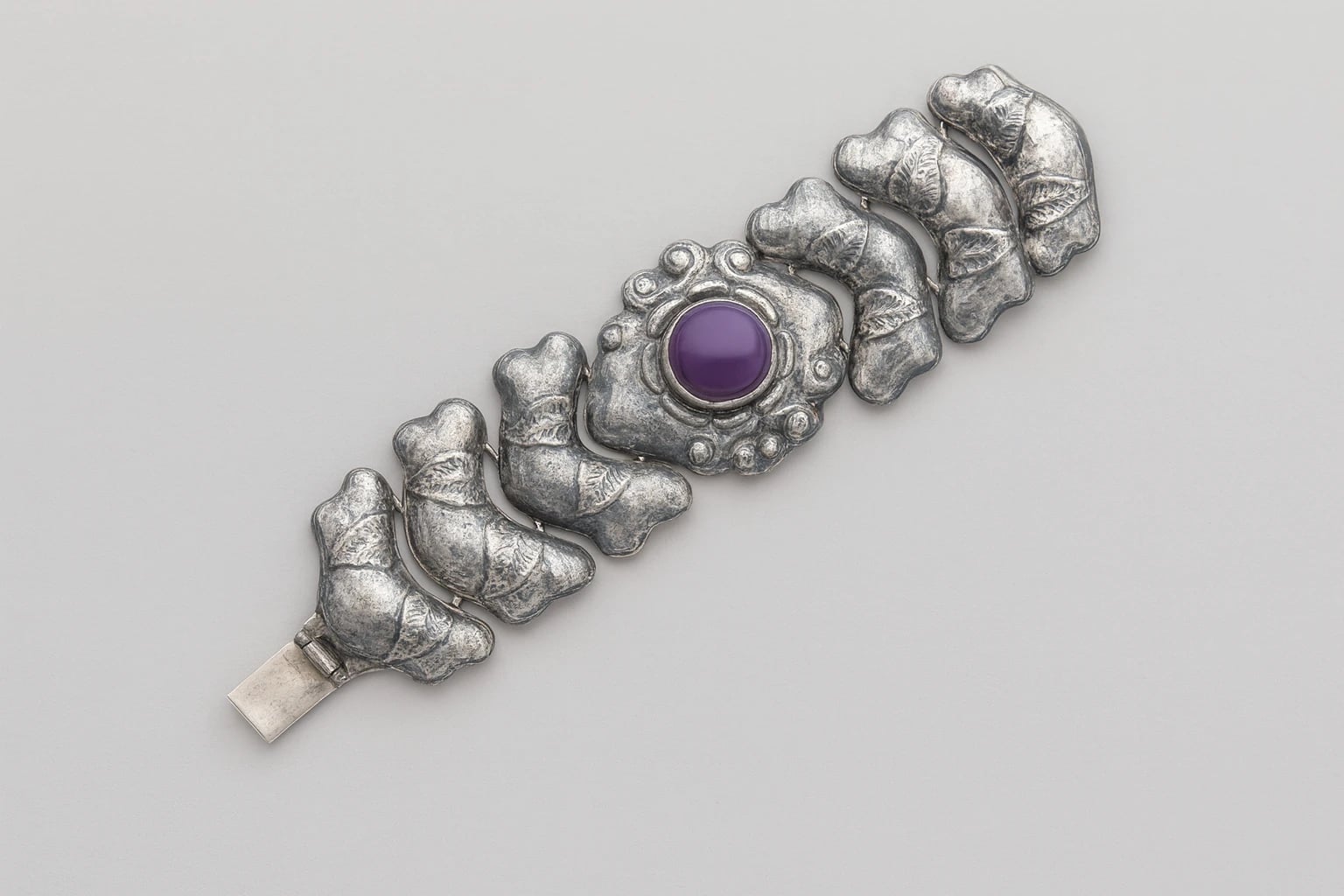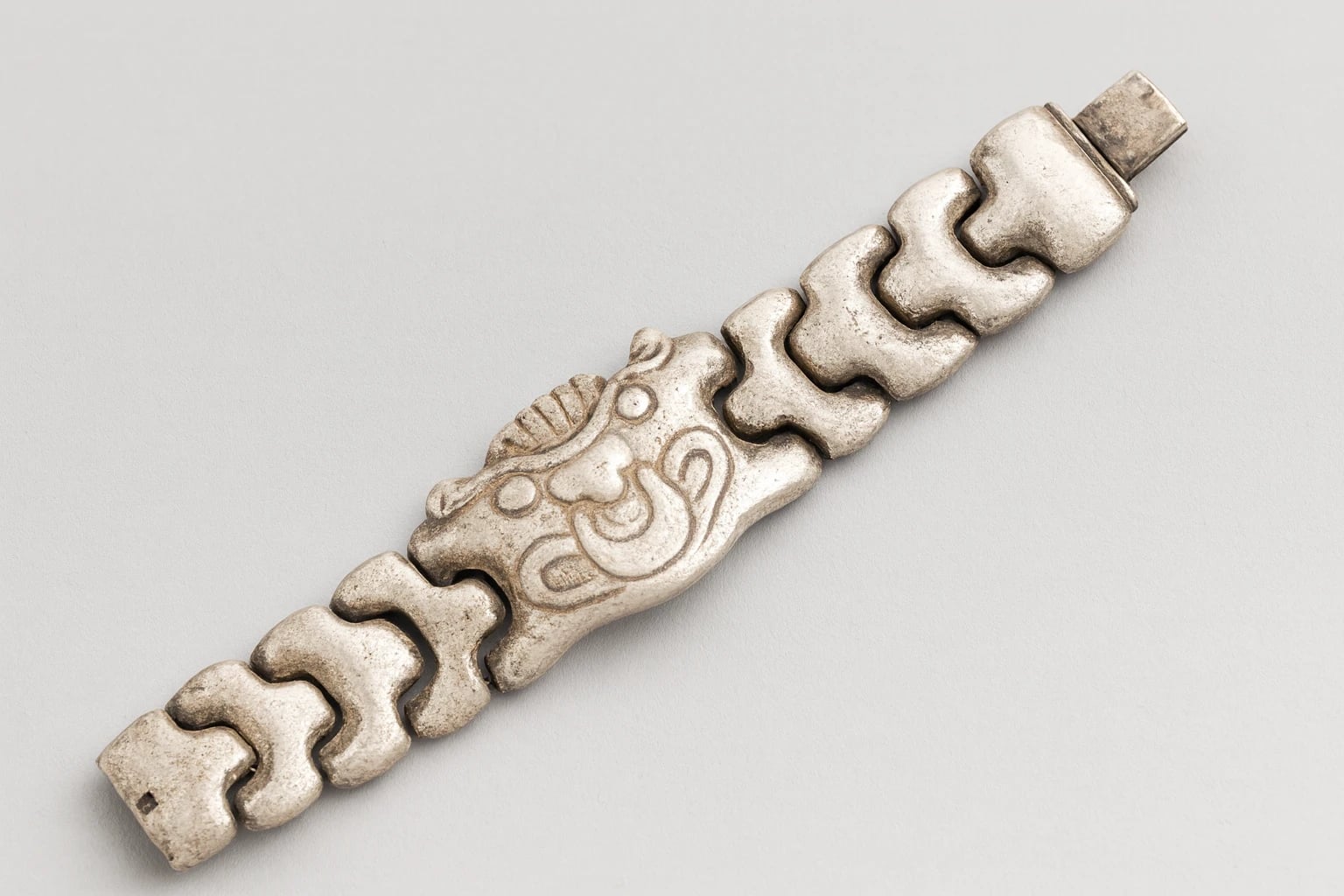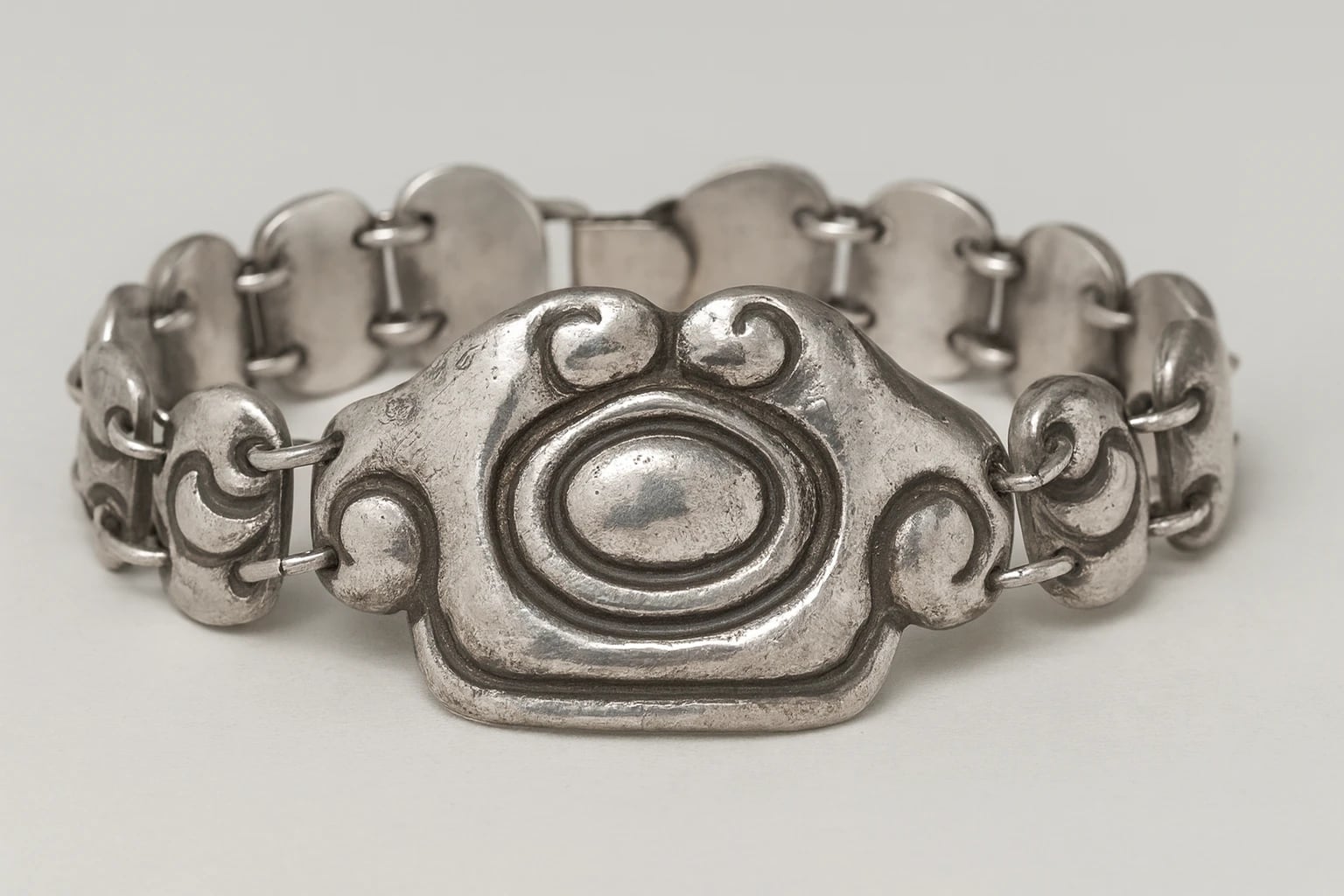
Part of the design family Figure-Eight, Design No. 5100
Saves instantly, no account needed. Already a member? Sign in.
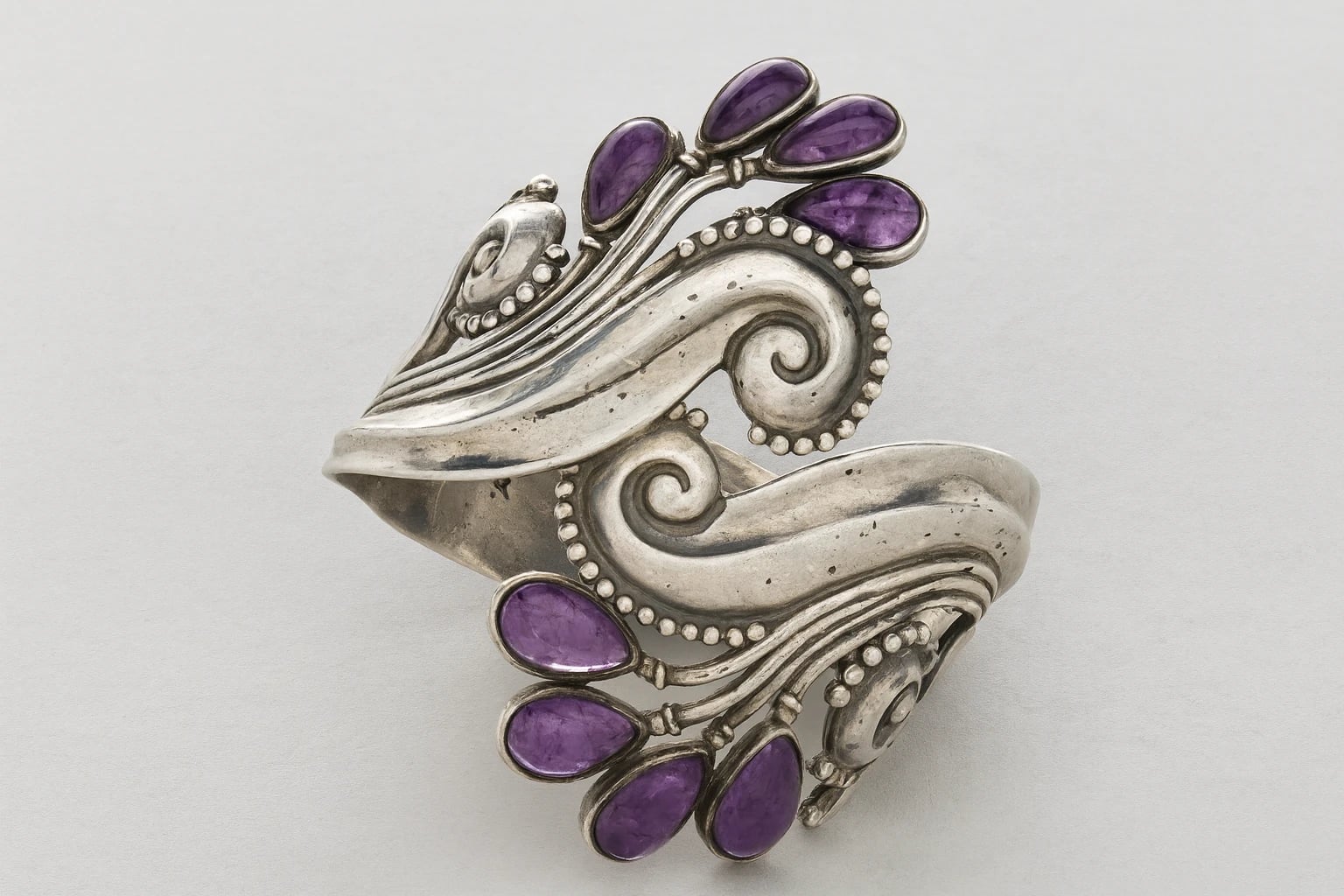
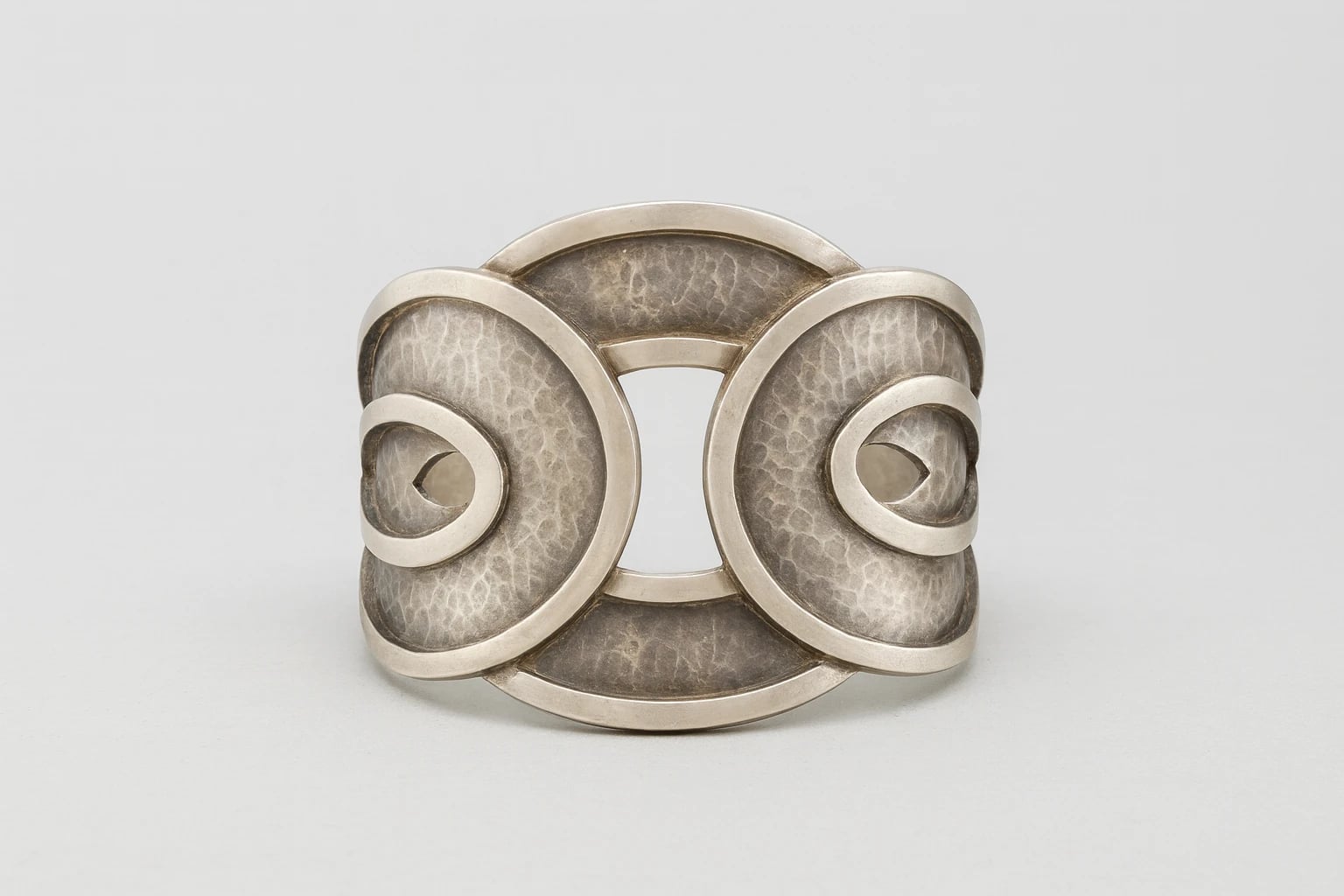
The figure eight that gives this cuff its name is not applied ornament but the structure of the bracelet itself. Two broad, hammered oval panels wrap the sides of the wrist, each carrying a raised loop that curls back on itself and opens into a pierced teardrop, and the two halves meet across a rectangular void at the center of the design. The composition is design number 5100 from the workshop of Margot de Taxco, a number documented in Hougart's hallmark reference on a stamp reading Margot de Taxco, Sterling, Made in Mexico, used between 1948 and 1978. Within her numbered sequence, 5100 sits low, below the enamel designs recorded in the 5300s and 5600s, which places this design among the earlier products of her independent taller.
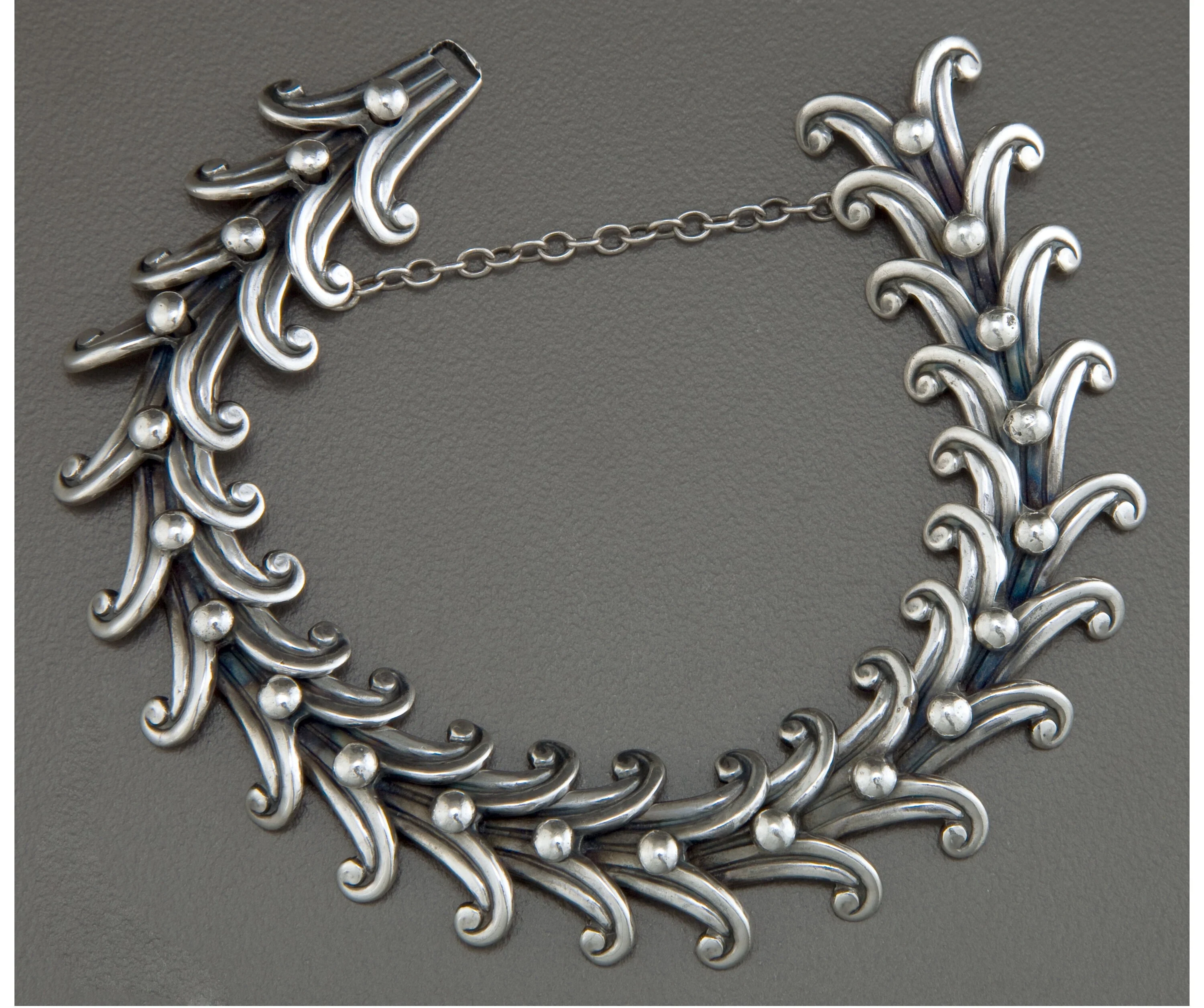
The bracelet is organized around a single repeated decision: every mass is answered by an opening. The heavy oval fields are relieved by the pierced loops, the joined center is cut through rather than filled, and the applied rims that frame each panel keep the hammered interiors reading as recessed grounds rather than solid slabs. The planished surface does most of the optical work, breaking light into small facets so that the cuff shifts in brightness as the wrist turns, while the smooth raised loops read as continuous bright lines against that texture. Enamel appears here as a restrained dark accent within the composition rather than the saturated color fields that dominate her later production, a reminder that Margot was a designer in silver first and an enamelist second. The record indicates that this design was produced as a matched necklace and bracelet suite, and the logic of the design supports that origin: the figure-eight unit is modular, capable of repeating link by link around the neck or, as here, concentrating into a single emphatic form on the wrist.
Margot van Voorhies came to jewelry through the Castillo family enterprise. She married Antonio Castillo before the founding of the Los Castillo taller in 1939 and worked within that influential workshop until their divorce in 1946, after which she established her own firm under the Margot de Taxco name (Hougart). Morrill and Berk group her with Spratling among the transplanted North Americans whose designs drew principally on Mexico's artistic heritage, and this cuff shows how she translated that inheritance into her own vocabulary: the interlocked curvilinear forms and pierced eyes recall the scroll conventions of ancient Mexican ornament without quoting any single source, resolved instead into a symmetrical modern composition. Her style became distinctive enough to attract imitation; Hougart notes that the enameled work of the Castelan mark is "very reminiscent of Margot," an indication of how recognizable her designs had become within the Taxco trade.
Museum of Mexican Silver. “Figure-Eight Cuff Bracelet, Design No. 5100.” Catalog no. MoMS-002290. https://museumofmexicansilver.com/pieces/margot-bracelet-5100
See something wrong with this record? Suggest a correction and the piece details fill in automatically.
For the Museum, the value of this cuff lies in what it documents about the first phase of an independent workshop that would become one of the most identifiable enamel houses of the Taxco School. It shows the formal system already in place, the balance of hammered ground, applied line, and pierced void, before color took over as her signature, and it preserves one half of a suite design whose modular construction explains how her taller could move a single idea across multiple jewelry formats.
Design 5192 Bracelet
Sterling silver