Saves instantly, no account needed. Already a member? Sign in.
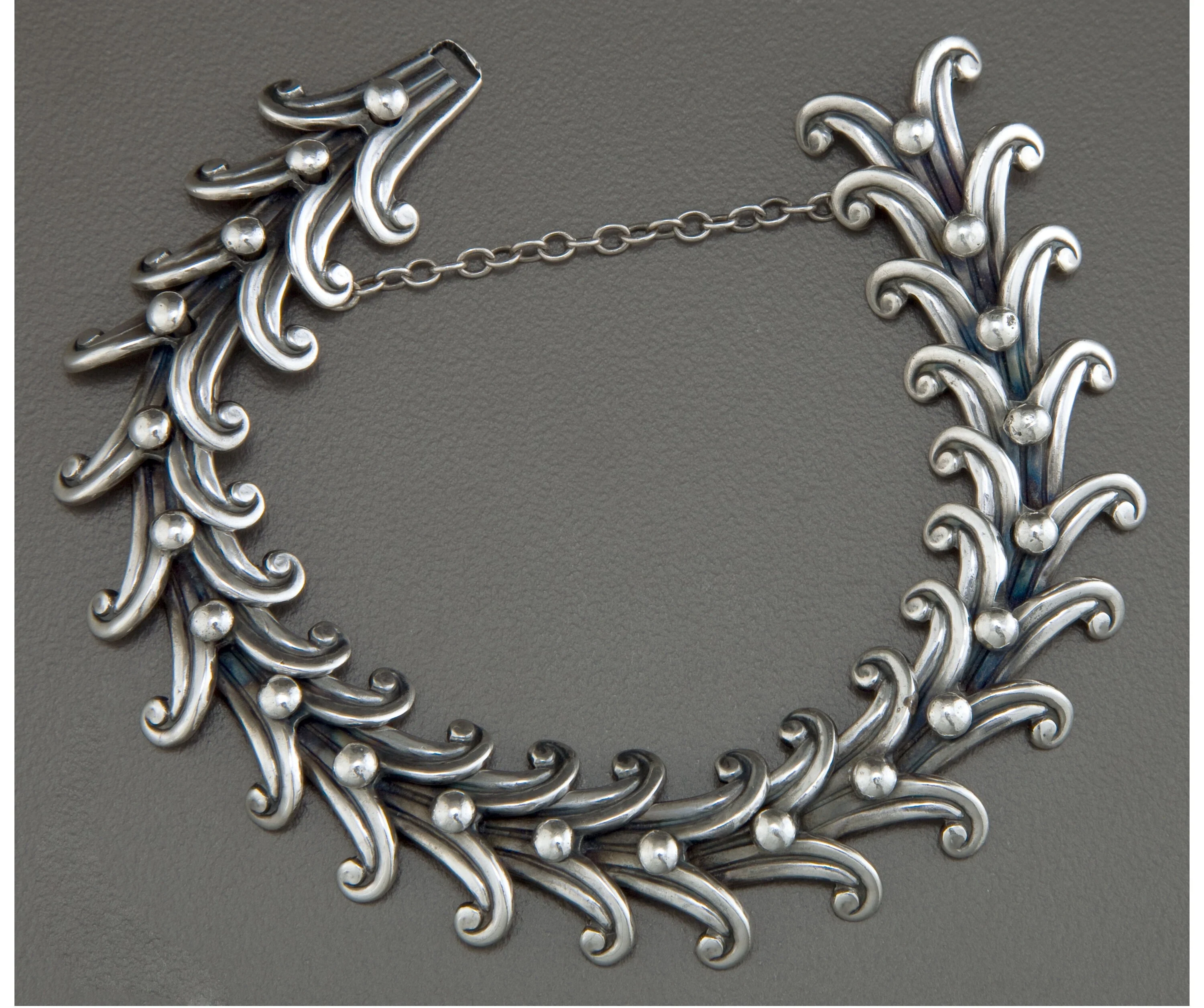
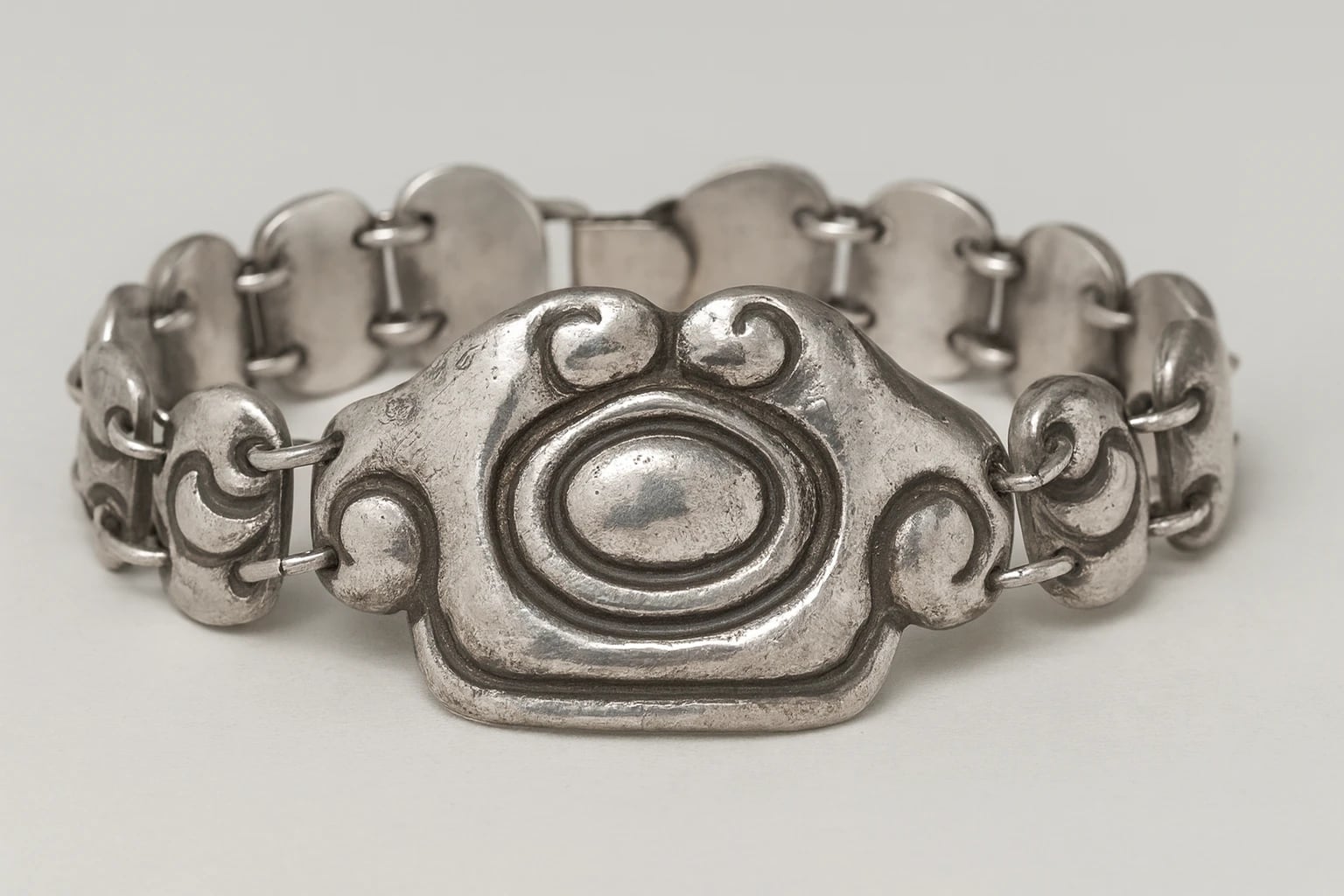
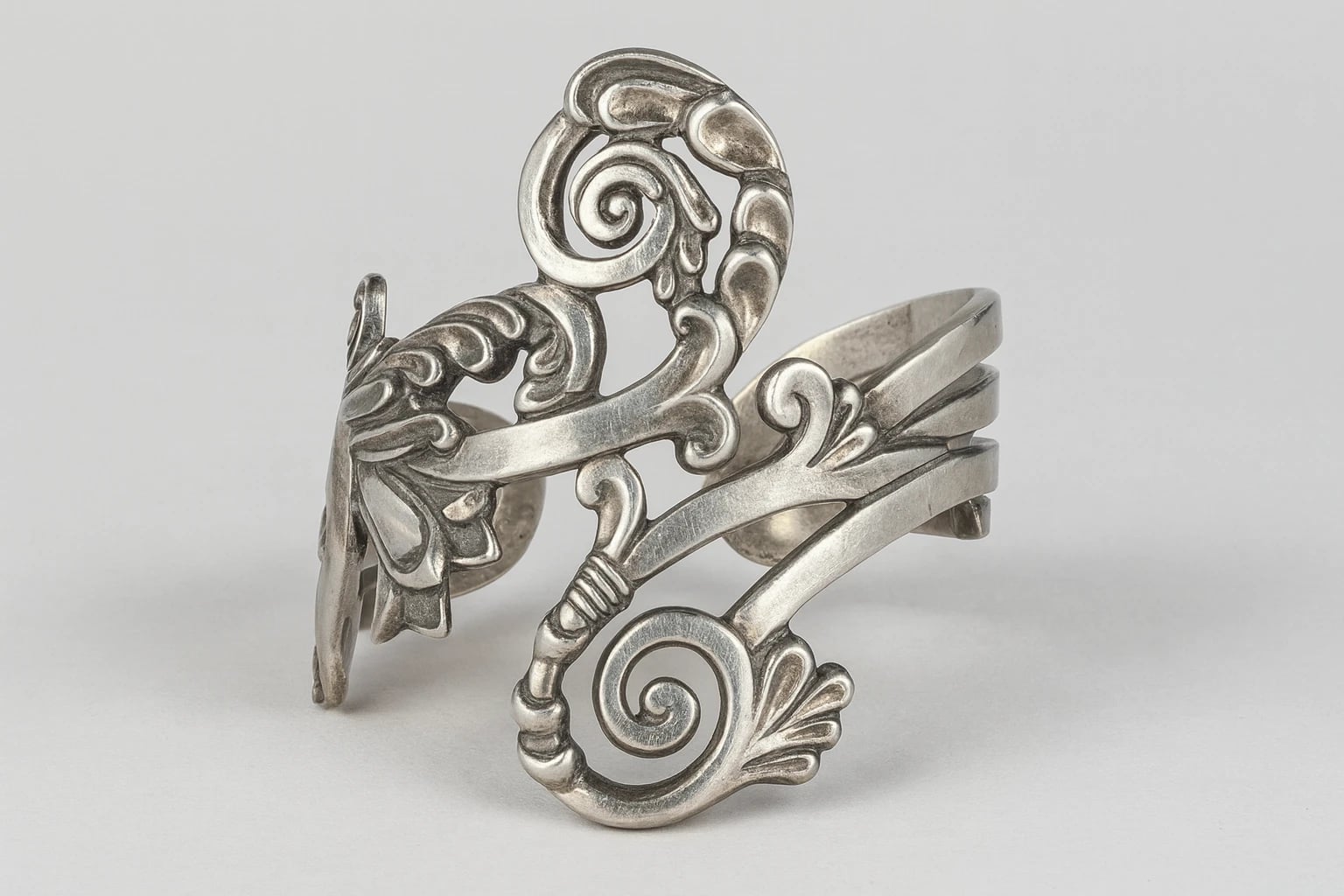
This hinged bracelet organizes a generous height of silver into a light, open structure. Its front rises to 2 5/8 inches, but the design avoids a solid shield. Spirals, leaf forms, crossing bands, and hand wired accents divide the surface into intervals of silver and air, so that the cuff reads as a piece of drawn metal rather than a closed mass. The 6 3/4 inch circumference gives the form a close relation to the wrist, while the hinge permits a more sculptural front than a simple slip on bangle would allow.
The foliage motif is not treated naturalistically. Leaves curl, narrow, and flare as they move around the bracelet, while the two spirals create a counter rhythm at the upper and lower front. Margot de Taxco often returned to the spiral as a generative form, and this bracelet shows why it suited her work so well: the spiral concentrates movement without requiring narrative. The hand wired elements sharpen that effect. They add a linear register above the broader silver planes, like a second drawing laid across the main composition. Polished surfaces catch light on the ridges and outer curves, while the open spaces keep the design from becoming visually heavy.
The marks place the bracelet securely within the production of Margot de Taxco: Margot de Taxco, Eagle 16, and design number 5563. Hougart records Eagle 16 among the documented Margot marks, with related sterling Margot de Taxco marks in use between 1948 and 1978. Morrill and Berk note that Margot maintained separate numbered lines for silver and enamel on silver, and that her silver models ran from 5100 to 5790 before the shop closed. Design number 5563 therefore belongs within the workshop’s numbered silver production rather than standing as an anonymous ornamental cuff. The number should not be forced into an exact year, but it helps locate the bracelet within Margot’s disciplined system of design identification.
The bracelet also belongs to a particular workshop culture. Morrill and Berk describe Margot as designing everything her company produced, while the realization of those designs depended on skilled specialists in the taller. They also record her attention to the fit of bracelets, including the use of a wooden wrist form after she recognized that women’s wrists were not being properly served by forms based on male silversmiths’ wrists. That detail matters here. The bracelet is assertive in height and profile, yet it remains organized around the body. Its hinge, its curved bands, and its controlled openwork show the practical intelligence behind Margot’s decorative imagination.
Museum of Mexican Silver. “Design 5563 Foliate Scroll Hinged Bracelet.” Catalog no. MoMS-002317. https://museumofmexicansilver.com/pieces/margot-de-taxco-hinged-bracelet-marvelous-detailed-design-with-hand-wired
See something wrong with this record? Suggest a correction and the piece details fill in automatically.
Within the Mexican silver renaissance, this bracelet represents a quieter but important side of Margot de Taxco’s achievement. Her enamel work brought her the greatest fame, but her silver designs show the same concern for line, repetition, and controlled movement without relying on color. The flowing foliage recalls her long interest in natural forms, Japanese design, and the curling ornamental sources that Morrill and Berk connect to Taxco’s Santa Prisca and to Art Nouveau jewelry. In this example, those sources are absorbed into a modern hinged cuff whose ornament is inseparable from structure. The bracelet adds to the Museum’s account of Margot not simply as a colorist, but as a designer who could make silver itself behave like a flexible, dimensional drawing.
Margot de Taxco
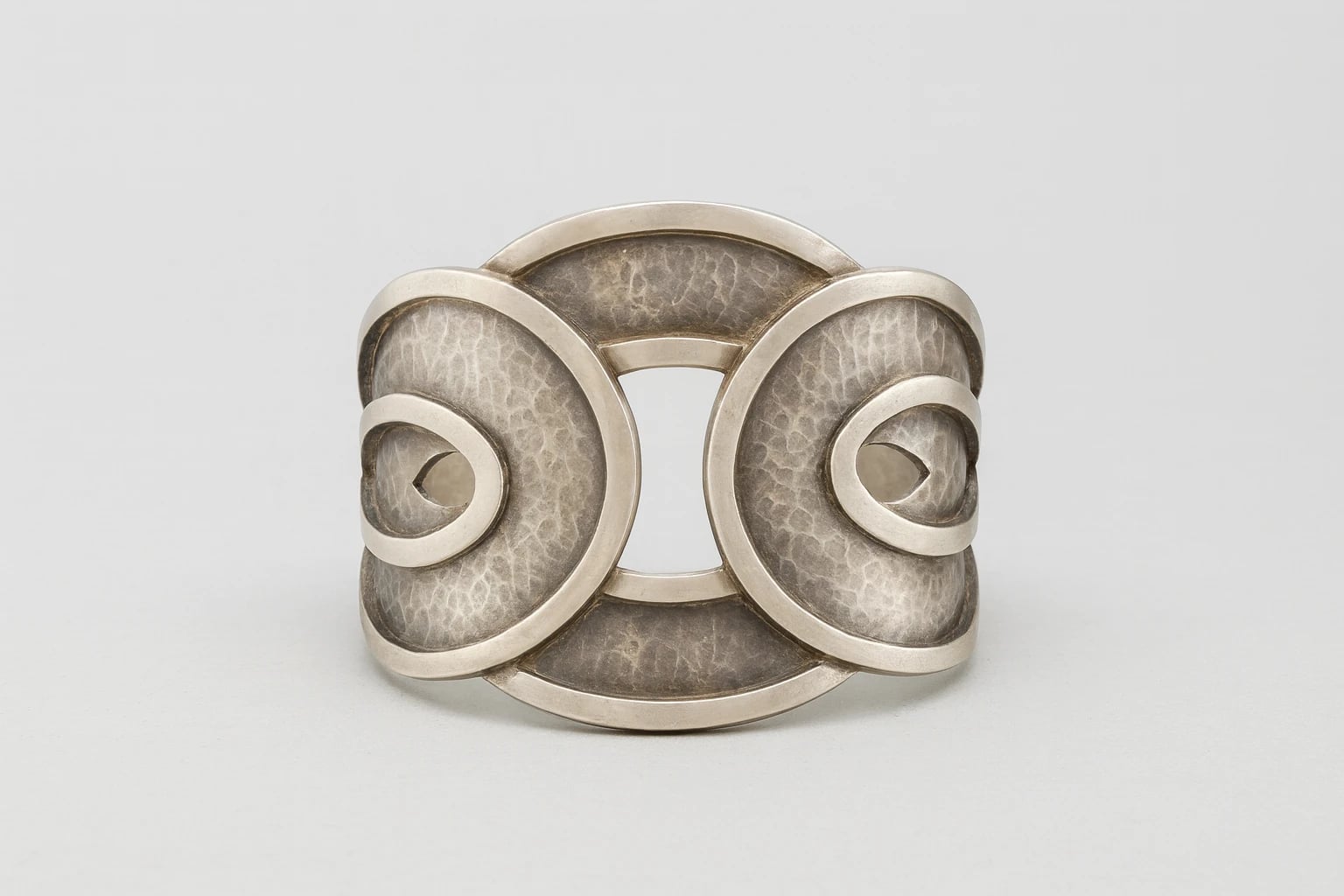
Figure-Eight Cuff Bracelet, Design No. 5100
Sterling silver