Saves instantly, no account needed. Already a member? Sign in.
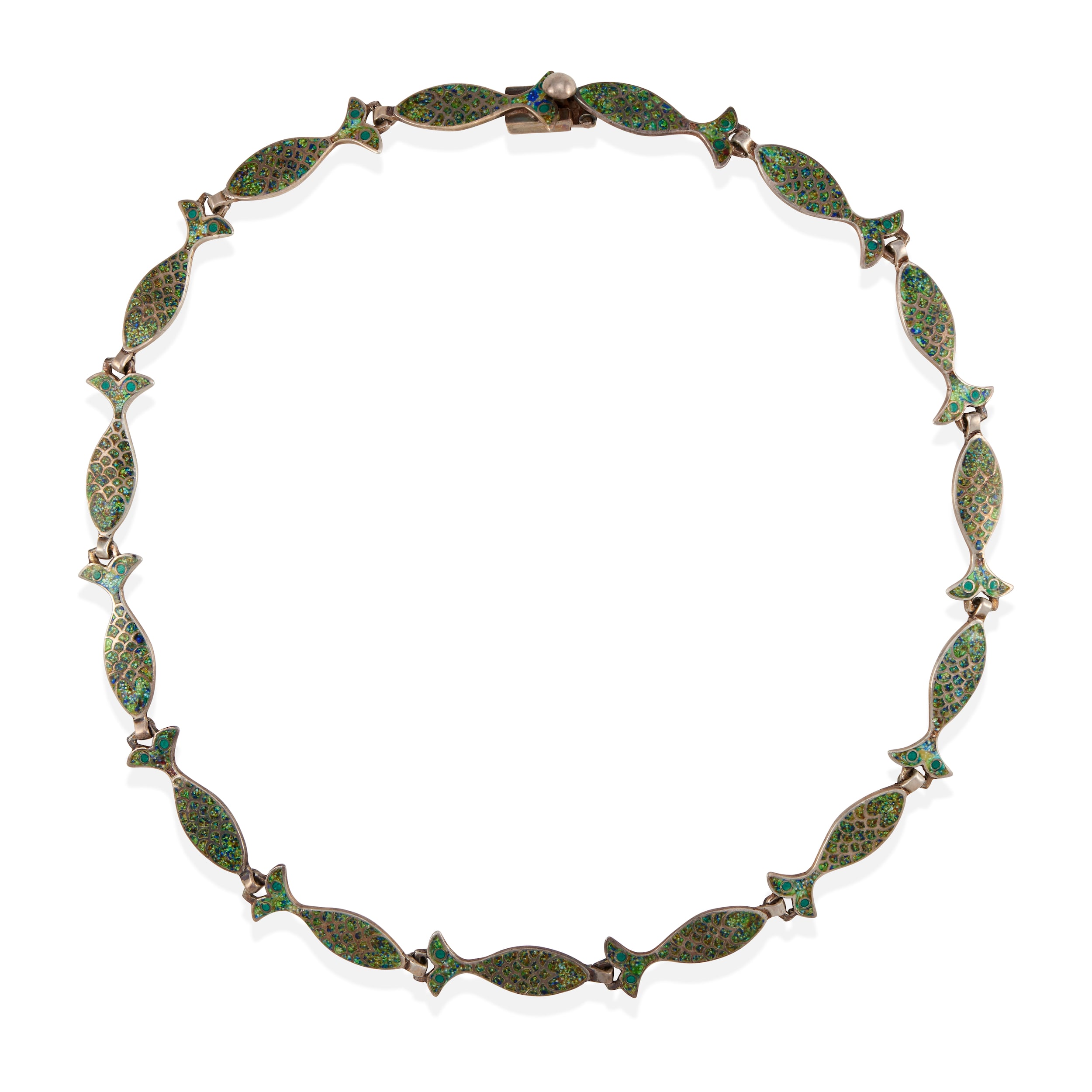
The Fish necklace organizes a school of swimming forms into a continuous band of silver and enamel, each fish set in its own frame so the row bends easily around the neck. Margot de Taxco built the design as a series of repeating links, and the repetition itself becomes the ornament: a shoal read as pattern rather than as a single decorative centerpiece. The fish are stylized, reduced to a clean profile with a curved body and a fanned tail, and the enameled color across their surfaces distinguishes one from the next while holding the row together as a single sweep.
The enamel is the reason the design holds attention. Margot van Voorhies worked in champlevé, a technique in which recesses are cut or cast into the metal and filled with vitreous color, so that the raised silver contours function as drawn lines separating one field of color from another. On these fish the silver outlines the eye, the gill, and the seam between body and tail, while the enamel fills the interior with saturated color that reflects light differently than the polished metal around it. The contrast is structural rather than applied decoration: the silver frame both draws the fish and contains its color. Margot's shop began producing enamel work in 1955, and the champlevé fish belong to that mature phase of her production rather than to the earlier all-silver designs. The articulation between links lets the necklace follow the curve of the body, and the weight of enamel over silver gives each unit a distinct presence as it moves.
Margot van Voorhies opened Margot de Taxco in 1947, after helping shape the early designs at Los Castillo, the taller she had launched with Antonio Castillo before their marriage ended in 1946. Her independent work is known above all for enamel, and Hougart records her champlevé production beginning in 1955 and continuing under a range of design numbers stamped alongside the Margot de Taxco name, the eagle 16 assay mark, and the sterling and Mexican origin marks. The distinctiveness of her enamel palette was recognized in her own period; Hougart notes that some Castelan pieces in sterling with enamel were considered very reminiscent of Margot, a comparison that measures how identifiable her color and technique had become. The Fish necklace sits within a body of animal and marine subjects she treated as repeating decorative modules, where a natural motif is simplified into a form that can be multiplied along a chain.
Within the Mexican silver renaissance, Margot's enamel work marks a direction distinct from the sculptural silver and married-metals of her former workshop. Where Los Castillo pursued the interplay of copper, brass, and silver, Margot pursued color through vitreous enamel bounded by silver line, closer to a jeweler's use of drawing and hue than to metal sculpture. The Fish necklace records that choice clearly: a subject drawn from nature, reduced to a legible profile, repeated as pattern, and given life through color contained by the metal itself. It documents the enamel practice that defined the second half of her career and the particular way she turned a single motif into a continuous ornament for the body.
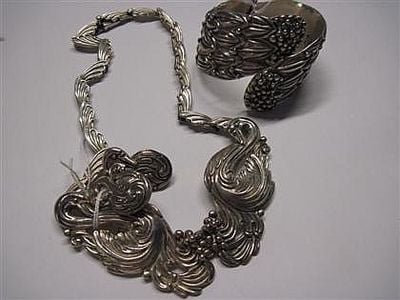
MARGOT DE TAXCO: A STERLING SILVER AND AMETHYST NECKLACE BROOCH AND BROOCH
Bonhams · 2024-06-19
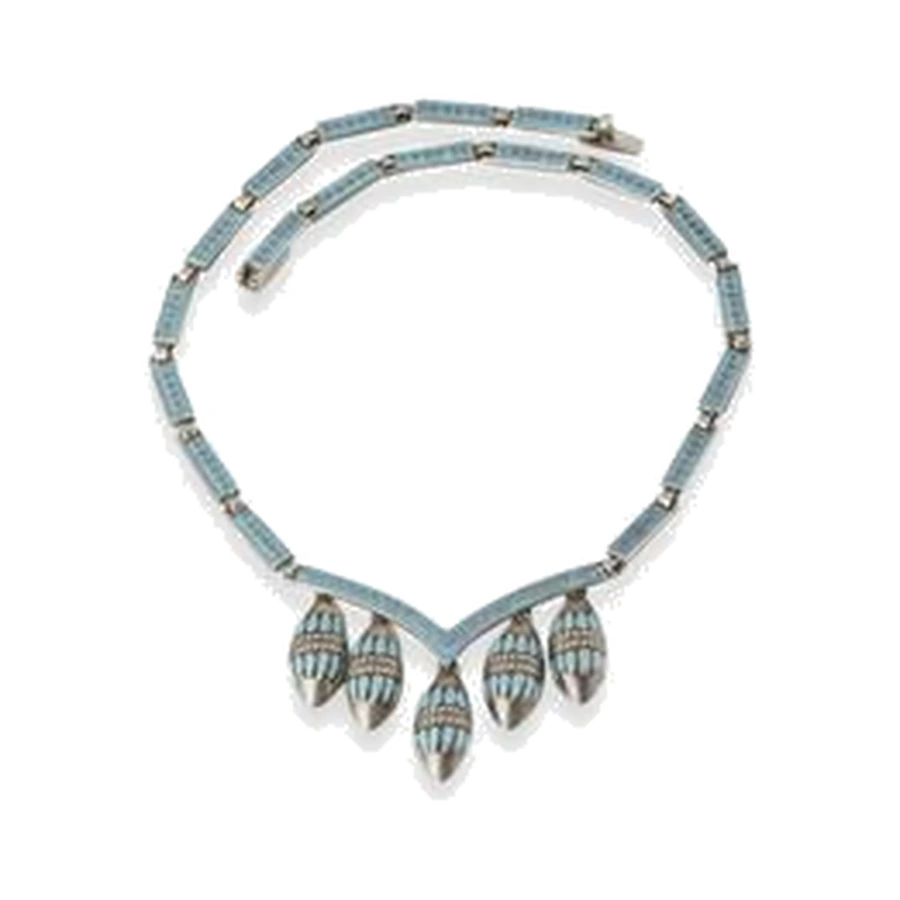
Margot de Taxco sterling silver enamel fish necklace
Strawser Auction Group · 2016-05-26
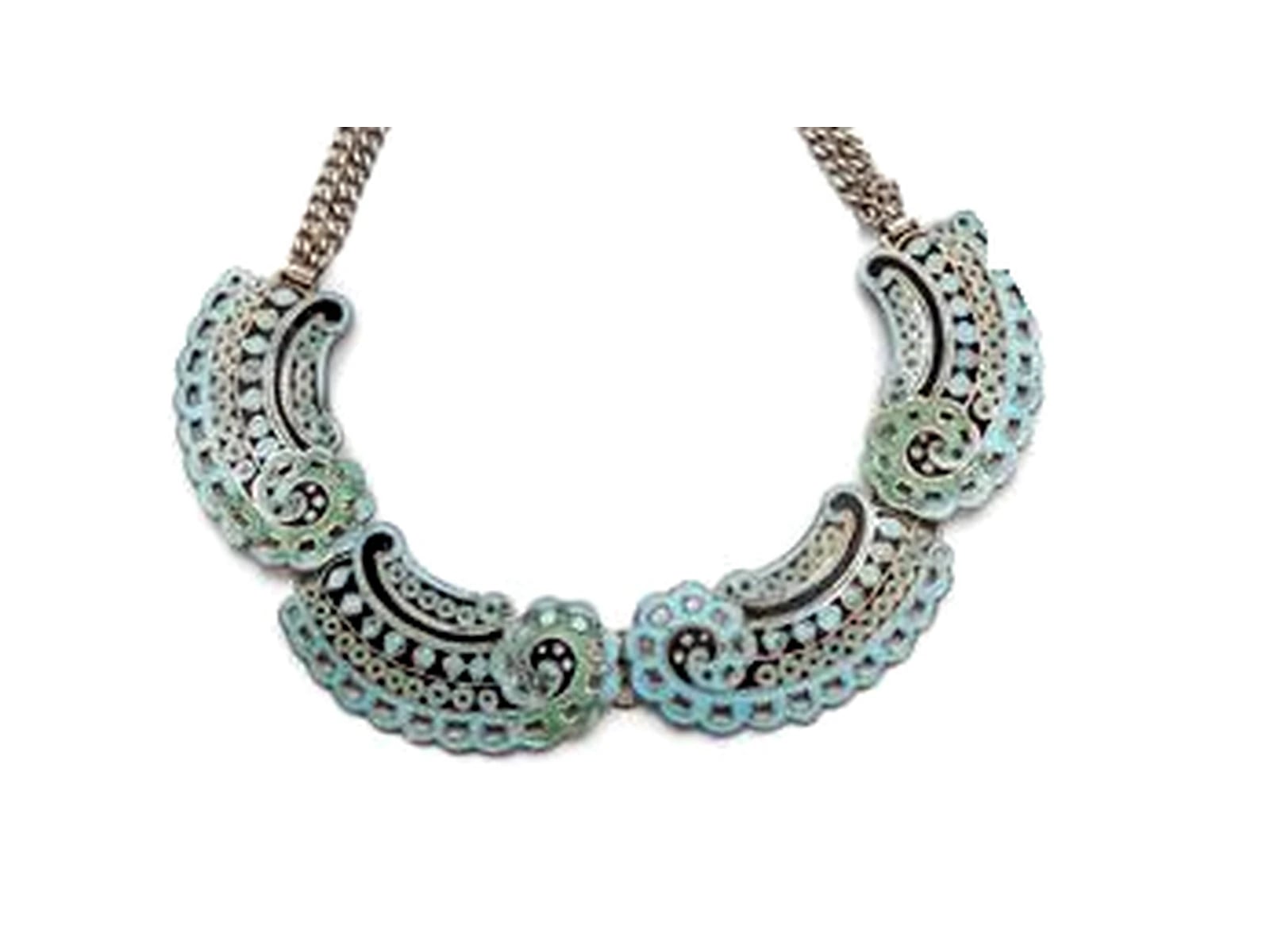
MARGOT DE TAXCO ENAMEL, STERLING SILVER NECKLACE
Michaan's Auctions · 2010-12-06
Margot de Taxco Necklace and Earrings Suite and Assorted Other Mexican Silver Jewelry, including a s...
Skinner · 2008-09-17
Museum of Mexican Silver. “Fish Necklace.” Catalog no. MoMS-001091. https://museumofmexicansilver.com/pieces/margot-necklace-fish
See something wrong with this record? Suggest a correction and the piece details fill in automatically.
MARGOT DE TAXCO: A SILVER AND ENAMEL FISH LINK NECKLACE
Bonhams (United States)
Margot de Taxco
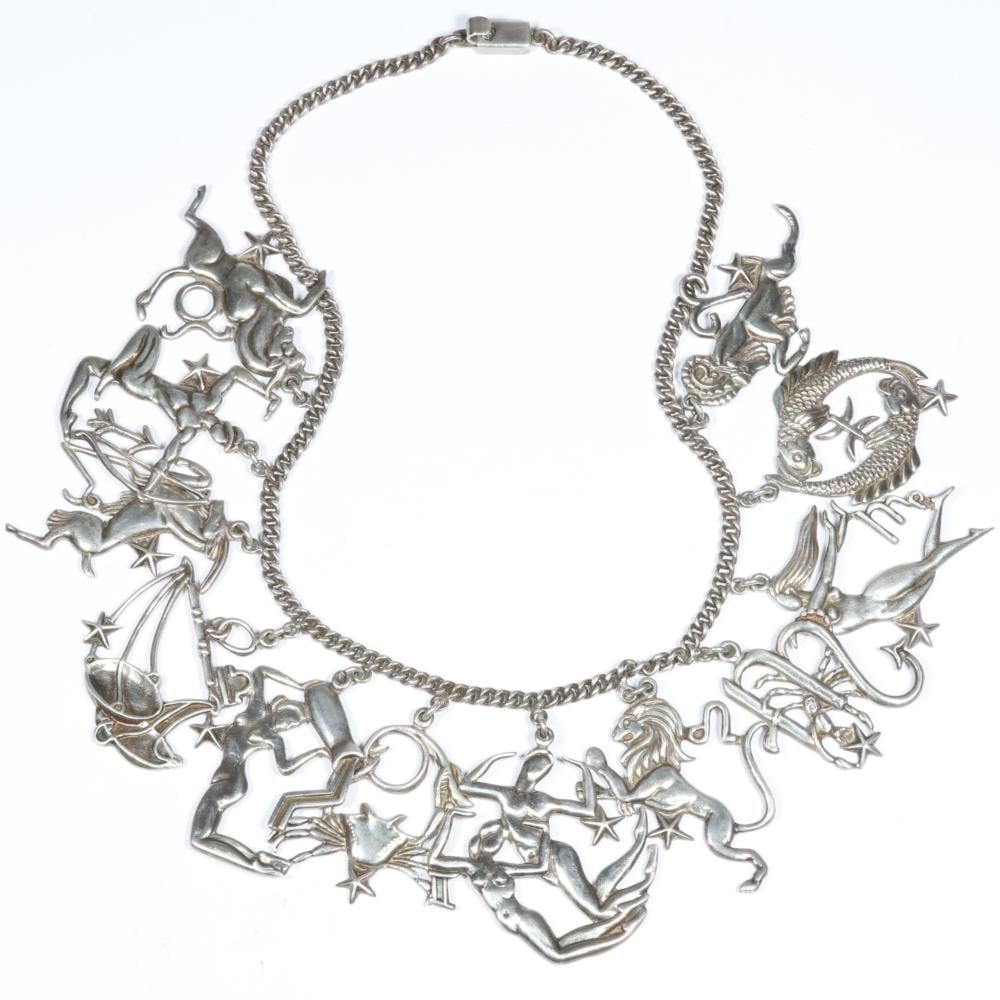
Necklace Assembled from Twelve Zodiac Pendants
Date unknown
Sterling silver