Saves instantly, no account needed. Already a member? Sign in.
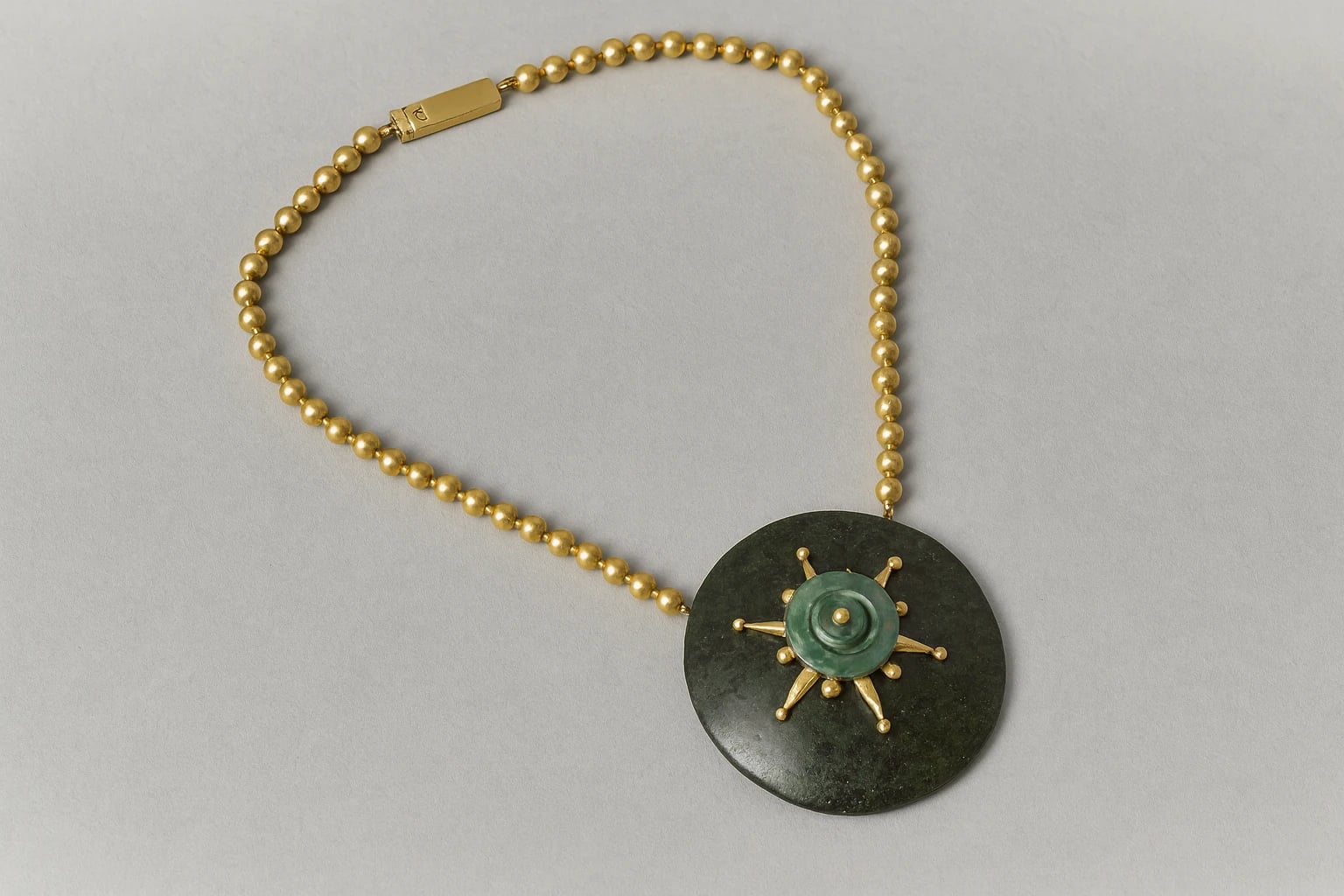
Gold rarely enters the Spratling story, and when it does the whole logic of his work shifts. This necklace, worked in gold and set with jade, moves away from the silver that defined the Taxco renaissance toward a material pairing rooted in older Mexican ground. Gold and jade were the prestige materials of Mesoamerica long before European silver reshaped the country's metalwork. To see Spratling handle them together is to watch a designer who built his reputation in sterling reach back to a specifically Mexican idea of value, one measured in the green of jade and the warm density of gold rather than in the cool reflectivity he usually commanded.
The interplay here is one of opacity and weight. Jade does not flash or scatter light the way faceted stones do; it holds color inward, a saturated green that reads as substance rather than sparkle. Gold answers it with a warmth that silver cannot supply, absorbing light into a soft luster instead of throwing it back. Spratling understood that these two materials share a quality of restraint, and the necklace appears to be built on that agreement rather than on contrast for its own sake. Where his silver jewelry often stages drama through negative space and high polish, gold and jade ask to be read slowly, by color and mass, the eye settling into the green stone and the metal that frames it.
Spratling's gold work occupies a narrow and unusual corner of his output. His documented marks run overwhelmingly through the silver fineness stamps of 925 and 980 that anchor the Taxco years, with an 18K gold mark recorded but standing apart from that main current. The rarity of gold in his production is not incidental; silver was the material of the Taller de Las Delicias and the market Spratling cultivated from 1931 onward, the metal that carried his designs into international circulation. A gold and jade necklace belongs instead to the vein of his work that drew most directly on ancient Mexican precedent, the same postrevolutionary interest in indigenous material culture that shaped so much of his sensibility. Jade in particular carries that reference plainly, the stone the Maya and the peoples of central Mexico prized above gold itself.
For a collection built around the Mexican silver renaissance, a gold example tests and extends the boundaries of what that renaissance produced. It shows Spratling reasoning outside his signature metal while remaining recognizably himself, committed to material honesty and to a Mexican rather than an imported idea of preciousness. The necklace records a road Spratling traveled far less often than his silver, and for that reason it sharpens our sense of the choices behind the more familiar work. It marks the point where his design language met the two materials Mexico had honored longest.
Museum of Mexican Silver. “Gold and Jade Necklace.” Catalog no. MoMS-000589. https://museumofmexicansilver.com/pieces/spratling-278
See something wrong with this record? Suggest a correction and the piece details fill in automatically.
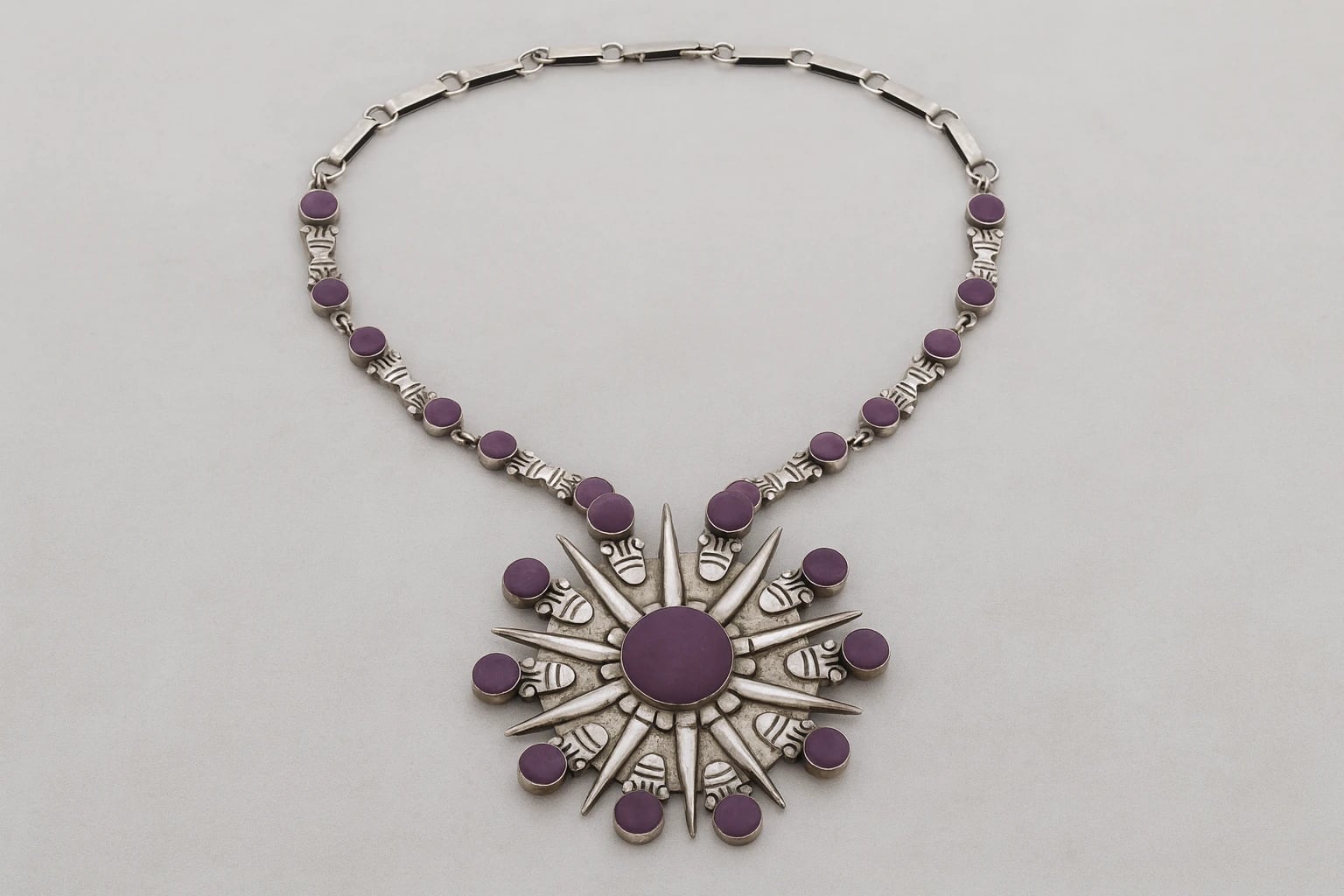
Amethyst Aztec Sunburst Necklace
Silver